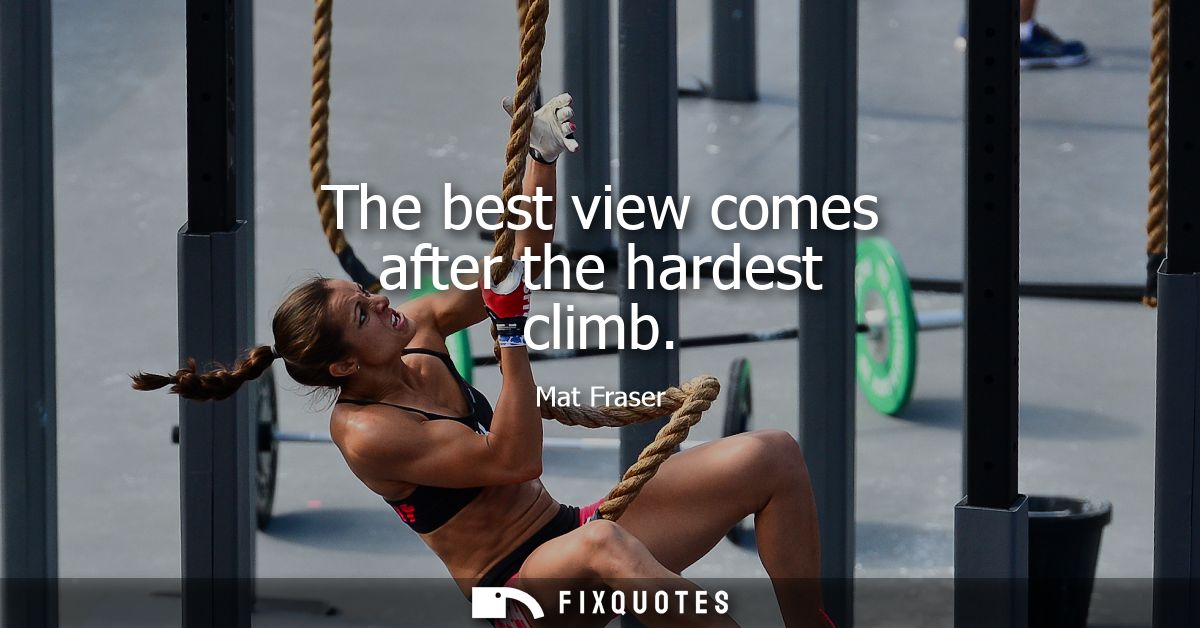
"The best view comes after the hardest climb"
About this Quote
“The best view comes after the hardest climb” is motivational on the surface, but its real power is in how it translates pain into proof. Coming from Mat Fraser - not a CEO with a podcast mic, but an athlete whose career is built on measurable suffering - the line reads less like a poster and more like a private rule for surviving the day-to-day brutality of training.
The intent is simple: keep going. The subtext is sharper: if it feels terrible, you’re probably doing it right. “Hardest climb” isn’t just about difficulty; it’s about choosing discomfort when no one is watching, logging unglamorous reps, and returning to the same weakness until it stops being a weakness. The “view” is the reward, but also a subtle reframing of reward itself. It’s not a trophy fetish; it’s a perspective shift earned by endurance. You don’t just get a better outcome - you become the kind of person who can stand where others quit.
In the context of modern athletic culture, the quote pushes back against shortcut thinking and highlight-reel expectations. It’s a clean antidote to optimization mania: there’s no hack, just elevation gained the slow way. It also flatters the reader’s grit, which is why it’s so shareable. Everyone wants their struggle to mean something. Fraser’s line doesn’t promise ease; it promises that the suffering can be organized into a story with a payoff.
The intent is simple: keep going. The subtext is sharper: if it feels terrible, you’re probably doing it right. “Hardest climb” isn’t just about difficulty; it’s about choosing discomfort when no one is watching, logging unglamorous reps, and returning to the same weakness until it stops being a weakness. The “view” is the reward, but also a subtle reframing of reward itself. It’s not a trophy fetish; it’s a perspective shift earned by endurance. You don’t just get a better outcome - you become the kind of person who can stand where others quit.
In the context of modern athletic culture, the quote pushes back against shortcut thinking and highlight-reel expectations. It’s a clean antidote to optimization mania: there’s no hack, just elevation gained the slow way. It also flatters the reader’s grit, which is why it’s so shareable. Everyone wants their struggle to mean something. Fraser’s line doesn’t promise ease; it promises that the suffering can be organized into a story with a payoff.
Quote Details
| Topic | Perseverance |
|---|---|
| Source | Help us find the source |
| Cite |
Citation Formats
APA Style (7th ed.)
Fraser, Mat. (2026, January 13). The best view comes after the hardest climb. FixQuotes. https://fixquotes.com/quotes/the-best-view-comes-after-the-hardest-climb-172414/
Chicago Style
Fraser, Mat. "The best view comes after the hardest climb." FixQuotes. January 13, 2026. https://fixquotes.com/quotes/the-best-view-comes-after-the-hardest-climb-172414/.
MLA Style (9th ed.)
"The best view comes after the hardest climb." FixQuotes, 13 Jan. 2026, https://fixquotes.com/quotes/the-best-view-comes-after-the-hardest-climb-172414/. Accessed 15 Mar. 2026.
More Quotes by Mat
Add to List