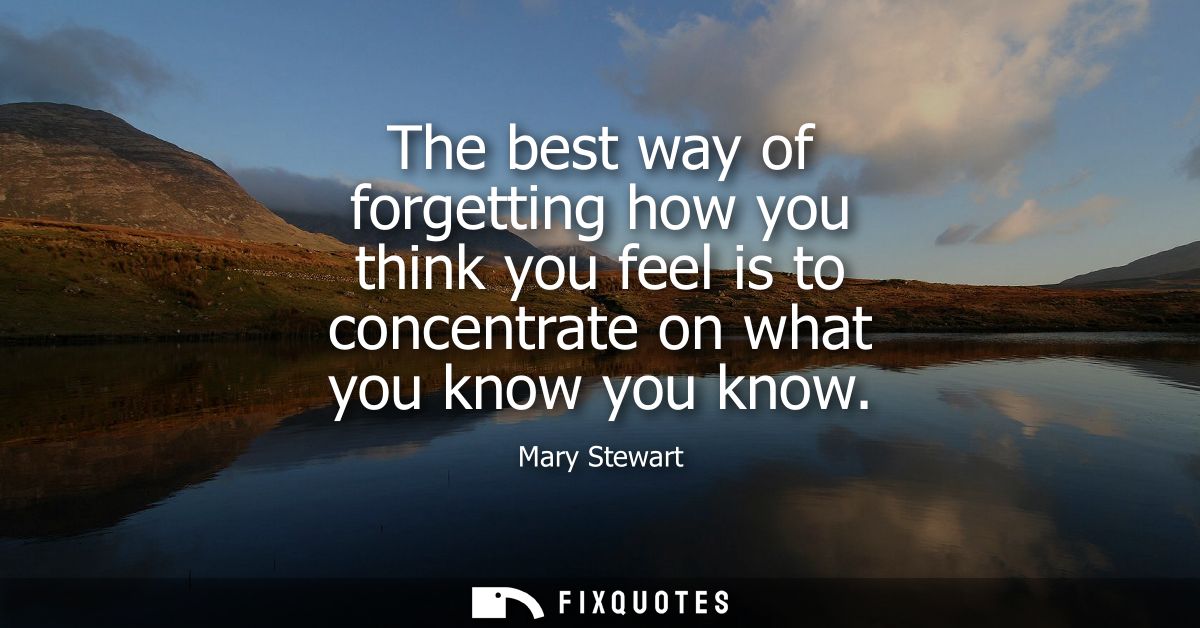
"The best way of forgetting how you think you feel is to concentrate on what you know you know"
About this Quote
The remedy is equally pointed. “Concentrate on what you know you know” is almost tautological, but that’s the trick. The doubled “know” acts like a hand on the shoulder, grounding you in the reliable and testable: facts, tasks, craft, sensory detail, whatever can be verified outside the swirl of interpretation. It’s a novelist’s advice because it’s also a technique: when the mind spirals, return to the concrete. Plot, not panic.
There’s subtext here about control and agency. Stewart isn’t offering catharsis; she’s offering a pivot. Feelings can be weather, but attention is a rudder. The line refuses the modern temptation to treat introspection as virtue in itself. Sometimes “checking in” becomes rumination with better branding.
Context matters: Stewart wrote taut suspense and romantic thrillers where perception misleads and survival depends on noticing what’s actually in front of you. This is the ethic of her fiction translated into self-management: stop rereading your inner monologue; look for the evidence, the next step, the thing you can truly know.
Quote Details
| Topic | Wisdom |
|---|---|
| Source | Help us find the source |
| Cite |
Citation Formats
APA Style (7th ed.)
Stewart, Mary. (2026, January 16). The best way of forgetting how you think you feel is to concentrate on what you know you know. FixQuotes. https://fixquotes.com/quotes/the-best-way-of-forgetting-how-you-think-you-feel-116710/
Chicago Style
Stewart, Mary. "The best way of forgetting how you think you feel is to concentrate on what you know you know." FixQuotes. January 16, 2026. https://fixquotes.com/quotes/the-best-way-of-forgetting-how-you-think-you-feel-116710/.
MLA Style (9th ed.)
"The best way of forgetting how you think you feel is to concentrate on what you know you know." FixQuotes, 16 Jan. 2026, https://fixquotes.com/quotes/the-best-way-of-forgetting-how-you-think-you-feel-116710/. Accessed 3 Apr. 2026.