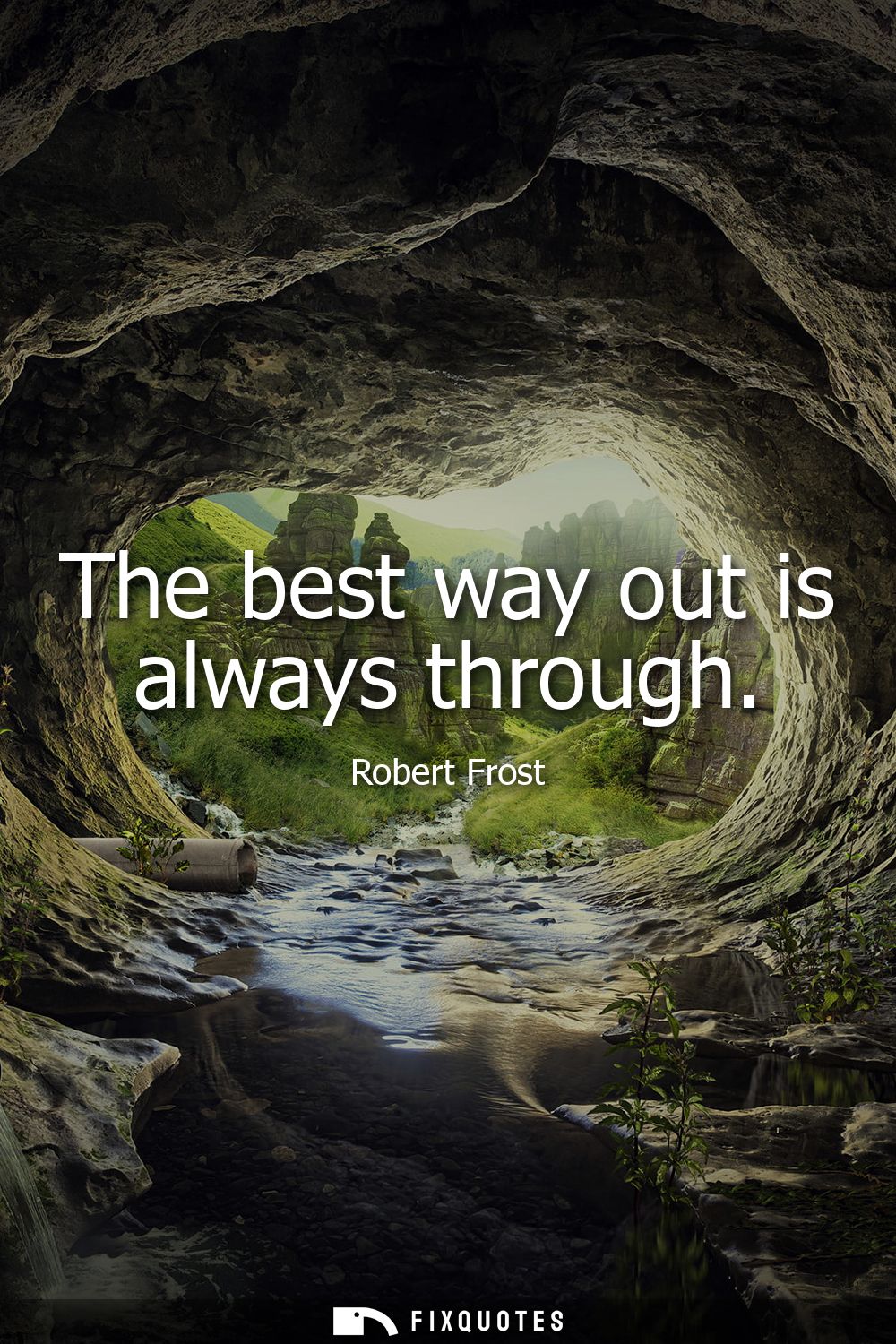
"The best way out is always through"
About this Quote
Frost’s line is a deceptively plainspoken dare: stop hunting for trapdoors. “The best way out is always through” turns on an almost physical logic, like pushing into a snowdrift instead of pacing around it until you freeze. Its power comes from how it refuses the soothing fantasy of shortcuts without slipping into macho posturing. “Best” isn’t “easiest”; it’s the option that actually works.
The subtext is classic Frost: the world doesn’t reorganize itself around your comfort, and pretending otherwise is a form of self-deception. “Out” implies confinement, but the line quietly suggests the prison is as much psychological as external. You don’t exit grief, guilt, fear, or conflict by denial or cleverness; you exit by enduring the uncomfortable middle where you’d rather not be. The phrase “always through” sounds absolute, even moral, which is part of the trick. Frost delivers counsel that borders on stoicism, but he packages it as common sense - a New England practicality that makes suffering feel like a route you can take, not just weather you must endure.
Context matters: Frost’s poems routinely stage crises in ordinary settings - woods, roads, walls - where the landscape doubles as an argument about choice and responsibility. He’s often misread as pastoral and cozy; lines like this reveal the harder Frost, the one who knows that adulthood is mostly doing the difficult thing you can’t charm your way around. The quote endures because it flatters no one, yet offers a clear, bracing map: forward.
The subtext is classic Frost: the world doesn’t reorganize itself around your comfort, and pretending otherwise is a form of self-deception. “Out” implies confinement, but the line quietly suggests the prison is as much psychological as external. You don’t exit grief, guilt, fear, or conflict by denial or cleverness; you exit by enduring the uncomfortable middle where you’d rather not be. The phrase “always through” sounds absolute, even moral, which is part of the trick. Frost delivers counsel that borders on stoicism, but he packages it as common sense - a New England practicality that makes suffering feel like a route you can take, not just weather you must endure.
Context matters: Frost’s poems routinely stage crises in ordinary settings - woods, roads, walls - where the landscape doubles as an argument about choice and responsibility. He’s often misread as pastoral and cozy; lines like this reveal the harder Frost, the one who knows that adulthood is mostly doing the difficult thing you can’t charm your way around. The quote endures because it flatters no one, yet offers a clear, bracing map: forward.
Quote Details
| Topic | Perseverance |
|---|---|
| Source | Unverified source: North of Boston (Robert Frost, 1914)
Evidence: Poem: "A Servant to Servants" (line: "He says the best way out is always through."). The wording commonly quoted (“The best way out is always through”) appears verbatim in Frost’s poem “A Servant to Servants,” included in his 1914 collection North of Boston. In context it is spoken as part of the... Other candidates (2) Robert Frost (Robert Frost) compilation95.0% e steady pull more ought to do it he says the best way out is always through and The Best Way Out, A South American Odyssey (R. Scott Morris, 2020) compilation95.0% ... Robert Frost about dealing with adversity - " The best way out is always through . " William had studied poetry a... |
| Featured | This quote was our Quote of the Day on July 6, 2023 |
| Cite |
Citation Formats
APA Style (7th ed.)
Frost, Robert. (2026, January 11). The best way out is always through. FixQuotes. https://fixquotes.com/quotes/the-best-way-out-is-always-through-28927/
Chicago Style
Frost, Robert. "The best way out is always through." FixQuotes. January 11, 2026. https://fixquotes.com/quotes/the-best-way-out-is-always-through-28927/.
MLA Style (9th ed.)
"The best way out is always through." FixQuotes, 11 Jan. 2026, https://fixquotes.com/quotes/the-best-way-out-is-always-through-28927/. Accessed 21 Mar. 2026.
More Quotes by Robert
Add to List