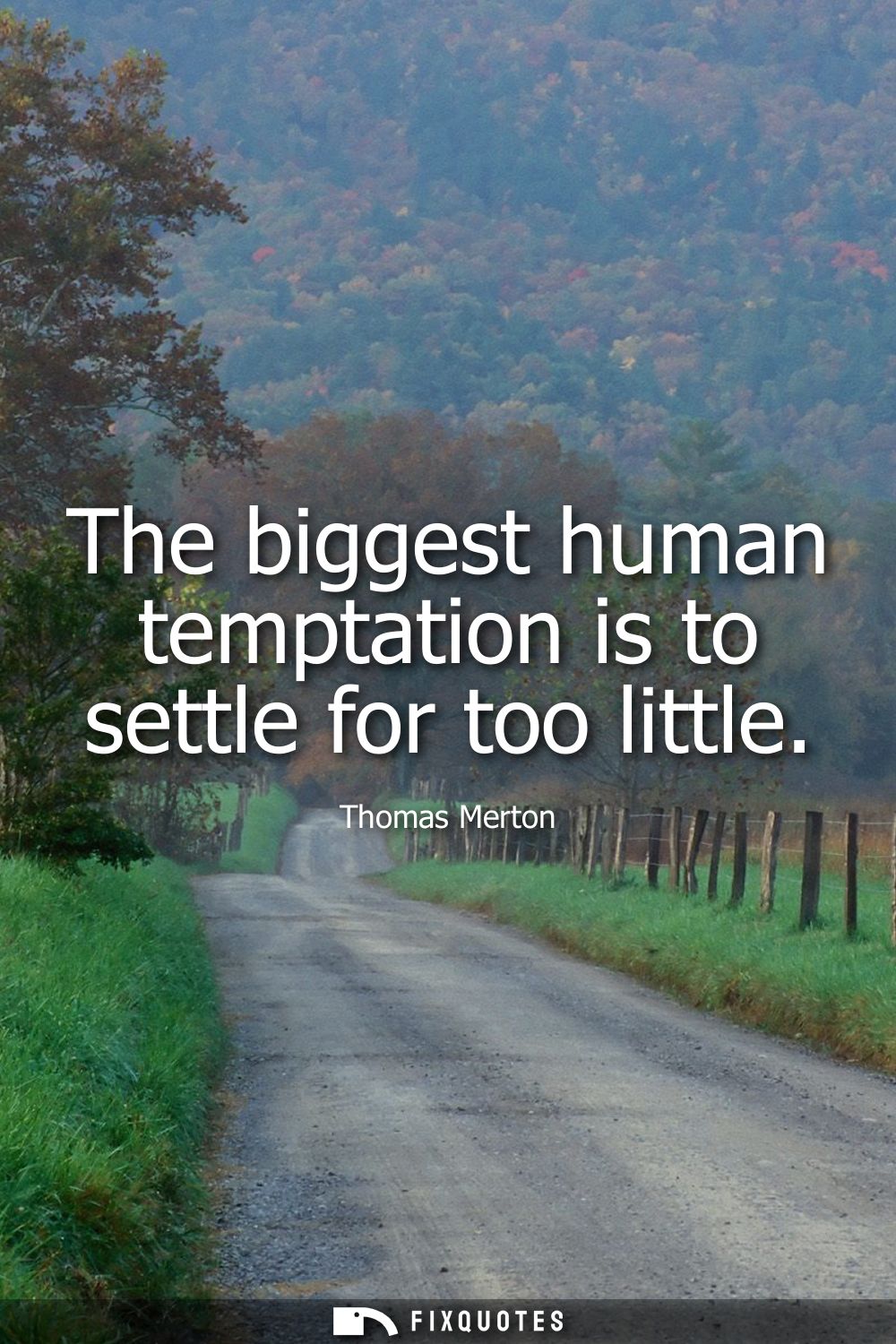
"The biggest human temptation is to settle for too little"
About this Quote
Merton’s line doesn’t scold our appetites; it indicts our fear. “The biggest human temptation” sounds like he’s about to talk about lust or greed, the usual moral headline-grabbers. Instead he pivots to something quieter and more corrosive: the impulse to shrink your life until it feels manageable. That misdirection is the point. He reframes temptation as low ambition dressed up as prudence, a spiritual bargain where you trade depth for comfort and call it maturity.
The subtext is monastic in the best sense: renunciation is only holy if it’s chosen for something larger, not because you’re tired, scared, or addicted to approval. “Settle” is the operative verb - it’s domestic, legalistic, final. It evokes a case closed, a debt paid, a negotiation ended. Merton suggests we can “settle” not just in careers and relationships, but in our moral imagination: accepting shallow convictions, secondhand identities, tiny definitions of freedom.
Context matters. Writing as a Trappist monk in mid-century America, Merton watched a culture of postwar plenty and Cold War anxiety normalize smallness: keep your head down, buy the right things, don’t ask the dangerous questions. For him, settling for too little isn’t modesty; it’s a surrender of the self’s capacity for God, for conscience, for real interior life. The sentence works because it treats mediocrity as a seduction, not a default - something that actively beckons, sweetly, every day.
The subtext is monastic in the best sense: renunciation is only holy if it’s chosen for something larger, not because you’re tired, scared, or addicted to approval. “Settle” is the operative verb - it’s domestic, legalistic, final. It evokes a case closed, a debt paid, a negotiation ended. Merton suggests we can “settle” not just in careers and relationships, but in our moral imagination: accepting shallow convictions, secondhand identities, tiny definitions of freedom.
Context matters. Writing as a Trappist monk in mid-century America, Merton watched a culture of postwar plenty and Cold War anxiety normalize smallness: keep your head down, buy the right things, don’t ask the dangerous questions. For him, settling for too little isn’t modesty; it’s a surrender of the self’s capacity for God, for conscience, for real interior life. The sentence works because it treats mediocrity as a seduction, not a default - something that actively beckons, sweetly, every day.
Quote Details
| Topic | Motivational |
|---|---|
| Source | Help us find the source |
| Cite |
Citation Formats
APA Style (7th ed.)
Merton, Thomas. (2026, January 17). The biggest human temptation is to settle for too little. FixQuotes. https://fixquotes.com/quotes/the-biggest-human-temptation-is-to-settle-for-too-23971/
Chicago Style
Merton, Thomas. "The biggest human temptation is to settle for too little." FixQuotes. January 17, 2026. https://fixquotes.com/quotes/the-biggest-human-temptation-is-to-settle-for-too-23971/.
MLA Style (9th ed.)
"The biggest human temptation is to settle for too little." FixQuotes, 17 Jan. 2026, https://fixquotes.com/quotes/the-biggest-human-temptation-is-to-settle-for-too-23971/. Accessed 12 Feb. 2026.
More Quotes by Thomas
Add to List