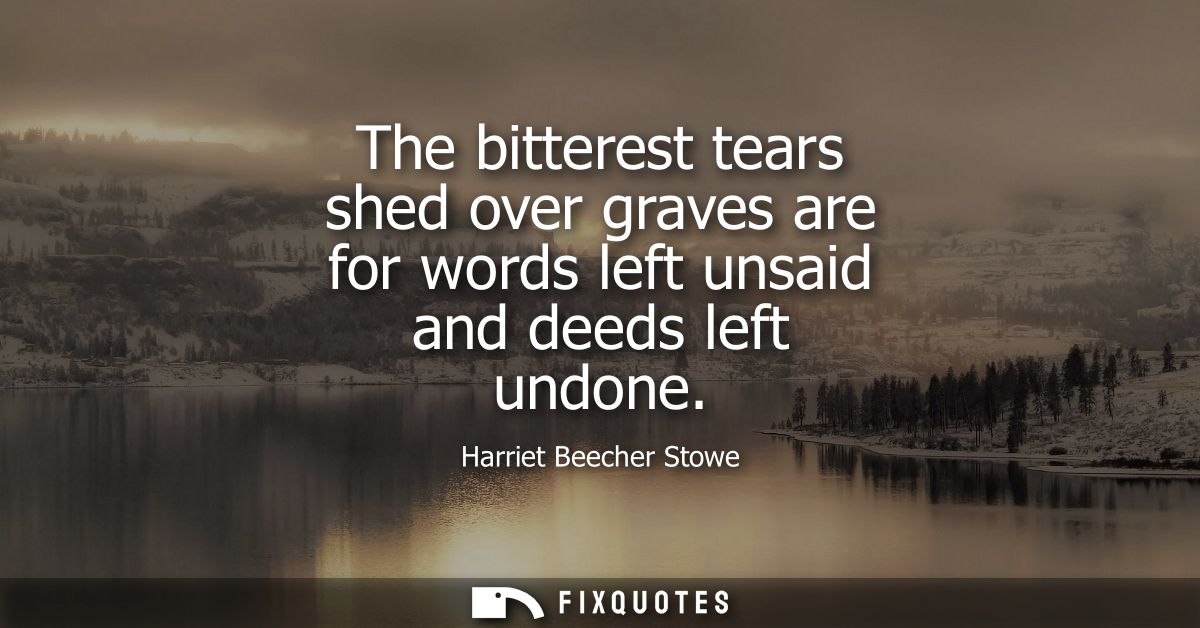
"The bitterest tears shed over graves are for words left unsaid and deeds left undone"
About this Quote
Stowe was a novelist steeped in the evangelical and reform culture of 19th-century America, where conscience wasn’t abstract but actionable. In the shadow of slavery, women’s constrained public roles, and religious rhetoric that emphasized accountability, this sentiment reads less like a Hallmark maxim and more like a pressure point: you are responsible for what you fail to oppose, confess, or repair. The grave is the cruel deadline that turns procrastination into permanence.
The sentence works because it trades in specifics without being literal. “Graves” are concrete; “unsaid” and “undone” are maddeningly open-ended, allowing the reader to supply their own omissions. Stowe also chooses “bitterest,” a comparative that quietly suggests other tears are easier - the sad but clean kind. These are harsher because they carry self-knowledge: the dead are unreachable, and the self can’t plead ignorance anymore.
Quote Details
| Topic | Legacy & Remembrance |
|---|---|
| Source | Verified source: Little Foxes (Harriet Beecher Stowe, 1865)
Evidence:
The bitterest tears shed over graves are for words left unsaid and deeds left undone. (Chapter 3, page 129). Verified in Harriet Beecher Stowe's own work, published under the pseudonym Christopher Crowfield: Little Foxes; or, The Insignificant Little Habits Which Mar Domestic Happiness (Boston: Ticknor and Fields, 1865). The quote appears in Chapter III ('Repression') on page 129 in the scanned/etext edition consulted. This is a primary-source match. The surrounding text in the same passage continues with examples such as “She never knew how I loved her.” and “He never knew what he was to me.” Project Gutenberg and multiple secondary references also point to Little Foxes, chapter 3, but the identification is confirmed directly from the text itself. ([mirrorservice.org](https://www.mirrorservice.org/sites/ftp.ibiblio.org/pub/docs/books/gutenberg/6/7/3/8/67383/67383-h/67383-h.htm)) |
| Cite |
Citation Formats
APA Style (7th ed.)
Stowe, Harriet Beecher. (2026, March 13). The bitterest tears shed over graves are for words left unsaid and deeds left undone. FixQuotes. https://fixquotes.com/quotes/the-bitterest-tears-shed-over-graves-are-for-132871/
Chicago Style
Stowe, Harriet Beecher. "The bitterest tears shed over graves are for words left unsaid and deeds left undone." FixQuotes. March 13, 2026. https://fixquotes.com/quotes/the-bitterest-tears-shed-over-graves-are-for-132871/.
MLA Style (9th ed.)
"The bitterest tears shed over graves are for words left unsaid and deeds left undone." FixQuotes, 13 Mar. 2026, https://fixquotes.com/quotes/the-bitterest-tears-shed-over-graves-are-for-132871/. Accessed 4 Apr. 2026.