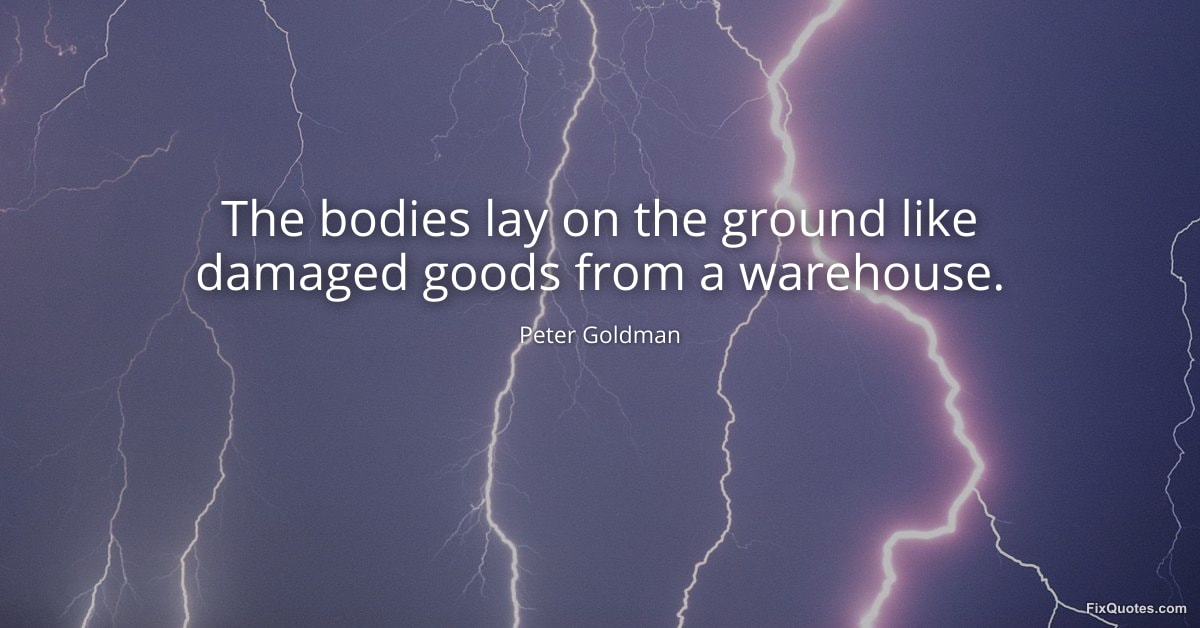
"The bodies lay on the ground like damaged goods from a warehouse"
About this Quote
“The bodies lay on the ground like damaged goods from a warehouse” is a metaphor designed to make you flinch twice: first at the scene, then at your own recognition of the logic behind it. By comparing human corpses to dented inventory, Goldman drags the language of commerce into the aftermath of violence. It’s not just dehumanization; it’s dehumanization with a paper trail. A warehouse implies systems: storage, sorting, labeling, liability. The dead aren’t merely “fallen” or “lost” (words that soften responsibility). They’re treated as write-offs.
The specific intent feels accusatory. The line isn’t trying to beautify tragedy or dignify the fallen; it’s exposing a worldview where people are processed the way products are. “Damaged goods” is especially loaded because it suggests usefulness as the measure of worth. Damage doesn’t mean moral horror; it means reduced value. That’s the chilling subtext: the violence is appalling, but what’s equally appalling is how easily an economy of language can make it legible, almost routine.
Context matters, and even without a known profession you can hear reportage or war writing in the blunt staging: bodies, ground, simile, no names. That absence is part of the effect. It mimics the distance of institutions - militaries, police, bureaucracies, markets - that manage catastrophe at scale. The image turns the viewer into an unwilling participant in that management, forcing you to see how modern brutality often arrives wrapped in the tidy metaphors of logistics.
The specific intent feels accusatory. The line isn’t trying to beautify tragedy or dignify the fallen; it’s exposing a worldview where people are processed the way products are. “Damaged goods” is especially loaded because it suggests usefulness as the measure of worth. Damage doesn’t mean moral horror; it means reduced value. That’s the chilling subtext: the violence is appalling, but what’s equally appalling is how easily an economy of language can make it legible, almost routine.
Context matters, and even without a known profession you can hear reportage or war writing in the blunt staging: bodies, ground, simile, no names. That absence is part of the effect. It mimics the distance of institutions - militaries, police, bureaucracies, markets - that manage catastrophe at scale. The image turns the viewer into an unwilling participant in that management, forcing you to see how modern brutality often arrives wrapped in the tidy metaphors of logistics.
Quote Details
| Topic | War |
|---|---|
| Source | Help us find the source |
| Cite |
Citation Formats
APA Style (7th ed.)
Goldman, Peter. (2026, January 16). The bodies lay on the ground like damaged goods from a warehouse. FixQuotes. https://fixquotes.com/quotes/the-bodies-lay-on-the-ground-like-damaged-goods-83315/
Chicago Style
Goldman, Peter. "The bodies lay on the ground like damaged goods from a warehouse." FixQuotes. January 16, 2026. https://fixquotes.com/quotes/the-bodies-lay-on-the-ground-like-damaged-goods-83315/.
MLA Style (9th ed.)
"The bodies lay on the ground like damaged goods from a warehouse." FixQuotes, 16 Jan. 2026, https://fixquotes.com/quotes/the-bodies-lay-on-the-ground-like-damaged-goods-83315/. Accessed 7 Mar. 2026.
More Quotes by Peter
Add to List