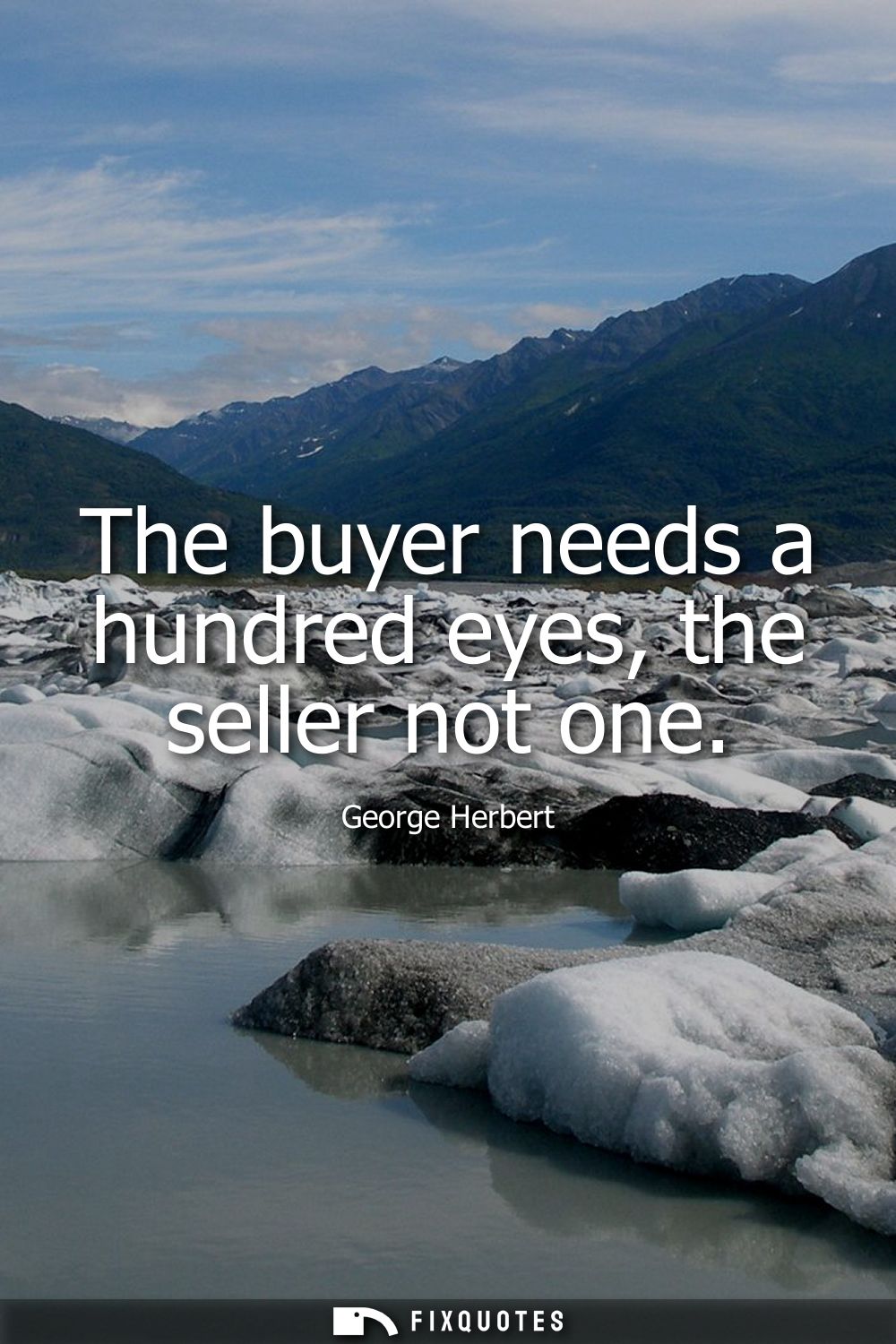
"The buyer needs a hundred eyes, the seller not one"
About this Quote
Commerce, Herbert suggests, is a game built on asymmetry: the buyer must see everything, the seller can afford to see nothing. The line lands because it’s not really about eyesight. It’s about moral hazard. Sellers can profit from ignorance - sometimes by design, sometimes simply by letting optimism do the work - while buyers carry the burden of verification. “A hundred eyes” is a comic exaggeration with a hard edge: diligence isn’t a virtue here, it’s self-defense.
Herbert’s context matters. Writing in early 17th-century England, he’s a devotional poet living amid expanding markets, rising consumer goods, and a culture that still treated trade with suspicion. The proverb-like snap fits his era’s appetite for moral epigrams: tiny sentences that pretend to be common sense while smuggling in an ethical warning. His subtext is Protestant and pragmatic at once: the world is fallen, incentives are crooked, so don’t confuse a confident pitch with truth.
What makes the line durable is how neatly it anticipates modern buyer-beware economics. “Seller not one” doesn’t mean sellers are literally blind; it implies they don’t need to look because the system often doesn’t require them to. In that sense, Herbert isn’t just scolding individual dishonesty. He’s pointing at a structure where risk is unevenly distributed - and reminding you that trust, in a marketplace, is rarely free.
Herbert’s context matters. Writing in early 17th-century England, he’s a devotional poet living amid expanding markets, rising consumer goods, and a culture that still treated trade with suspicion. The proverb-like snap fits his era’s appetite for moral epigrams: tiny sentences that pretend to be common sense while smuggling in an ethical warning. His subtext is Protestant and pragmatic at once: the world is fallen, incentives are crooked, so don’t confuse a confident pitch with truth.
What makes the line durable is how neatly it anticipates modern buyer-beware economics. “Seller not one” doesn’t mean sellers are literally blind; it implies they don’t need to look because the system often doesn’t require them to. In that sense, Herbert isn’t just scolding individual dishonesty. He’s pointing at a structure where risk is unevenly distributed - and reminding you that trust, in a marketplace, is rarely free.
Quote Details
| Topic | Sales |
|---|---|
| Source | Verified source: Outlandish Proverbs (George Herbert, 1640)
Evidence: The buyer needes a hundred eyes, the seller not one.. Earliest located primary appearance is in the 1640 book/tract titled "Outlandish Proverbs, Selected by Mr. G. H." (commonly taken to be George Herbert). In the online transcription, this appears as item/proverb number 390. A later, better-known appearance is in "Jacula Prudentum" (1651), where it is often numbered 386 in modern quote listings; however, 1651 is not the first publication. I could not reliably extract a scan-based page number from the accessible transcription, so page is left null. Other candidates (1) The English Poems of George Herbert (George Herbert, 1871) compilation95.0% Together with His Collection of Proverbs Entitled Jacula Prudentum George Herbert. We are fools one to another ... Th... |
| Cite |
Citation Formats
APA Style (7th ed.)
Herbert, George. (2026, February 16). The buyer needs a hundred eyes, the seller not one. FixQuotes. https://fixquotes.com/quotes/the-buyer-needs-a-hundred-eyes-the-seller-not-one-18201/
Chicago Style
Herbert, George. "The buyer needs a hundred eyes, the seller not one." FixQuotes. February 16, 2026. https://fixquotes.com/quotes/the-buyer-needs-a-hundred-eyes-the-seller-not-one-18201/.
MLA Style (9th ed.)
"The buyer needs a hundred eyes, the seller not one." FixQuotes, 16 Feb. 2026, https://fixquotes.com/quotes/the-buyer-needs-a-hundred-eyes-the-seller-not-one-18201/. Accessed 5 Apr. 2026.
More Quotes by George
Add to List