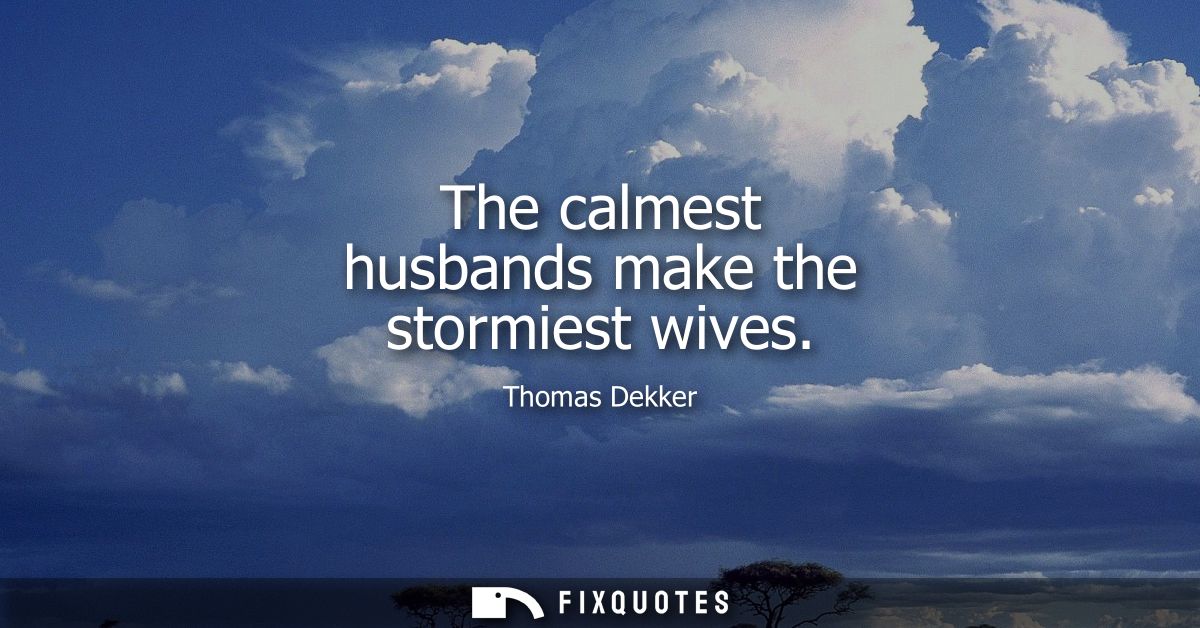
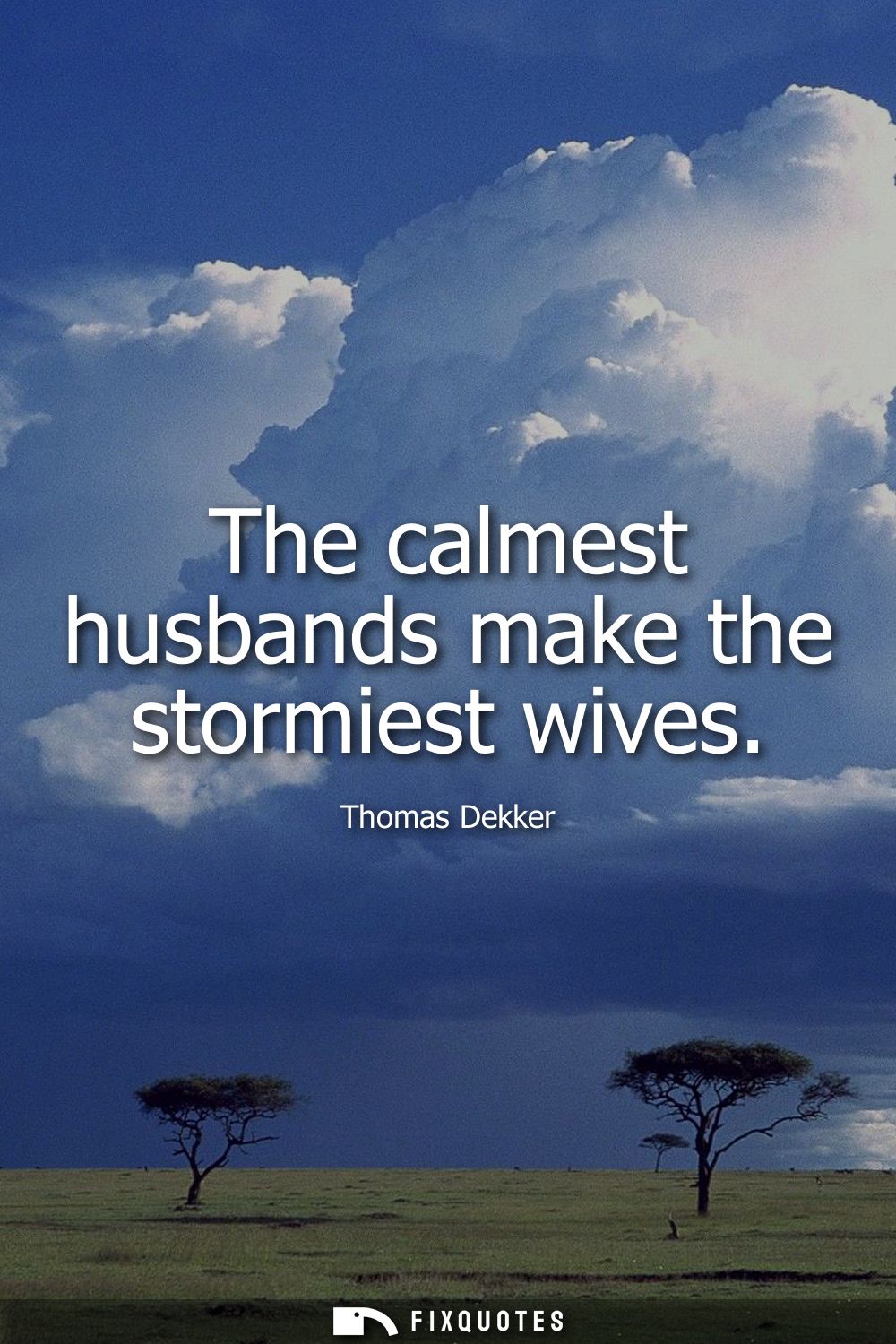
"The calmest husbands make the stormiest wives"
About this Quote
“The calmest husbands make the stormiest wives” lands like a neat little compliment to male composure, then quietly flips into an indictment. Dekker, writing for the stage in a culture obsessed with household hierarchy, knows that “calm” isn’t just temperament; it’s a strategy. Early modern marriage ideals prized the husband’s steadiness as authority, a kind of emotional monopoly that could look like virtue while functioning as control. The line’s sting is that the wife’s “storm” isn’t innate hysteria but weather created by someone else’s climate.
As a dramatist, Dekker is interested in domestic life as performance: who gets to be reasonable, who gets cast as excessive. The phrasing is almost proverb-like, giving it the feel of folk wisdom, which is exactly how social norms launder themselves into common sense. “Make” is the operative word. It assigns causality, suggesting that the wife’s outbursts are reactive, even manufactured. A husband’s calm can be a refusal to engage, a cool dismissal, a posture that forces the other person to carry the scene’s emotional energy alone. Her volume becomes proof of her instability; his quiet becomes proof of his righteousness.
Context matters: Dekker wrote amid anxieties about “unruly” women and the policing of female speech. The quote plays in that arena but also exposes its mechanics. It’s less a joke about nagging wives than a sideways warning: tranquility can be provocative when it’s weaponized, and the so-called shrew may be the only one honestly registering what’s happening.
As a dramatist, Dekker is interested in domestic life as performance: who gets to be reasonable, who gets cast as excessive. The phrasing is almost proverb-like, giving it the feel of folk wisdom, which is exactly how social norms launder themselves into common sense. “Make” is the operative word. It assigns causality, suggesting that the wife’s outbursts are reactive, even manufactured. A husband’s calm can be a refusal to engage, a cool dismissal, a posture that forces the other person to carry the scene’s emotional energy alone. Her volume becomes proof of her instability; his quiet becomes proof of his righteousness.
Context matters: Dekker wrote amid anxieties about “unruly” women and the policing of female speech. The quote plays in that arena but also exposes its mechanics. It’s less a joke about nagging wives than a sideways warning: tranquility can be provocative when it’s weaponized, and the so-called shrew may be the only one honestly registering what’s happening.
Quote Details
| Topic | Husband & Wife |
|---|---|
| Source | Help us find the source |
| Cite |
Citation Formats
APA Style (7th ed.)
Dekker, Thomas. (2026, January 17). The calmest husbands make the stormiest wives. FixQuotes. https://fixquotes.com/quotes/the-calmest-husbands-make-the-stormiest-wives-27753/
Chicago Style
Dekker, Thomas. "The calmest husbands make the stormiest wives." FixQuotes. January 17, 2026. https://fixquotes.com/quotes/the-calmest-husbands-make-the-stormiest-wives-27753/.
MLA Style (9th ed.)
"The calmest husbands make the stormiest wives." FixQuotes, 17 Jan. 2026, https://fixquotes.com/quotes/the-calmest-husbands-make-the-stormiest-wives-27753/. Accessed 13 Mar. 2026.
More Quotes by Thomas
Add to List