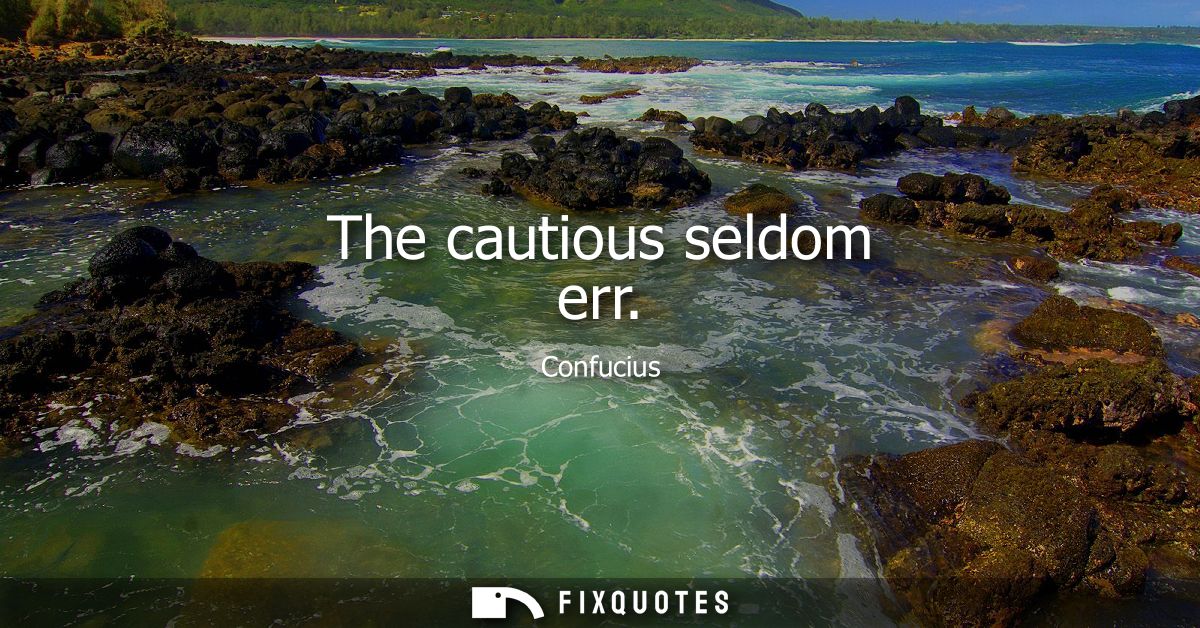
"The cautious seldom err"
About this Quote
Caution is being sold here as a kind of moral technology: not bravery, not brilliance, but a disciplined refusal to be pushed off-balance. In Confucius' world, that mattered. He lived in the Spring and Autumn period, an era of political fragmentation where a wrong word to the wrong person could cost a job, a family’s standing, or a life. Against that backdrop, "The cautious seldom err" reads less like a personality trait and more like a survival ethic dressed up as virtue.
The line works because it compresses a whole Confucian program into a single, almost bureaucratic promise: stability over spectacle. "Seldom" is doing important work. Confucius isn’t claiming caution makes you pure or omniscient; he’s offering a probabilistic advantage. That modesty makes the counsel feel practical rather than pious, closer to risk management than moralizing. It also hints at a deeper Confucian suspicion of impulse: error is not just a factual mistake, it’s a breach in ritual propriety, a moment where the self fails to stay aligned with role, hierarchy, and timing.
There’s subtext, too, about power. Caution is easier to preach from a position that values order and continuity; it quietly discourages disruptive action and rewards those who can afford patience. The aphorism flatters restraint as wisdom, while implicitly casting boldness as a breeding ground for social harm. It’s a philosophy of governance as much as self-cultivation: fewer errors means fewer ruptures, fewer ruptures means a society that can hold.
The line works because it compresses a whole Confucian program into a single, almost bureaucratic promise: stability over spectacle. "Seldom" is doing important work. Confucius isn’t claiming caution makes you pure or omniscient; he’s offering a probabilistic advantage. That modesty makes the counsel feel practical rather than pious, closer to risk management than moralizing. It also hints at a deeper Confucian suspicion of impulse: error is not just a factual mistake, it’s a breach in ritual propriety, a moment where the self fails to stay aligned with role, hierarchy, and timing.
There’s subtext, too, about power. Caution is easier to preach from a position that values order and continuity; it quietly discourages disruptive action and rewards those who can afford patience. The aphorism flatters restraint as wisdom, while implicitly casting boldness as a breeding ground for social harm. It’s a philosophy of governance as much as self-cultivation: fewer errors means fewer ruptures, fewer ruptures means a society that can hold.
Quote Details
| Topic | Chinese Proverbs |
|---|
More Quotes by Confucius
Add to List