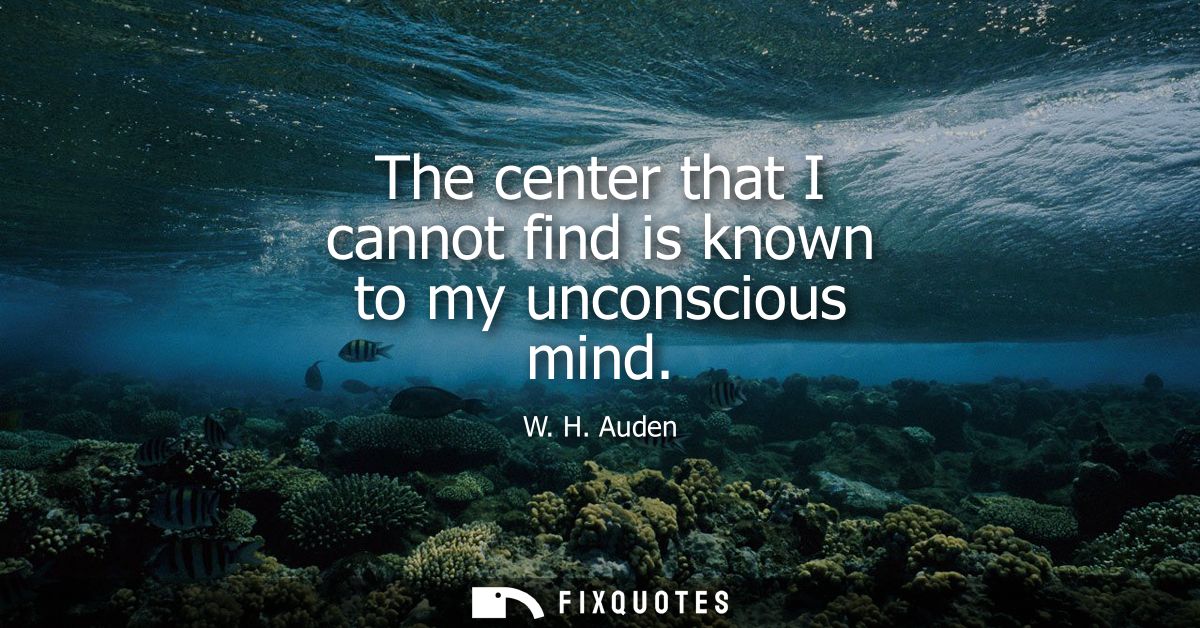
"The center that I cannot find is known to my unconscious mind"
About this Quote
Auden turns the modernist crisis of meaning into a psychological riddle: the center is missing, yet somehow already mapped. The line reads like a confession from someone exhausted by conscious striving. “The center” evokes more than personal balance; it’s the old promise of a stable moral or metaphysical anchor that 20th-century life (war, ideology, mass society) kept shaking loose. Auden doesn’t romanticize that loss. He makes it feel like a practical problem - a thing you go looking for and can’t locate, the way you lose your keys while they’re in your pocket.
The clever twist is the second clause: what the speaker can’t find, the unconscious “knows.” That’s not a comforting mysticism; it’s a reminder that the self is divided, and the part running the show isn’t the one doing the narrating. Auden is flirting with Freud here, but with a poet’s skepticism: the unconscious becomes both oracle and saboteur, a storehouse of buried conviction, fear, desire, and half-remembered faith. The syntax itself performs the split - “I” versus “my unconscious mind” - as if the speaker has to cite an internal authority because personal agency no longer feels reliable.
Context matters: Auden wrote in an era when traditional centers (religion, empire, inherited social scripts) were collapsing or becoming suspect, while psychoanalysis offered a new explanatory machine. The line works because it refuses a clean cure. It suggests that what we call “lost” meaning might not be gone at all; it’s simply inaccessible to the part of us that insists on being in control.
The clever twist is the second clause: what the speaker can’t find, the unconscious “knows.” That’s not a comforting mysticism; it’s a reminder that the self is divided, and the part running the show isn’t the one doing the narrating. Auden is flirting with Freud here, but with a poet’s skepticism: the unconscious becomes both oracle and saboteur, a storehouse of buried conviction, fear, desire, and half-remembered faith. The syntax itself performs the split - “I” versus “my unconscious mind” - as if the speaker has to cite an internal authority because personal agency no longer feels reliable.
Context matters: Auden wrote in an era when traditional centers (religion, empire, inherited social scripts) were collapsing or becoming suspect, while psychoanalysis offered a new explanatory machine. The line works because it refuses a clean cure. It suggests that what we call “lost” meaning might not be gone at all; it’s simply inaccessible to the part of us that insists on being in control.
Quote Details
| Topic | Deep |
|---|---|
| Source | Later attribution: The Artist's Way (Julia Cameron, 2002) modern compilationISBN: 9781101156889 · ID: ZaC7Br7sMBMC
Evidence:
... The center that I cannot find is known to my unconscious mind. W. H. AUDEN All you need to do to receive guidance is to ask for it and then listen. SANAYA ROMAN If you look over the time you have been doing your morning writing, you ... |
| Cite |
Citation Formats
APA Style (7th ed.)
Auden, W. H. (2026, April 4). The center that I cannot find is known to my unconscious mind. FixQuotes. https://fixquotes.com/quotes/the-center-that-i-cannot-find-is-known-to-my-66513/
Chicago Style
Auden, W. H. "The center that I cannot find is known to my unconscious mind." FixQuotes. April 4, 2026. https://fixquotes.com/quotes/the-center-that-i-cannot-find-is-known-to-my-66513/.
MLA Style (9th ed.)
"The center that I cannot find is known to my unconscious mind." FixQuotes, 4 Apr. 2026, https://fixquotes.com/quotes/the-center-that-i-cannot-find-is-known-to-my-66513/. Accessed 8 Apr. 2026.
More Quotes by H. Auden
Add to List