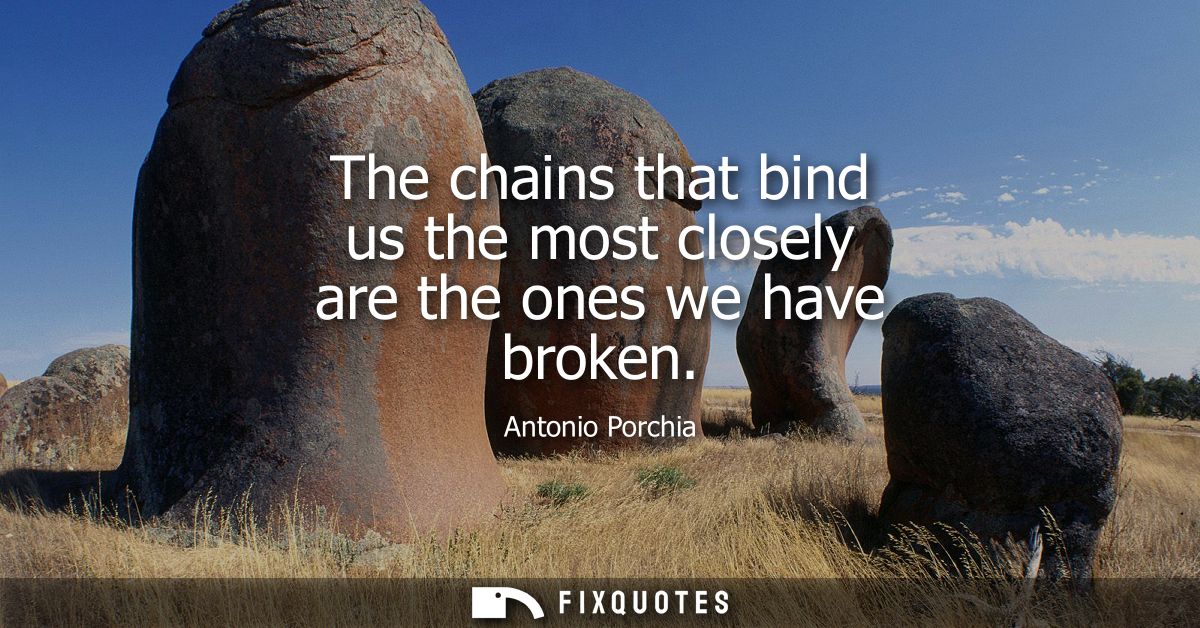
"The chains that bind us the most closely are the ones we have broken"
About this Quote
Porchia’s line turns liberation into a trapdoor. We expect broken chains to mean clean escape, the satisfying snap of metal and a body finally unowned. Instead, he suggests the opposite: what we “break” can start binding us more intimately than what ever held us in the first place.
The intent feels less motivational than diagnostic. Porchia is writing from the interior life, where history and psychology don’t obey victory narratives. The subtext is that rupture creates residue: the memory of captivity, the habit of bracing for punishment, the identity built around resistance. A person can leave the prison and still organize their days around it. The chain is gone; the posture remains.
Why it works is the paradox’s precision. “The most closely” implies contact, almost tenderness - bondage not as public spectacle but as private attachment. Brokenness becomes a kind of adhesive. The phrase also smuggles in a moral twist: we can grow loyal to our own rebellions. The ego keeps trophies. We retell the story of what we escaped until the story becomes the new restraint, narrowing how we imagine ourselves and what we’re allowed to want.
Contextually, Porchia’s aphorisms (Voices) emerged from displacement, poverty, and immigrant life in Argentina, a world where grand ideologies promised emancipation while daily survival demanded compromise. His skepticism reads as hard-won: freedom isn’t a door you walk through once. It’s a practice, and the hardest chains are the ones that have already taught you how to live.
The intent feels less motivational than diagnostic. Porchia is writing from the interior life, where history and psychology don’t obey victory narratives. The subtext is that rupture creates residue: the memory of captivity, the habit of bracing for punishment, the identity built around resistance. A person can leave the prison and still organize their days around it. The chain is gone; the posture remains.
Why it works is the paradox’s precision. “The most closely” implies contact, almost tenderness - bondage not as public spectacle but as private attachment. Brokenness becomes a kind of adhesive. The phrase also smuggles in a moral twist: we can grow loyal to our own rebellions. The ego keeps trophies. We retell the story of what we escaped until the story becomes the new restraint, narrowing how we imagine ourselves and what we’re allowed to want.
Contextually, Porchia’s aphorisms (Voices) emerged from displacement, poverty, and immigrant life in Argentina, a world where grand ideologies promised emancipation while daily survival demanded compromise. His skepticism reads as hard-won: freedom isn’t a door you walk through once. It’s a practice, and the hardest chains are the ones that have already taught you how to live.
Quote Details
| Topic | Letting Go |
|---|---|
| Source | Help us find the source |
| Cite |
Citation Formats
APA Style (7th ed.)
Porchia, Antonio. (2026, January 14). The chains that bind us the most closely are the ones we have broken. FixQuotes. https://fixquotes.com/quotes/the-chains-that-bind-us-the-most-closely-are-the-6111/
Chicago Style
Porchia, Antonio. "The chains that bind us the most closely are the ones we have broken." FixQuotes. January 14, 2026. https://fixquotes.com/quotes/the-chains-that-bind-us-the-most-closely-are-the-6111/.
MLA Style (9th ed.)
"The chains that bind us the most closely are the ones we have broken." FixQuotes, 14 Jan. 2026, https://fixquotes.com/quotes/the-chains-that-bind-us-the-most-closely-are-the-6111/. Accessed 12 Feb. 2026.
More Quotes by Antonio
Add to List