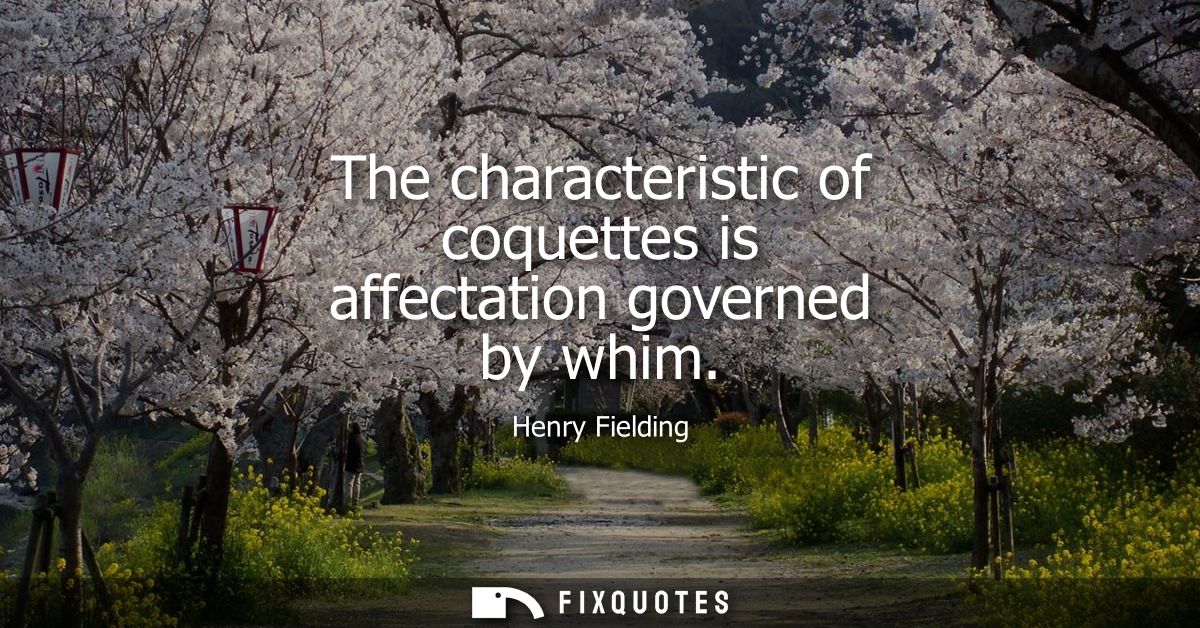
"The characteristic of coquettes is affectation governed by whim"
About this Quote
Fielding lands the insult with a novelist's efficiency: "coquettes" aren't merely flirtatious, they're engineered. The sting is in "affectation" - performance, not feeling - and in the cold suggestion that this performance isn't even strategic. It's "governed by whim", meaning the coquette's power is both deliberate and capricious, a kind of social improvisation that keeps everyone else off-balance.
The line works because it frames flirtation as a technology of status in a culture where women's formal agency was constrained and their reputations policed. If you can't own property or vote, you can still manage attention. Fielding's phrasing turns that management into moral failure: affectation implies fakery, and whim implies irresponsibility. Together they paint a figure who manipulates desire without the adult virtues of consistency or sincerity - a person who treats other people's emotions like props.
There's also a gendered double move typical of 18th-century satire. By casting the coquette as ruled by whim, Fielding borrows an old misogynist trope (female fickleness) while simultaneously acknowledging a real form of power: the ability to set the terms of social interaction through ambiguity. The subtext is anxiety. A coquette unsettles the period's preferred story about courtship as a rational march toward marriage. She makes it messy, theatrical, and unpredictable, and Fielding - chronicler of manners and their hypocrisies - names that unpredictability as the real threat.
The line works because it frames flirtation as a technology of status in a culture where women's formal agency was constrained and their reputations policed. If you can't own property or vote, you can still manage attention. Fielding's phrasing turns that management into moral failure: affectation implies fakery, and whim implies irresponsibility. Together they paint a figure who manipulates desire without the adult virtues of consistency or sincerity - a person who treats other people's emotions like props.
There's also a gendered double move typical of 18th-century satire. By casting the coquette as ruled by whim, Fielding borrows an old misogynist trope (female fickleness) while simultaneously acknowledging a real form of power: the ability to set the terms of social interaction through ambiguity. The subtext is anxiety. A coquette unsettles the period's preferred story about courtship as a rational march toward marriage. She makes it messy, theatrical, and unpredictable, and Fielding - chronicler of manners and their hypocrisies - names that unpredictability as the real threat.
Quote Details
| Topic | Witty One-Liners |
|---|---|
| Source | Help us find the source |
| Cite |
Citation Formats
APA Style (7th ed.)
Fielding, Henry. (2026, January 15). The characteristic of coquettes is affectation governed by whim. FixQuotes. https://fixquotes.com/quotes/the-characteristic-of-coquettes-is-affectation-148428/
Chicago Style
Fielding, Henry. "The characteristic of coquettes is affectation governed by whim." FixQuotes. January 15, 2026. https://fixquotes.com/quotes/the-characteristic-of-coquettes-is-affectation-148428/.
MLA Style (9th ed.)
"The characteristic of coquettes is affectation governed by whim." FixQuotes, 15 Jan. 2026, https://fixquotes.com/quotes/the-characteristic-of-coquettes-is-affectation-148428/. Accessed 2 Mar. 2026.
More Quotes by Henry
Add to List