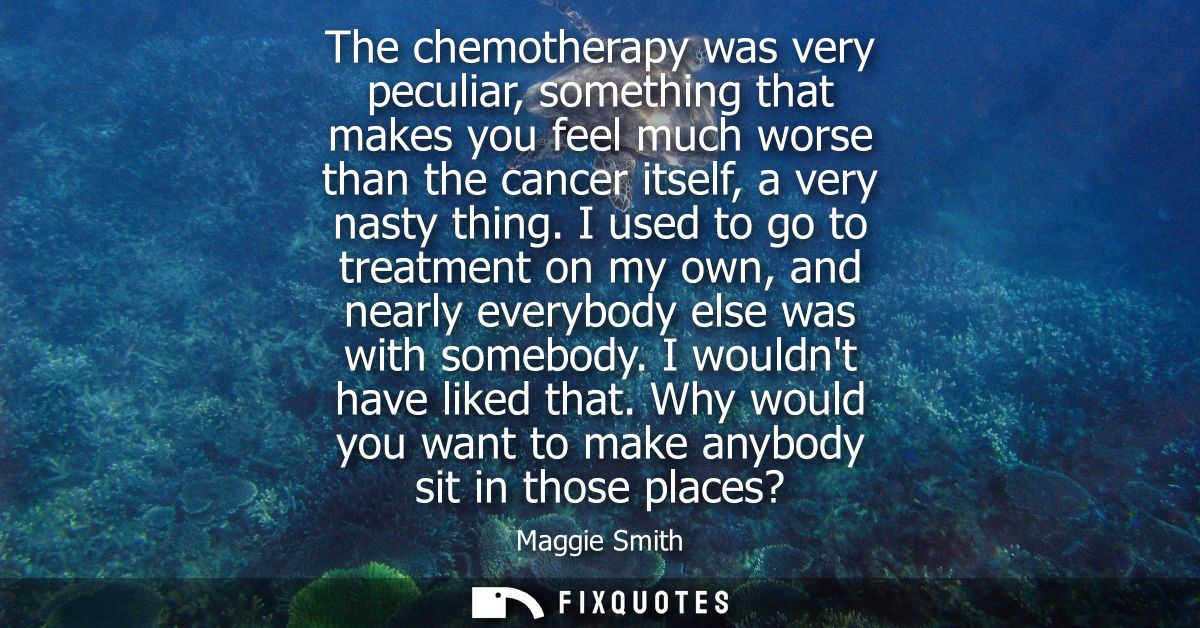
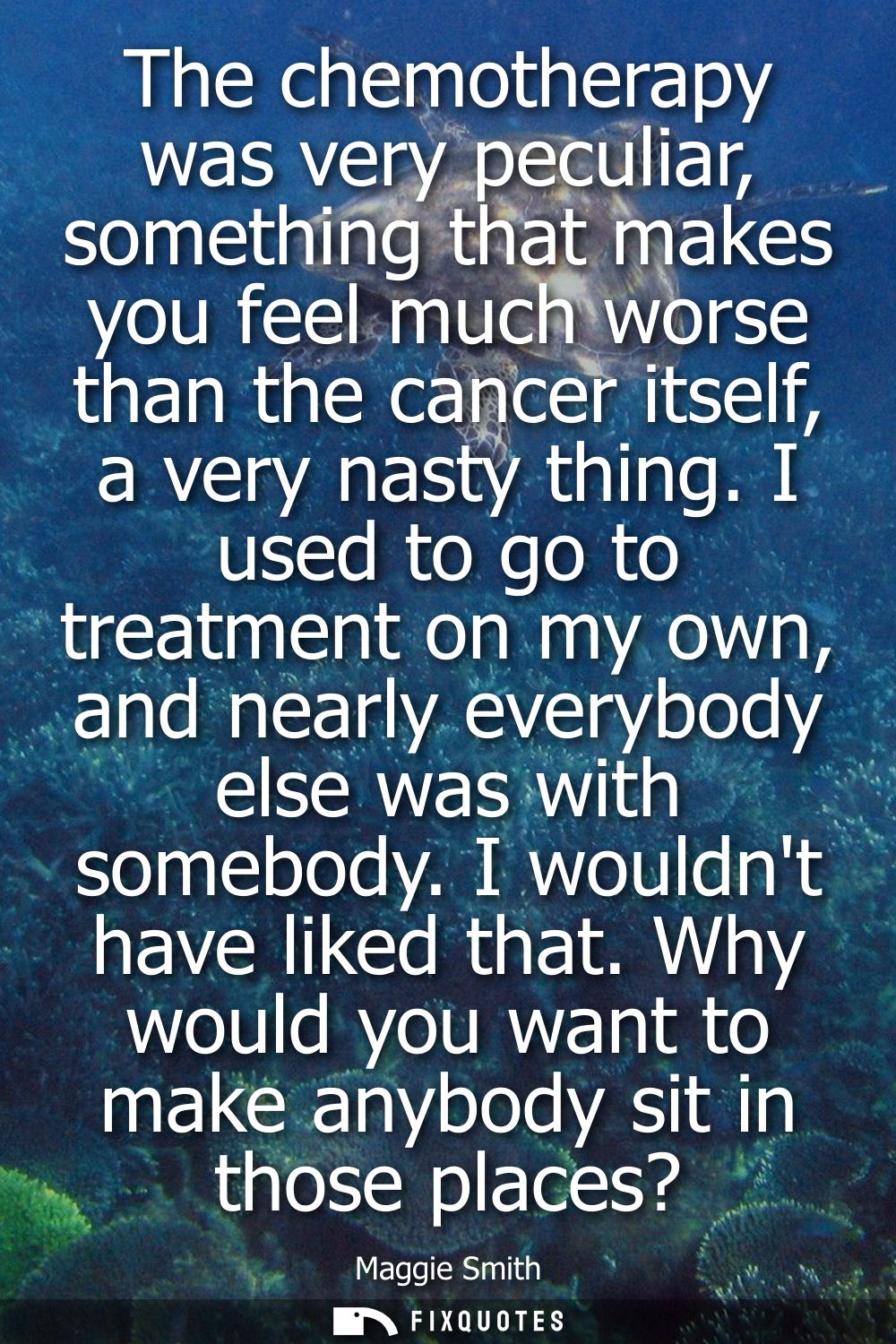
"The chemotherapy was very peculiar, something that makes you feel much worse than the cancer itself, a very nasty thing. I used to go to treatment on my own, and nearly everybody else was with somebody. I wouldn't have liked that. Why would you want to make anybody sit in those places?"
About this Quote
The subtext sharpens when she talks about going alone. In a culture that treats “support systems” as mandatory proof of love, Smith quietly refuses the expected script. “Nearly everybody else was with somebody” sketches a room full of paired-off suffering, yet she insists, “I wouldn’t have liked that.” Not because she’s stoic for sport, but because she’s protective: of her privacy, her dignity, and other people’s time. The final line flips the usual narrative of care. Instead of “How could you go alone?” she asks, “Why would you want to make anybody sit in those places?” It’s darkly considerate, almost mischievous: an actress famous for barbed elegance reframing companionship as an imposition.
Context matters: Smith is from a generation trained to keep pain tidy, but the intent isn’t to romanticize toughness. It’s to reclaim agency in a medical experience that strips it away, insisting that love doesn’t have to look like a waiting room.
Quote Details
| Topic | Health |
|---|---|
| Source | Help us find the source |
| Cite |
Citation Formats
APA Style (7th ed.)
Smith, Maggie. (2026, January 17). The chemotherapy was very peculiar, something that makes you feel much worse than the cancer itself, a very nasty thing. I used to go to treatment on my own, and nearly everybody else was with somebody. I wouldn't have liked that. Why would you want to make anybody sit in those places? FixQuotes. https://fixquotes.com/quotes/the-chemotherapy-was-very-peculiar-something-that-76825/
Chicago Style
Smith, Maggie. "The chemotherapy was very peculiar, something that makes you feel much worse than the cancer itself, a very nasty thing. I used to go to treatment on my own, and nearly everybody else was with somebody. I wouldn't have liked that. Why would you want to make anybody sit in those places?" FixQuotes. January 17, 2026. https://fixquotes.com/quotes/the-chemotherapy-was-very-peculiar-something-that-76825/.
MLA Style (9th ed.)
"The chemotherapy was very peculiar, something that makes you feel much worse than the cancer itself, a very nasty thing. I used to go to treatment on my own, and nearly everybody else was with somebody. I wouldn't have liked that. Why would you want to make anybody sit in those places?" FixQuotes, 17 Jan. 2026, https://fixquotes.com/quotes/the-chemotherapy-was-very-peculiar-something-that-76825/. Accessed 13 Feb. 2026.