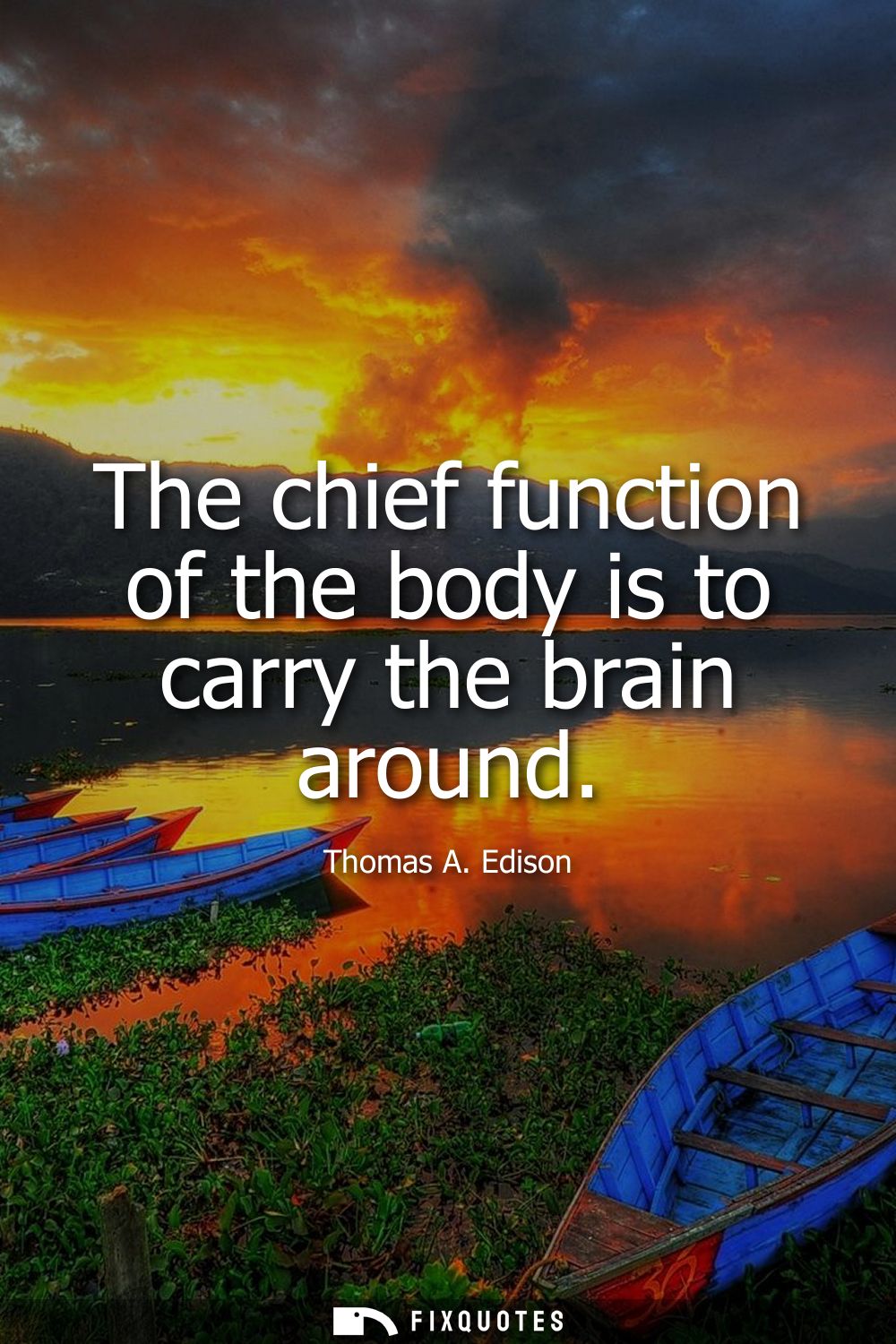
"The chief function of the body is to carry the brain around"
About this Quote
A body reduced to a glorified backpack: that’s Edison at his most bluntly utilitarian, turning human life into an engineering diagram. The line flatters the intellect while quietly scolding everything else we do with our time and energy. It’s not just mind-over-matter; it’s mind-over-nearly-everything. In one clean inversion, Edison downgrades appetite, leisure, even sensuality to secondary systems, useful only insofar as they keep the “real” apparatus operational.
The intent is partly motivational and partly managerial. Edison built a public persona around relentless work, punishing hours, and suspicion of rest. Read in that light, the quote functions like a lab memo: stop pampering the chassis and keep the processor running. The subtext is a moral hierarchy that rewards cognition, productivity, and problem-solving while treating the body as a maintenance cost. There’s a hint of comedy in the overstatement, but it’s the hard-edged humor of a man who thinks efficiency is a virtue you can measure.
Context matters: Edison’s era canonized invention as national destiny, and the new industrial order prized brains that could turn ideas into patents and infrastructure. This aphorism harmonizes with a culture that was beginning to treat mental labor as the premium commodity. It also reveals what gets erased in that bargain: illness, exhaustion, pleasure, and the messy realities of being human. The body isn’t just a vehicle; it’s where consequences land. Edison’s quip works because it’s both a crisp credo and a tell: it sells ambition while betraying the cost of living like a machine.
The intent is partly motivational and partly managerial. Edison built a public persona around relentless work, punishing hours, and suspicion of rest. Read in that light, the quote functions like a lab memo: stop pampering the chassis and keep the processor running. The subtext is a moral hierarchy that rewards cognition, productivity, and problem-solving while treating the body as a maintenance cost. There’s a hint of comedy in the overstatement, but it’s the hard-edged humor of a man who thinks efficiency is a virtue you can measure.
Context matters: Edison’s era canonized invention as national destiny, and the new industrial order prized brains that could turn ideas into patents and infrastructure. This aphorism harmonizes with a culture that was beginning to treat mental labor as the premium commodity. It also reveals what gets erased in that bargain: illness, exhaustion, pleasure, and the messy realities of being human. The body isn’t just a vehicle; it’s where consequences land. Edison’s quip works because it’s both a crisp credo and a tell: it sells ambition while betraying the cost of living like a machine.
Quote Details
| Topic | Witty One-Liners |
|---|---|
| Source | Attributed to Thomas A. Edison; listed on the Thomas Edison Wikiquote page (no primary-source citation provided there). |
| Cite |
Citation Formats
APA Style (7th ed.)
Edison, Thomas. (2026, January 15). The chief function of the body is to carry the brain around. FixQuotes. https://fixquotes.com/quotes/the-chief-function-of-the-body-is-to-carry-the-34649/
Chicago Style
Edison, Thomas. "The chief function of the body is to carry the brain around." FixQuotes. January 15, 2026. https://fixquotes.com/quotes/the-chief-function-of-the-body-is-to-carry-the-34649/.
MLA Style (9th ed.)
"The chief function of the body is to carry the brain around." FixQuotes, 15 Jan. 2026, https://fixquotes.com/quotes/the-chief-function-of-the-body-is-to-carry-the-34649/. Accessed 3 Apr. 2026.
More Quotes by Thomas
Add to List