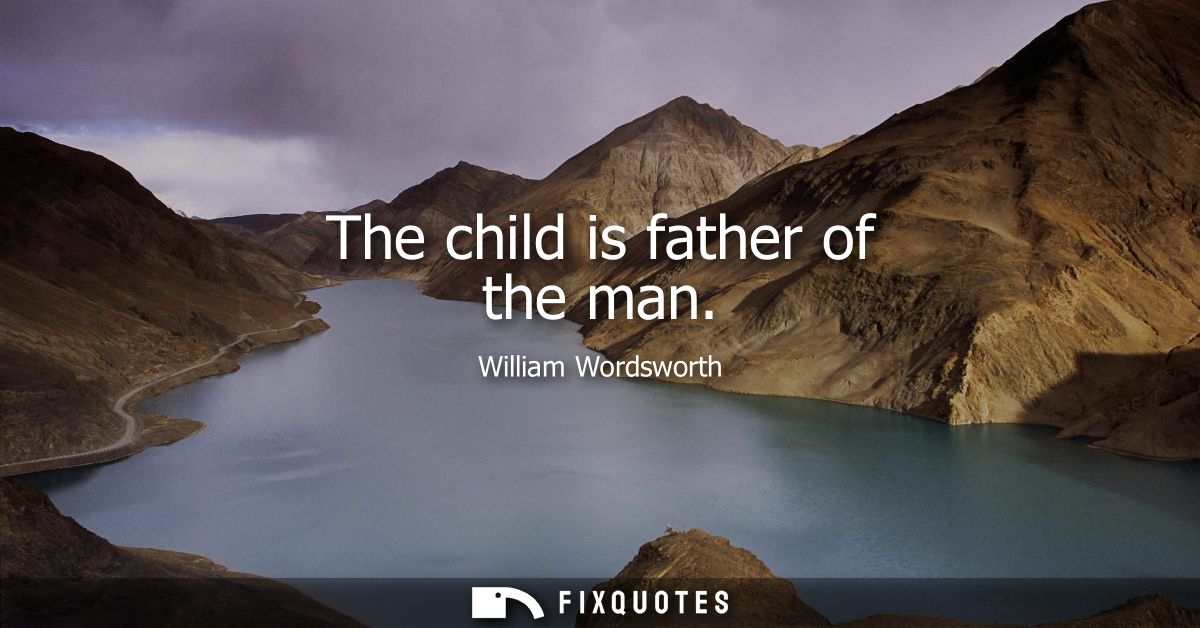
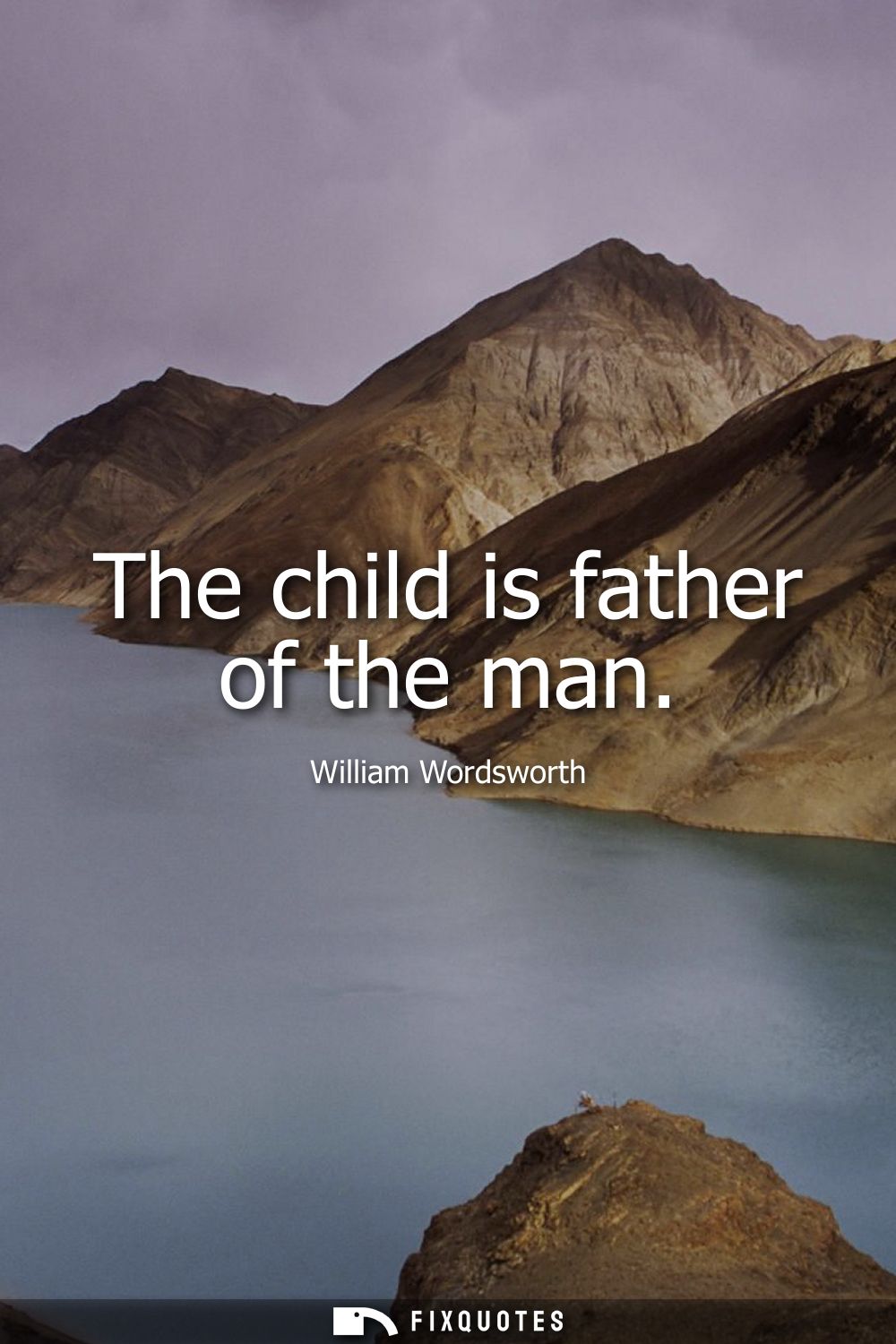
"The child is father of the man"
About this Quote
A Victorian-sounding line that still lands like a quiet threat: you never really outgrow yourself. Wordsworth flips the expected hierarchy - the father makes the child - to argue the opposite, that our earliest sensibilities author the adult we become. It works because it feels slightly wrong at first, then suddenly inevitable. The grammar performs the idea: "is", not "may be". Not metaphorical fluff, but an ontological claim.
In context, Wordsworth writes it in "My Heart Leaps Up" (1802), a short lyric that looks simple until you notice how hard it is pushing against modern adulthood. He’s reacting to a world in acceleration: early industrial Britain, urban drift, faith and social order under pressure. His Romantic project insists that childhood isn’t a prelude to real life; it’s the source code. The child’s capacity for awe, for unbought attention, becomes a moral standard that exposes adult compromise.
The subtext is less sentimental than it seems. Wordsworth isn’t just praising innocence; he’s policing continuity. The line is a dare: if your adult self can’t answer to what once made your "heart leap up", you’ve betrayed something essential. That’s why he follows with "Or let me die!" - melodramatic on the surface, but strategically absolute. He’s making a spiritual argument in domestic clothing: without a throughline from childhood wonder to adult ethics, the self becomes hollow, and progress starts to look like amnesia.
In context, Wordsworth writes it in "My Heart Leaps Up" (1802), a short lyric that looks simple until you notice how hard it is pushing against modern adulthood. He’s reacting to a world in acceleration: early industrial Britain, urban drift, faith and social order under pressure. His Romantic project insists that childhood isn’t a prelude to real life; it’s the source code. The child’s capacity for awe, for unbought attention, becomes a moral standard that exposes adult compromise.
The subtext is less sentimental than it seems. Wordsworth isn’t just praising innocence; he’s policing continuity. The line is a dare: if your adult self can’t answer to what once made your "heart leap up", you’ve betrayed something essential. That’s why he follows with "Or let me die!" - melodramatic on the surface, but strategically absolute. He’s making a spiritual argument in domestic clothing: without a throughline from childhood wonder to adult ethics, the self becomes hollow, and progress starts to look like amnesia.
Quote Details
| Topic | Youth |
|---|---|
| Source | William Wordsworth, "My Heart Leaps Up" (poem), written 1802, published in Poems, in Two Volumes (1807); contains the line "The Child is father of the Man". |
| Cite |
Citation Formats
APA Style (7th ed.)
Wordsworth, William. (2026, January 18). The child is father of the man. FixQuotes. https://fixquotes.com/quotes/the-child-is-father-of-the-man-11558/
Chicago Style
Wordsworth, William. "The child is father of the man." FixQuotes. January 18, 2026. https://fixquotes.com/quotes/the-child-is-father-of-the-man-11558/.
MLA Style (9th ed.)
"The child is father of the man." FixQuotes, 18 Jan. 2026, https://fixquotes.com/quotes/the-child-is-father-of-the-man-11558/. Accessed 27 Mar. 2026.
More Quotes by William
Add to List