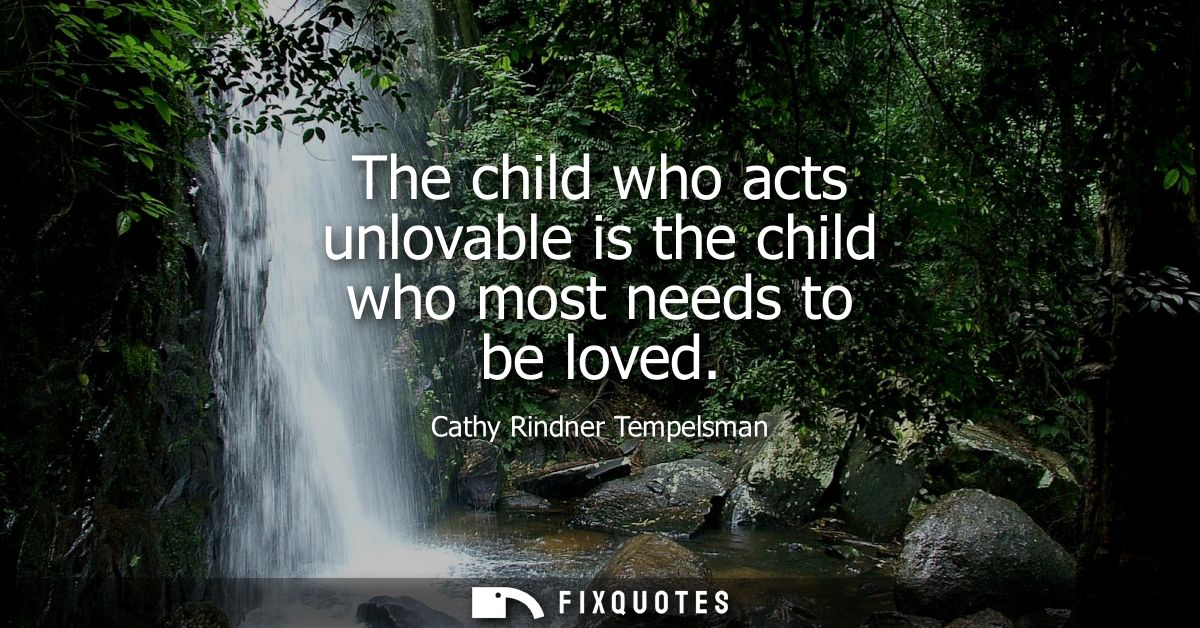
"The child who acts unlovable is the child who most needs to be loved"
About this Quote
The subtext is about power and safety. Children rarely have language for fear, grief, neglect, overstimulation, or shame; they have tactics. Acting out becomes a crude way to control the terms of closeness: “If I make you leave first, I won’t have to feel you leaving later.” The quote also quietly indicts adult convenience. “Unlovable” is a label that lets caregivers protect their own self-image: I’m not failing them; they’re impossible. Tempelsman punctures that excuse and relocates responsibility with the grown-up who has the broader emotional toolkit.
Contextually, this sits comfortably alongside modern attachment theory and trauma-informed parenting, where behavior is treated as communication and connection is framed as regulation. It’s not a free pass for harmful actions; it’s a warning about timing. Consequences without reassurance can confirm the child’s worst suspicion that love is conditional and fragile. What makes the line work is its reversal: the moment you feel least like loving is the moment love is most diagnostic, the stress test that reveals what kind of caregiver, school, or community you’re trying to be.
Quote Details
| Topic | Parenting |
|---|---|
| Source | Help us find the source |
| Cite |
Citation Formats
APA Style (7th ed.)
Tempelsman, Cathy Rindner. (2026, January 17). The child who acts unlovable is the child who most needs to be loved. FixQuotes. https://fixquotes.com/quotes/the-child-who-acts-unlovable-is-the-child-who-39445/
Chicago Style
Tempelsman, Cathy Rindner. "The child who acts unlovable is the child who most needs to be loved." FixQuotes. January 17, 2026. https://fixquotes.com/quotes/the-child-who-acts-unlovable-is-the-child-who-39445/.
MLA Style (9th ed.)
"The child who acts unlovable is the child who most needs to be loved." FixQuotes, 17 Jan. 2026, https://fixquotes.com/quotes/the-child-who-acts-unlovable-is-the-child-who-39445/. Accessed 14 Mar. 2026.