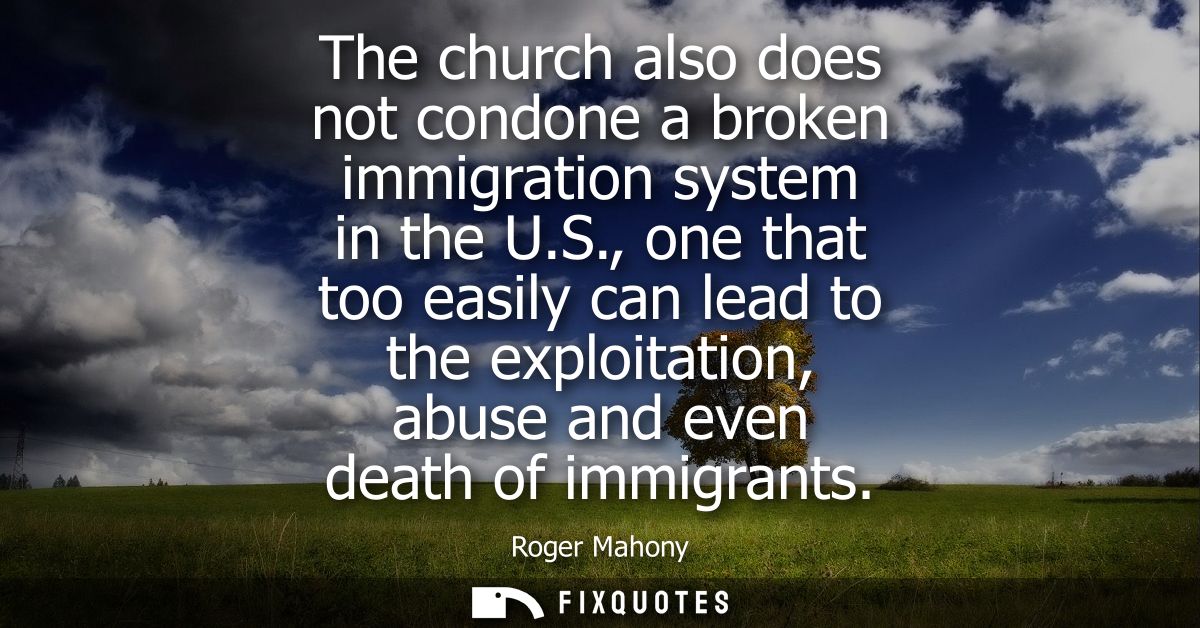
"The church also does not condone a broken immigration system in the U.S., one that too easily can lead to the exploitation, abuse and even death of immigrants"
About this Quote
Calling it “broken” is political shorthand, but Mahony immediately specifies the break: not bureaucratic inefficiency, but a structure “that too easily can lead” to exploitation and death. That phrase “too easily” is doing quiet heavy lifting. It suggests inevitability without claiming direct intent, indicting the system as a machine that reliably generates victims even when no single actor admits malice. “Exploitation, abuse and even death” escalates like a prosecutor’s charge sheet, widening the moral aperture from economic vulnerability to bodily peril.
The subtext is pastoral and strategic: immigrants aren’t merely lawbreakers or strangers; they are people pushed into predatory shadows by design. In the post-1990s climate of tightened borders and rising detention, the statement aligns Catholic social teaching with a distinctly American critique: when lawful pathways are scarce, illegality becomes a market, and human beings become inventory. Mahony isn’t asking for sentiment; he’s arguing that cruelty is a predictable output, and complicity begins at the level of public architecture.
Quote Details
| Topic | Human Rights |
|---|---|
| Source | Help us find the source |
| Cite |
Citation Formats
APA Style (7th ed.)
Mahony, Roger. (2026, January 15). The church also does not condone a broken immigration system in the U.S., one that too easily can lead to the exploitation, abuse and even death of immigrants. FixQuotes. https://fixquotes.com/quotes/the-church-also-does-not-condone-a-broken-145066/
Chicago Style
Mahony, Roger. "The church also does not condone a broken immigration system in the U.S., one that too easily can lead to the exploitation, abuse and even death of immigrants." FixQuotes. January 15, 2026. https://fixquotes.com/quotes/the-church-also-does-not-condone-a-broken-145066/.
MLA Style (9th ed.)
"The church also does not condone a broken immigration system in the U.S., one that too easily can lead to the exploitation, abuse and even death of immigrants." FixQuotes, 15 Jan. 2026, https://fixquotes.com/quotes/the-church-also-does-not-condone-a-broken-145066/. Accessed 30 Mar. 2026.