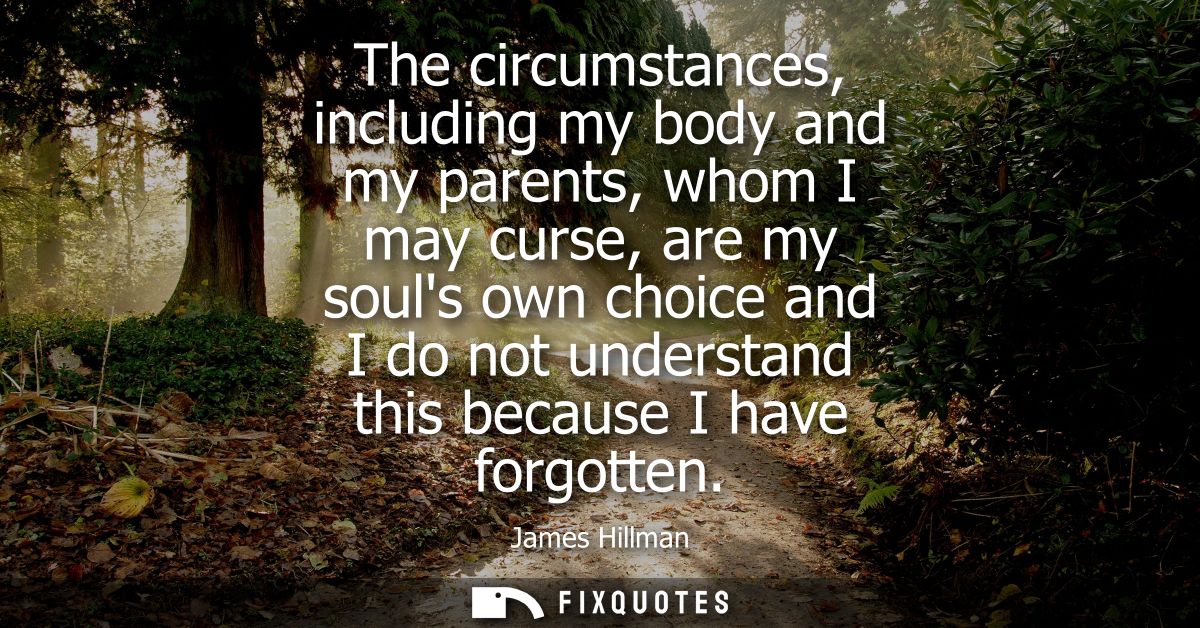
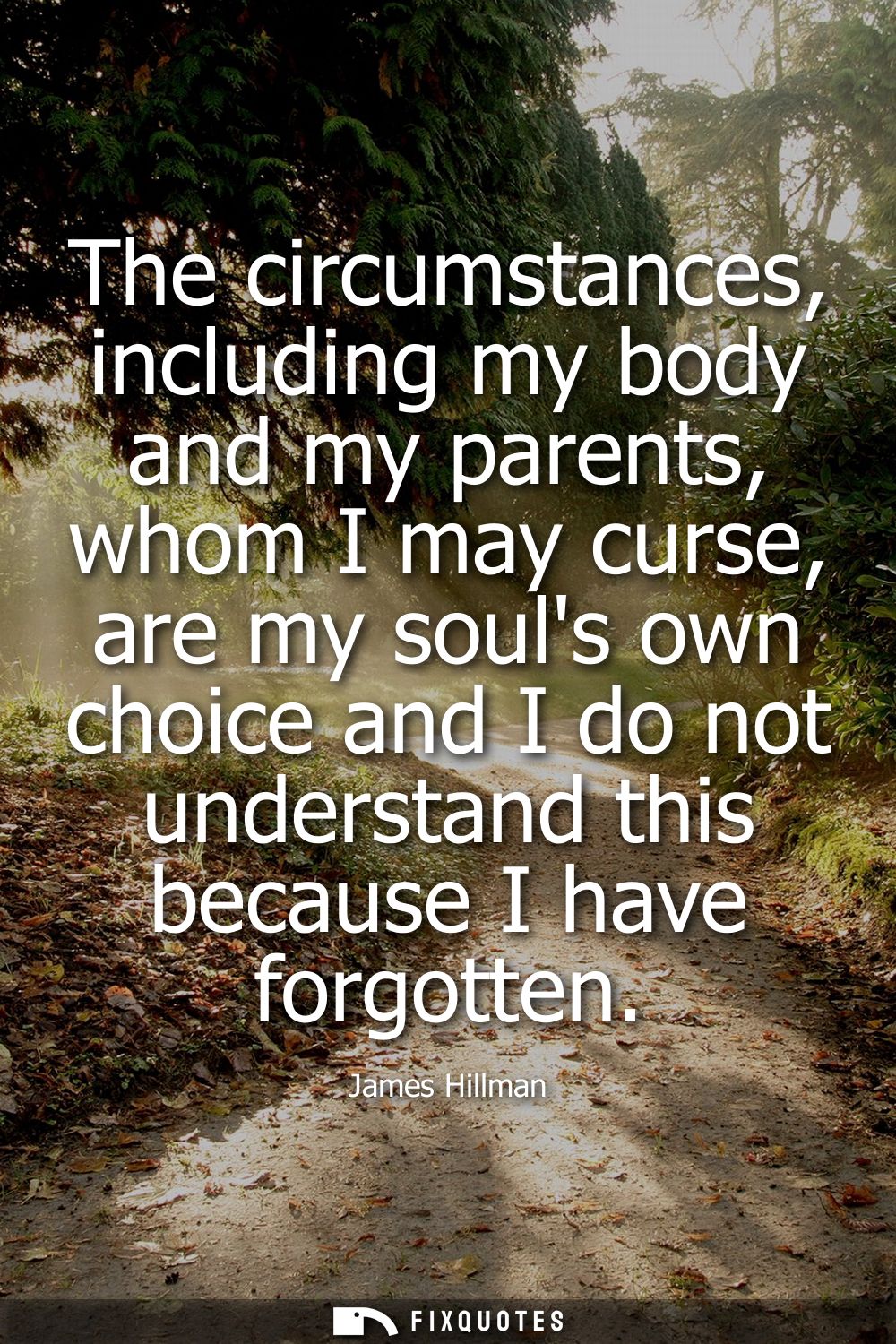
"The circumstances, including my body and my parents, whom I may curse, are my soul's own choice and I do not understand this because I have forgotten"
About this Quote
The subtext is archetypal, not moralistic. Hillman isn’t arguing that trauma is deserved or that suffering is good for you; he’s pushing a mythic frame where the soul has intention, even when the ego has only complaint. “I do not understand this because I have forgotten” is the sly twist: it turns metaphysics into psychology. Forgetting becomes a condition of being human, a built-in amnesia that makes life feel accidental and unfair. The line implies that recovery isn’t primarily about reconstructing the past like a case file; it’s about remembering a prior participation in the shape of one’s life.
Context matters. Hillman, a major voice in archetypal psychology, was famously suspicious of therapy-as-fix-it engineering. He wanted depth over cure, image over explanation, fate over lifestyle optimization. Read that way, the quote is less a doctrine than a tool: a way to make a stuck story move, by relocating agency to the level where meaning, not control, lives.
Quote Details
| Topic | Free Will & Fate |
|---|---|
| Source | Help us find the source |
| Cite |
Citation Formats
APA Style (7th ed.)
Hillman, James. (2026, January 17). The circumstances, including my body and my parents, whom I may curse, are my soul's own choice and I do not understand this because I have forgotten. FixQuotes. https://fixquotes.com/quotes/the-circumstances-including-my-body-and-my-70238/
Chicago Style
Hillman, James. "The circumstances, including my body and my parents, whom I may curse, are my soul's own choice and I do not understand this because I have forgotten." FixQuotes. January 17, 2026. https://fixquotes.com/quotes/the-circumstances-including-my-body-and-my-70238/.
MLA Style (9th ed.)
"The circumstances, including my body and my parents, whom I may curse, are my soul's own choice and I do not understand this because I have forgotten." FixQuotes, 17 Jan. 2026, https://fixquotes.com/quotes/the-circumstances-including-my-body-and-my-70238/. Accessed 13 Feb. 2026.