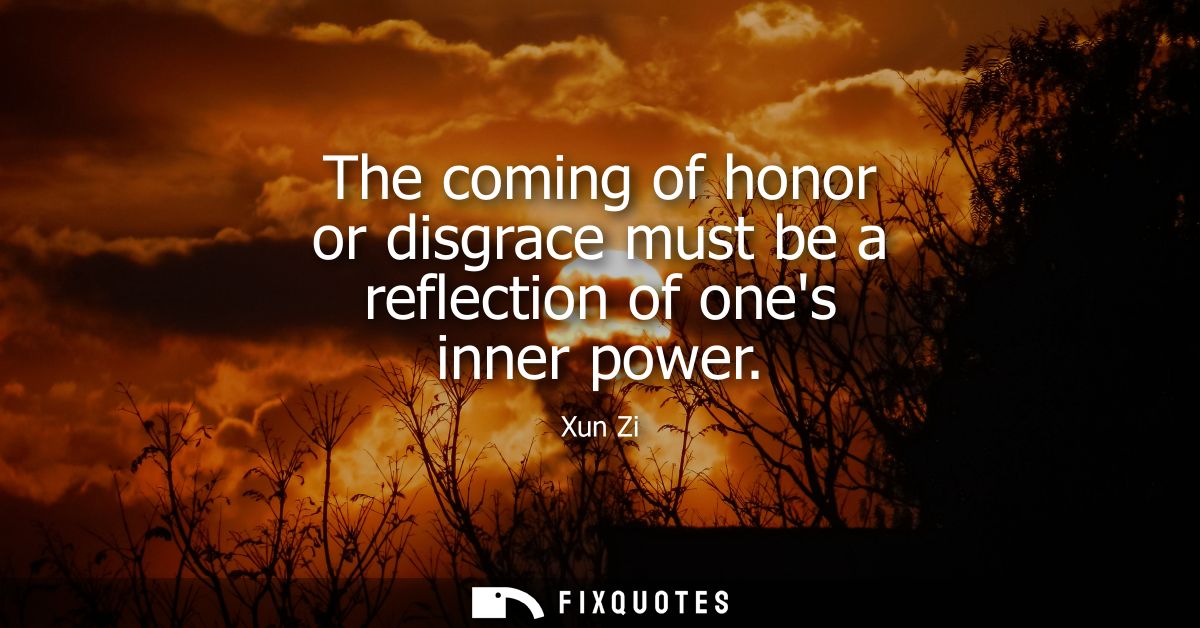
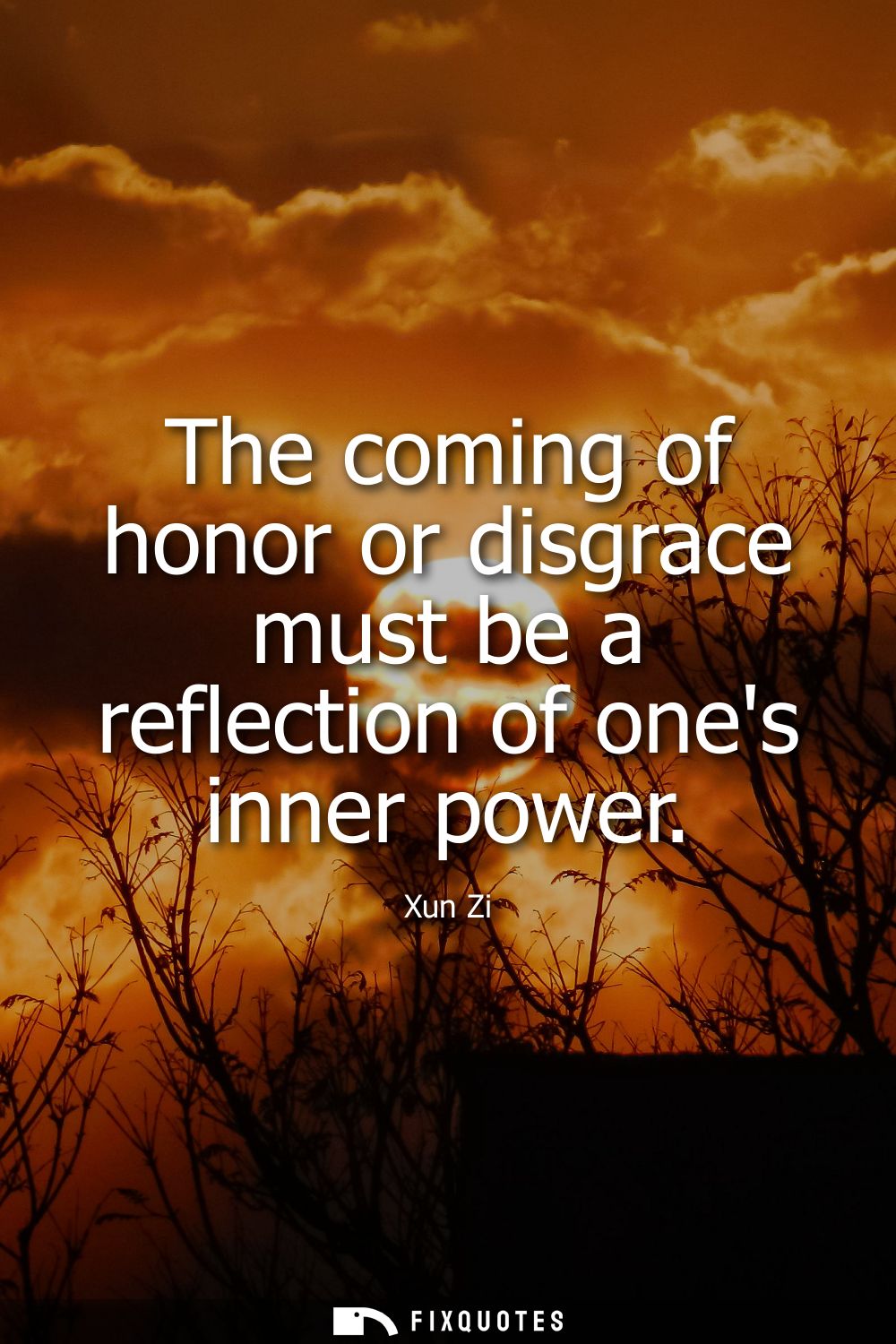
"The coming of honor or disgrace must be a reflection of one's inner power"
About this Quote
Honor and disgrace, for Xun Kuang (Xunzi), are not weather systems that roll in from the outside; they are pressure tests that reveal what kind of person you actually are. The line reads like a warning to anyone tempted to treat reputation as fate. If honor arrives, it should be earned because your inner discipline can sustain it. If disgrace arrives, it should be instructive because your inner discipline was insufficient to prevent it. Either way, the real drama is internal: character as the engine, public standing as the exhaust.
That framing makes sense coming from a philosopher famous for his unsentimental view of human nature. Xunzi argued that people are not naturally good; they require deliberate cultivation through ritual (li), learning, and conscious effort. In that context, “inner power” is not mystical charisma. It’s trained capacity: self-control, moral clarity, and the ability to act correctly even when incentives push the other way. Honor and disgrace become diagnostic tools, not random rewards and punishments.
The subtext also takes a swipe at status culture. If your sense of worth depends on applause, you’re already weak, because you’ve outsourced your center of gravity. Xunzi redirects ambition away from chasing recognition and toward building the inner machinery that can withstand recognition, resist corruption, and absorb humiliation without collapsing into resentment.
Politically, it’s a stabilizing ethic for an era of chaos: when courts are fickle and power is violent, the only durable sovereignty is self-sovereignty.
That framing makes sense coming from a philosopher famous for his unsentimental view of human nature. Xunzi argued that people are not naturally good; they require deliberate cultivation through ritual (li), learning, and conscious effort. In that context, “inner power” is not mystical charisma. It’s trained capacity: self-control, moral clarity, and the ability to act correctly even when incentives push the other way. Honor and disgrace become diagnostic tools, not random rewards and punishments.
The subtext also takes a swipe at status culture. If your sense of worth depends on applause, you’re already weak, because you’ve outsourced your center of gravity. Xunzi redirects ambition away from chasing recognition and toward building the inner machinery that can withstand recognition, resist corruption, and absorb humiliation without collapsing into resentment.
Politically, it’s a stabilizing ethic for an era of chaos: when courts are fickle and power is violent, the only durable sovereignty is self-sovereignty.
Quote Details
| Topic | Ethics & Morality |
|---|---|
| Source | Help us find the source |
| Cite | Cite this Quote |
Citation Formats
APA Style (7th ed.)
Kuang, Xun. (n.d.). The coming of honor or disgrace must be a reflection of one's inner power. FixQuotes. https://fixquotes.com/quotes/the-coming-of-honor-or-disgrace-must-be-a-16569/
Chicago Style
Kuang, Xun. "The coming of honor or disgrace must be a reflection of one's inner power." FixQuotes. Accessed February 3, 2026. https://fixquotes.com/quotes/the-coming-of-honor-or-disgrace-must-be-a-16569/.
MLA Style (9th ed.)
"The coming of honor or disgrace must be a reflection of one's inner power." FixQuotes, https://fixquotes.com/quotes/the-coming-of-honor-or-disgrace-must-be-a-16569/. Accessed 3 Feb. 2026.
More Quotes by Xun
Add to List