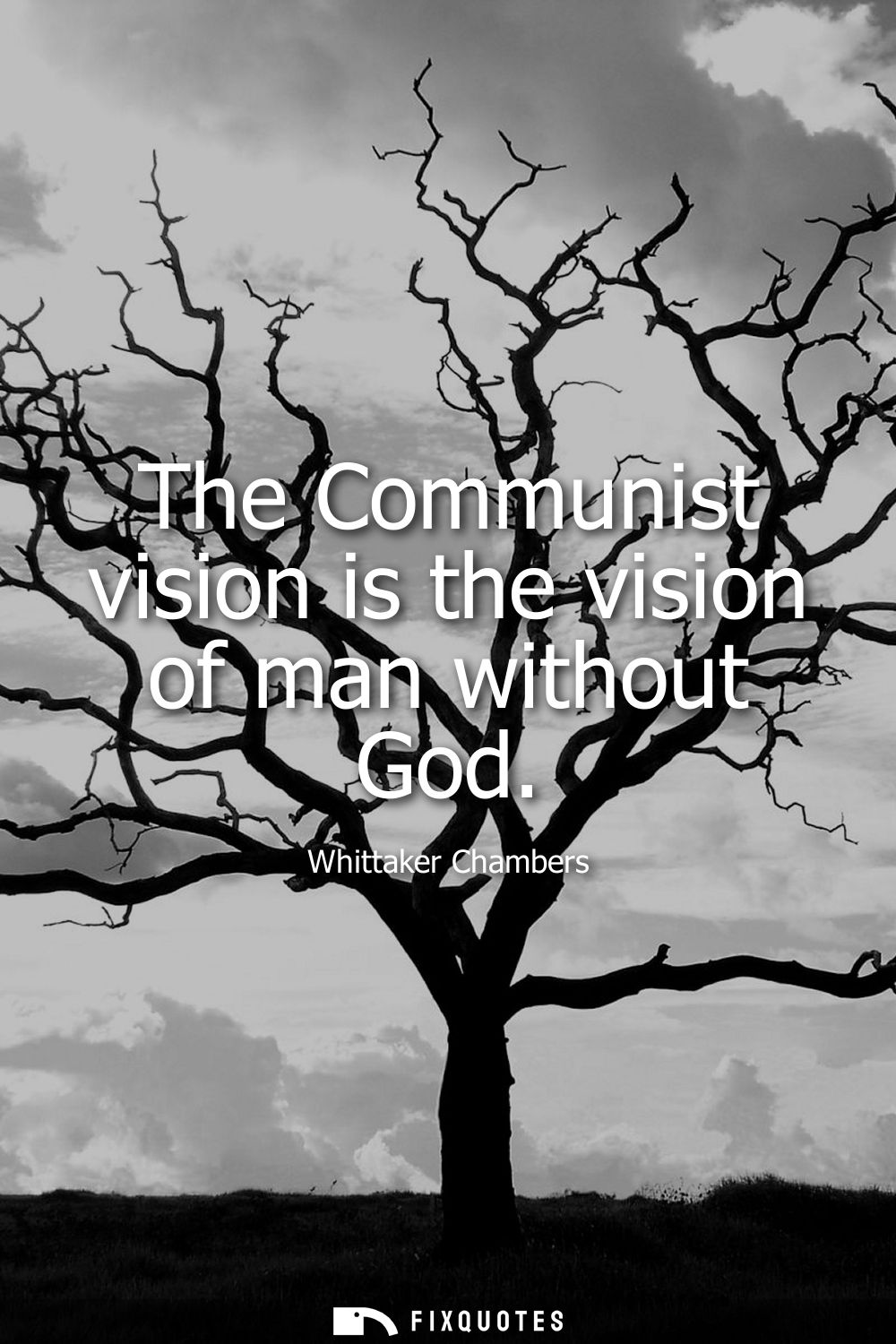
"The Communist vision is the vision of man without God"
About this Quote
Chambers doesn’t dress this up as policy critique; he frames communism as a spiritual rival religion, a total claim on the human soul. “Vision” is doing heavy work here: not an economic program, not a party line, but an image of what a human being is allowed to be. Strip away God and you don’t just remove a doctrine, Chambers implies; you remove the ceiling on power. The state, the Party, History itself rushes in to occupy the vacant altar.
The sentence lands because it’s both accusation and confession. Chambers wasn’t a lifelong Cold War scold; he was an ex-Communist who broke with the movement and testified against Alger Hiss. That biography gives the line its particular bite: he’s writing as someone who has felt communism’s moral seriousness from the inside, the way it offers purpose, fraternity, even purity. Calling it “man without God” translates that intensity into a warning: communism’s appeal is inseparable from its attempt to provide salvation in secular terms.
Subtextually, the quote also narrows the battlefield. If the contest is spiritual, compromise becomes betrayal. Chambers is making it easier to see liberalism as insufficiently armed: if the enemy is a comprehensive “vision,” then technocratic fixes and procedural freedoms look thin. That’s why the line works as rhetoric in the early Cold War: it recasts geopolitical struggle as an existential one, where the stakes aren’t wages or ownership but what counts as a human conscience.
The sentence lands because it’s both accusation and confession. Chambers wasn’t a lifelong Cold War scold; he was an ex-Communist who broke with the movement and testified against Alger Hiss. That biography gives the line its particular bite: he’s writing as someone who has felt communism’s moral seriousness from the inside, the way it offers purpose, fraternity, even purity. Calling it “man without God” translates that intensity into a warning: communism’s appeal is inseparable from its attempt to provide salvation in secular terms.
Subtextually, the quote also narrows the battlefield. If the contest is spiritual, compromise becomes betrayal. Chambers is making it easier to see liberalism as insufficiently armed: if the enemy is a comprehensive “vision,” then technocratic fixes and procedural freedoms look thin. That’s why the line works as rhetoric in the early Cold War: it recasts geopolitical struggle as an existential one, where the stakes aren’t wages or ownership but what counts as a human conscience.
Quote Details
| Topic | God |
|---|---|
| Source | Verified source: Witness (Whittaker Chambers, 1952)
Evidence: The Communist vision is the vision of Man without God. (Foreword in the Form of a Letter to My Children, p. 10 in the scanned excerpt; p. 9 in many book citations). The quote is verifiably in Whittaker Chambers's own memoir Witness (Random House, 1952), in the opening section titled "Foreword in the Form of a Letter to My Children." A contemporary TIME notice from early 1952 shows this passage was already appearing in the Saturday Evening Post serialization of Witness before the book's full publication, under the Post's series title "I Was the Witness." So the earliest presently verified appearance is in that pre-publication serialization in the Saturday Evening Post in February 1952, with the book Witness published later in 1952. The exact magazine installment/page would require issue-by-issue archive verification, but the primary source is unquestionably Chambers's own text in Witness. Other candidates (1) Marx, the Hammer and Sickle, and the Number of the Beast (Nicholas Brand, 2017) compilation95.0% Nicholas Brand. Whittaker Chambers Witness, Whittaker Chambers – Letter to My Grandchildren: Communism restores man t... |
| Cite |
Citation Formats
APA Style (7th ed.)
Chambers, Whittaker. (2026, March 13). The Communist vision is the vision of man without God. FixQuotes. https://fixquotes.com/quotes/the-communist-vision-is-the-vision-of-man-without-131220/
Chicago Style
Chambers, Whittaker. "The Communist vision is the vision of man without God." FixQuotes. March 13, 2026. https://fixquotes.com/quotes/the-communist-vision-is-the-vision-of-man-without-131220/.
MLA Style (9th ed.)
"The Communist vision is the vision of man without God." FixQuotes, 13 Mar. 2026, https://fixquotes.com/quotes/the-communist-vision-is-the-vision-of-man-without-131220/. Accessed 28 Mar. 2026.
More Quotes by Whittaker
Add to List