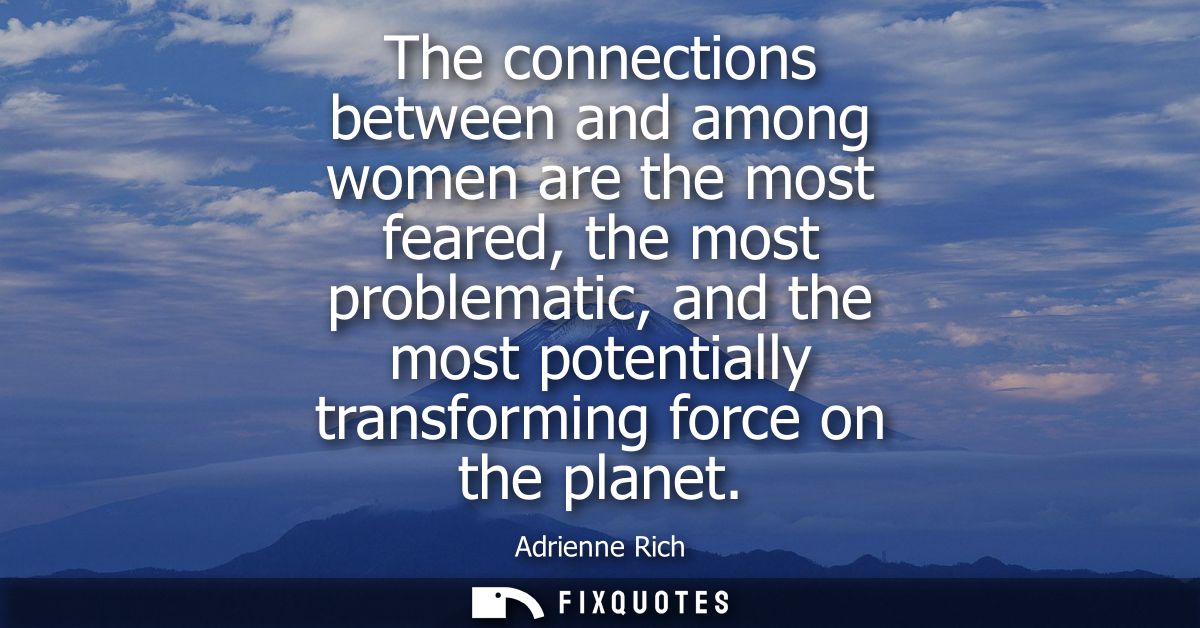
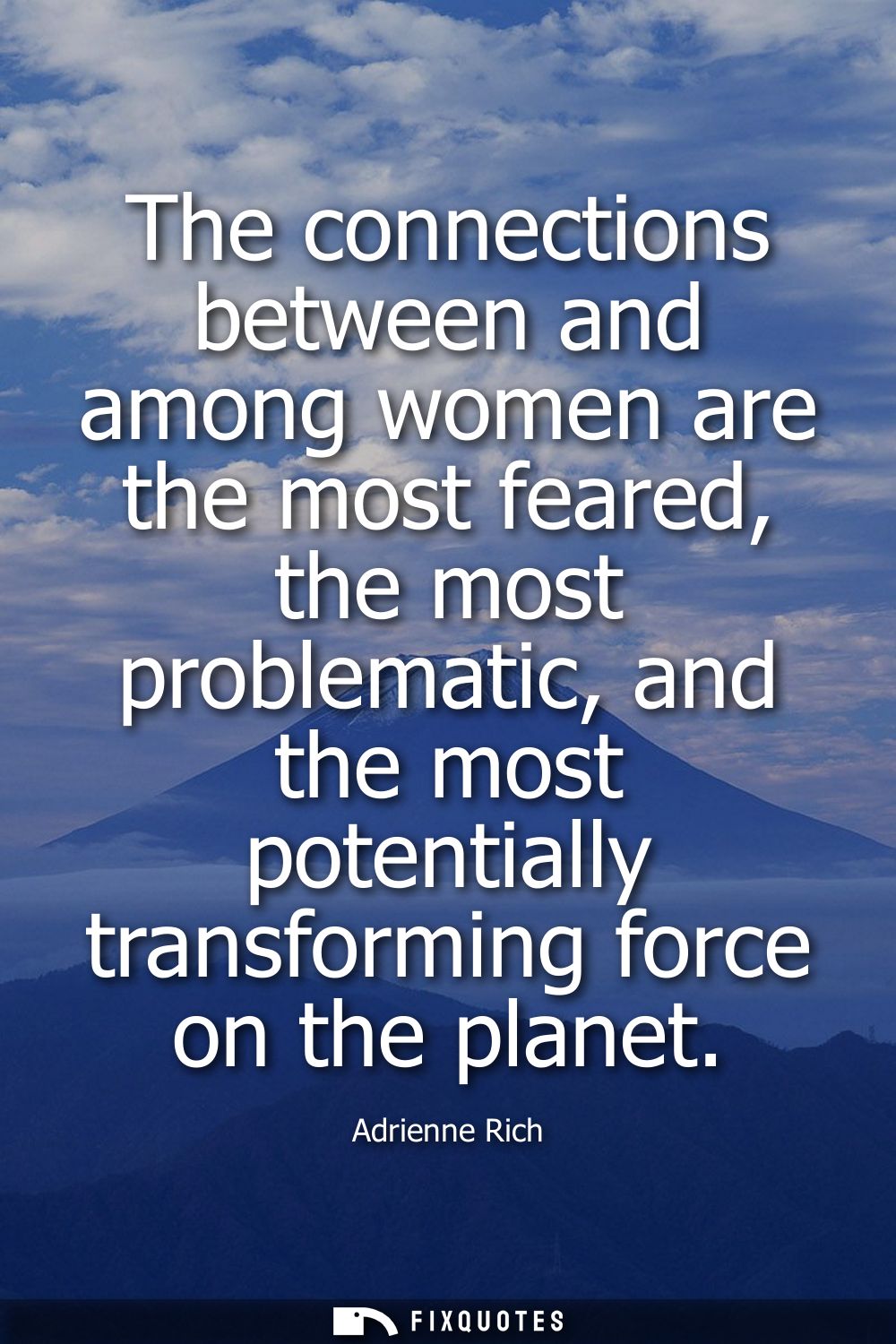
"The connections between and among women are the most feared, the most problematic, and the most potentially transforming force on the planet"
About this Quote
Rich is writing from a late-20th-century feminist moment shaped by second-wave organizing, lesbian feminism, and a growing critique of how patriarchy survives by keeping women separated: by competition for male approval, by racial and class divisions, by the idea that friendship is secondary to romance, by the demand that women be endlessly available but never allied. Calling these connections “problematic” is a pointed admission of friction. Solidarity isn’t a brand; it’s a practice with real conflicts, uneven power inside the group, and hard conversations about whose womanhood gets centered. Rich refuses the comforting fantasy that sisterhood is automatic.
“Potentially transforming” is the hinge: connection becomes transformation precisely because it moves women from private endurance to shared analysis. When experiences are compared, patterns emerge; when patterns are named, institutions become visible; when institutions are visible, they can be challenged. The subtext is almost a dare: if the world is built to keep women apart, then intimacy, coalition, and collective speech are not just relationships. They’re insurgent infrastructure.
Quote Details
| Topic | Equality |
|---|---|
| Source | Verified source: On Lies, Secrets, and Silence: Selected Prose 1966-1978 (Adrienne Rich, 1979)ISBN: 9780393009422
Evidence: As a lesbian/feminist, my nerves and my flesh, as well as my intellect, tell me that the connections between and among women are the most feared, the most problematic, and the most potentially transforming force on the planet. (Page 279 (essay: "Disloyal to Civilization: Feminism, Racism, Gynephobia")). The quote appears as a sentence within Adrienne Rich’s essay "Disloyal to Civilization: Feminism, Racism, Gynephobia," which is included in her 1979 Norton collection On Lies, Secrets, and Silence: Selected Prose 1966–1978. Multiple secondary references point to this essay and specifically to p. 279, but I did not retrieve a scanned page image from the book itself in this search session; confirm page number against your specific edition/printing. Other candidates (1) The Grumpy Guide To Radical Feminism (Andreia Nobre, 2020) compilation95.9% ... The connections between and among women are the most feared , the most problematic , and the most potentially tra... |
| Cite |
Citation Formats
APA Style (7th ed.)
Rich, Adrienne. (2026, February 9). The connections between and among women are the most feared, the most problematic, and the most potentially transforming force on the planet. FixQuotes. https://fixquotes.com/quotes/the-connections-between-and-among-women-are-the-36626/
Chicago Style
Rich, Adrienne. "The connections between and among women are the most feared, the most problematic, and the most potentially transforming force on the planet." FixQuotes. February 9, 2026. https://fixquotes.com/quotes/the-connections-between-and-among-women-are-the-36626/.
MLA Style (9th ed.)
"The connections between and among women are the most feared, the most problematic, and the most potentially transforming force on the planet." FixQuotes, 9 Feb. 2026, https://fixquotes.com/quotes/the-connections-between-and-among-women-are-the-36626/. Accessed 1 Apr. 2026.