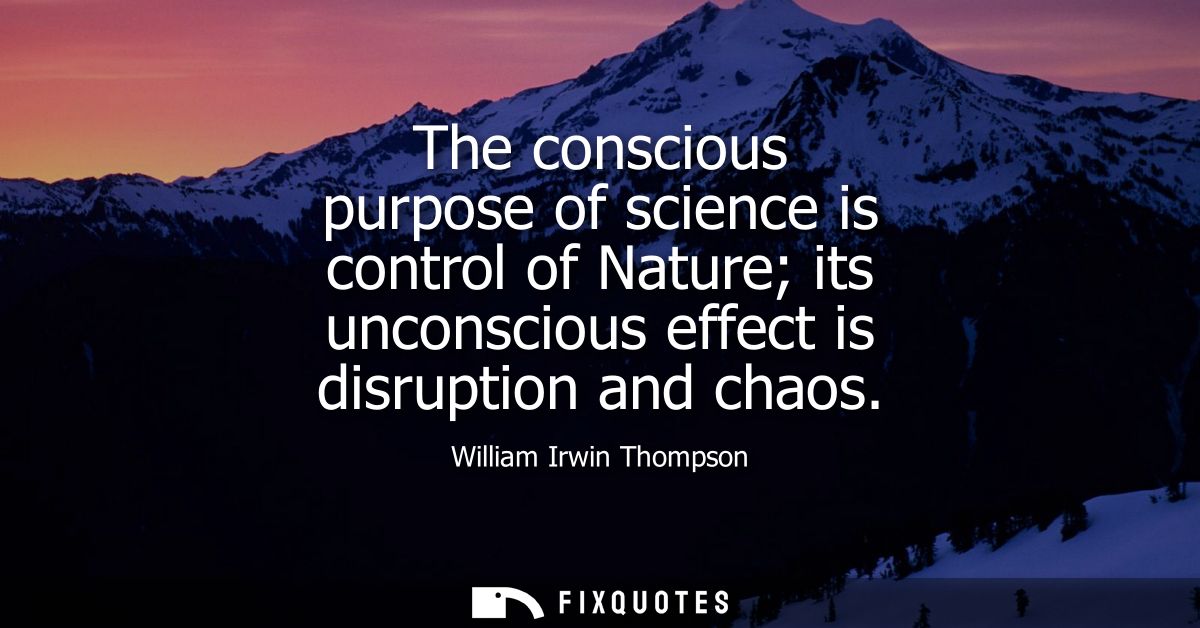
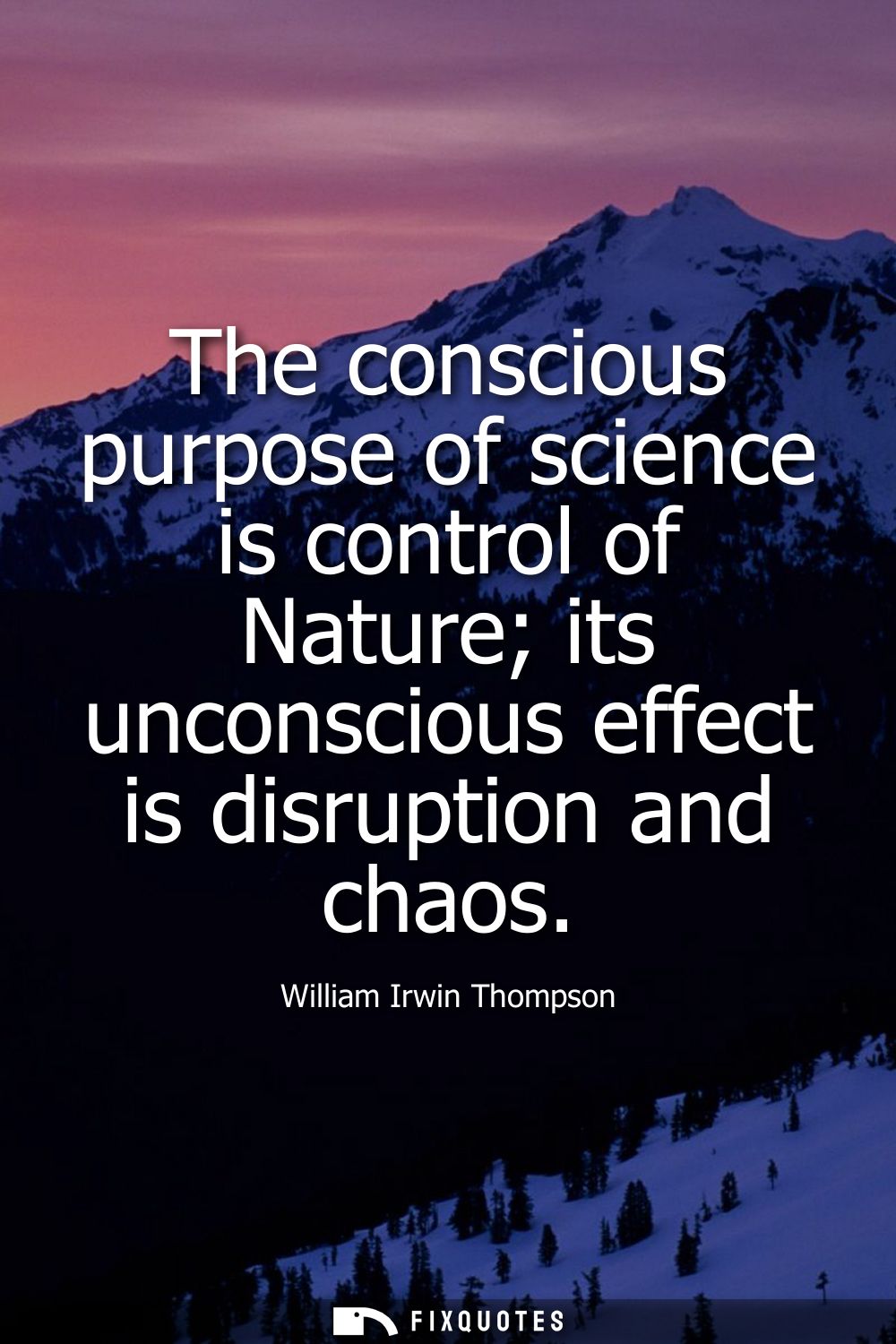
"The conscious purpose of science is control of Nature; its unconscious effect is disruption and chaos"
About this Quote
What makes the line work is its psychological framing. "Conscious" versus "unconscious" isn’t just rhetoric; it drags science out of the lab and into the realm of motives, blind spots, and unintended consequences. It implies a collective id: technologies and systems built to stabilize life end up destabilizing the world that holds them. The promise of control becomes the engine of volatility.
Thompson writes as a philosopher shaped by late-20th-century disillusionment: nuclear escalation, ecological degradation, and the dawning realization that complex systems don’t respond like obedient machines. Control, in this context, is less a neutral aim than an ideology: a way of relating to Nature as something external, inert, and governable. Treat the planet like a set of levers and you get feedback loops instead of obedience: pesticides breeding resistance, energy abundance driving climate change, connectivity amplifying social contagion.
The subtext isn’t anti-science so much as anti-naivete. It’s a warning that method can be rigorous while effects remain wild, because science is embedded in power, markets, and appetites. The chaos isn’t a glitch; it’s the shadow of the control fantasy.
Quote Details
| Topic | Science |
|---|---|
| Source | Verified source: Nine Theses for a Gaia Politique (William Irwin Thompson, 1986)
Evidence: The conscious purpose of science is control of Nature; its unconscious effect is disruption and chaos. (Page 58; thesis 7). The strongest primary-source trail points to William Irwin Thompson's article "Nine Theses for a Gaia Politique," published in Autumn 1986 in In Context / IC#14. A secondary source citing the article gives the exact bibliographic location as page 58, and another source reproducing the text places the line in thesis 7. A later scholarly article in Futures (2002) explicitly says the statement is contained in Thompson's "theses for a Gaia Politique." I did not find evidence of an earlier book, speech, or interview containing this wording before the 1986 article. One source labels the periodical issue as "Sustainable Habitat (IC#14)," while other references call it In Context, suggesting issue/subtitle variation rather than a different work. Other candidates (1) My Inaugural Address at the Great White Throne Judgment o... (Alvin Miller, 2011) compilation95.0% ... The conscious purpose of science is control of Nature; its unconscious effect is disruption and chaos.' William I... |
| Cite |
Citation Formats
APA Style (7th ed.)
Thompson, William Irwin. (2026, March 10). The conscious purpose of science is control of Nature; its unconscious effect is disruption and chaos. FixQuotes. https://fixquotes.com/quotes/the-conscious-purpose-of-science-is-control-of-148315/
Chicago Style
Thompson, William Irwin. "The conscious purpose of science is control of Nature; its unconscious effect is disruption and chaos." FixQuotes. March 10, 2026. https://fixquotes.com/quotes/the-conscious-purpose-of-science-is-control-of-148315/.
MLA Style (9th ed.)
"The conscious purpose of science is control of Nature; its unconscious effect is disruption and chaos." FixQuotes, 10 Mar. 2026, https://fixquotes.com/quotes/the-conscious-purpose-of-science-is-control-of-148315/. Accessed 23 Mar. 2026.