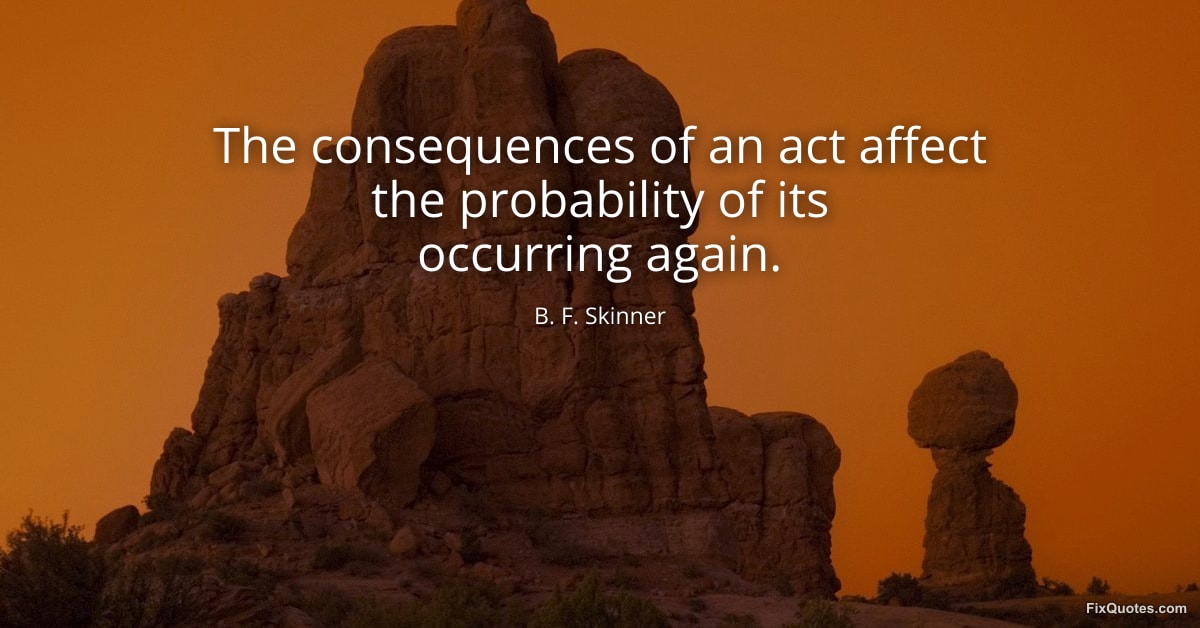
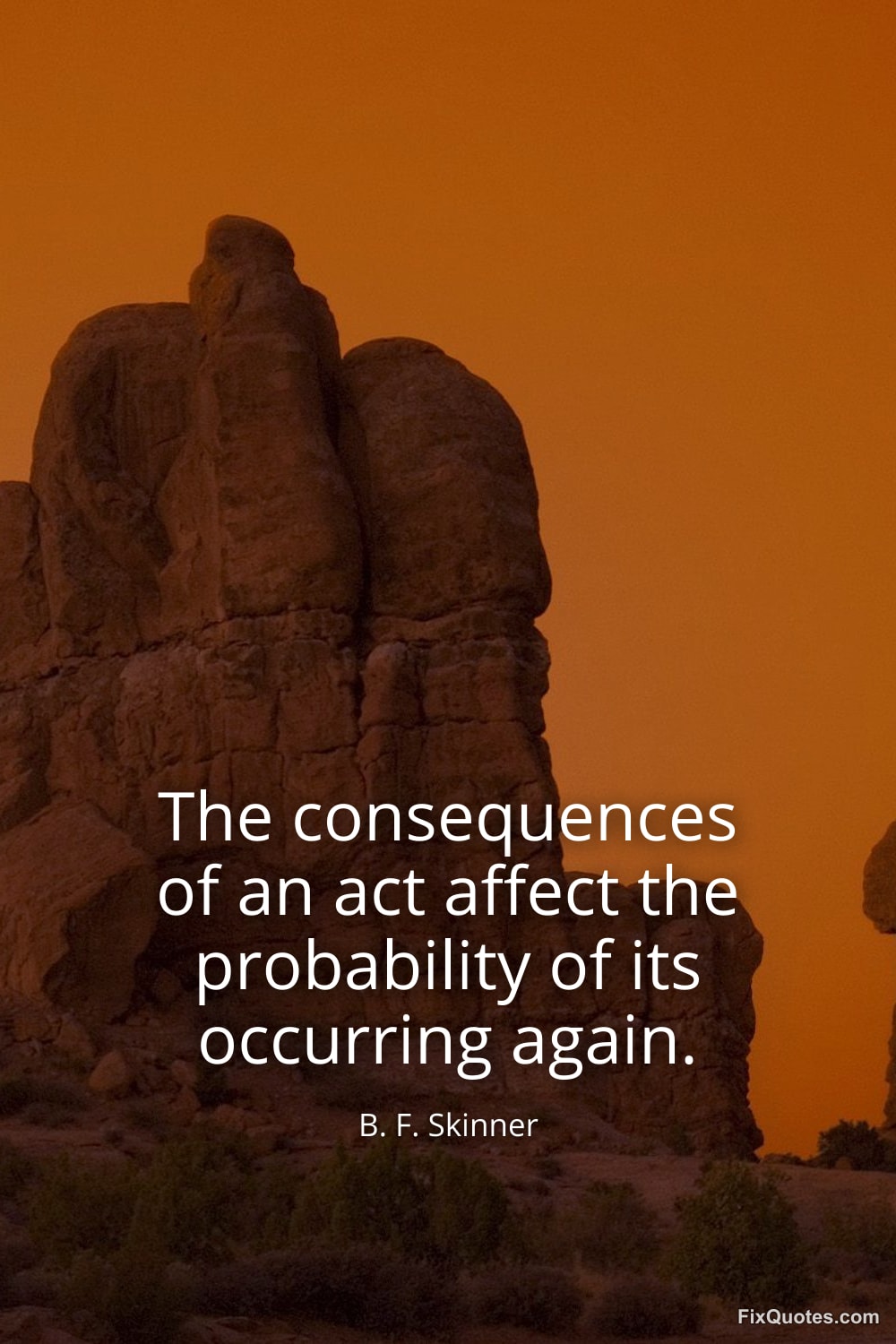
"The consequences of an act affect the probability of its occurring again"
About this Quote
Skinner’s line has the cool bluntness of a lab memo, and that’s the point: it strips “choice” down to a feedback loop. In one sentence, he reframes human behavior from something we author to something that gets engineered by its aftermath. The intent isn’t just descriptive; it’s polemical. Skinner is arguing that if you want to understand (or change) what people do, you should stop interrogating their inner narratives and start tracking the contingencies that follow their actions: reward, punishment, attention, relief.
The subtext is a quiet demotion of moral drama. When consequences shape probability, “bad habits,” “virtue,” even “willpower” become less like character traits and more like predictable outputs of reinforcement schedules. That’s why the sentence reads almost bureaucratic: “probability” belongs to statistics, not confession. It’s also why critics hear something chilling in it. If behavior is primarily consequence-driven, then the levers of power aren’t sermons or laws on paper but the day-to-day systems that deliver consequences: workplaces, schools, policing, platforms. Change the consequence structure and you change the person who emerges from it.
Context matters: Skinner is speaking from mid-century behaviorism, a movement that wanted psychology to be as measurable as physics. Introspection was treated as squishy; observable behavior was the data. The line condenses operant conditioning into a portable thesis, one that still haunts contemporary life. Social media’s likes, read receipts, algorithmic boosts, even the intermittent rewards of notifications are Skinner’s insight turned into infrastructure: consequence as product design, probability as profit.
The subtext is a quiet demotion of moral drama. When consequences shape probability, “bad habits,” “virtue,” even “willpower” become less like character traits and more like predictable outputs of reinforcement schedules. That’s why the sentence reads almost bureaucratic: “probability” belongs to statistics, not confession. It’s also why critics hear something chilling in it. If behavior is primarily consequence-driven, then the levers of power aren’t sermons or laws on paper but the day-to-day systems that deliver consequences: workplaces, schools, policing, platforms. Change the consequence structure and you change the person who emerges from it.
Context matters: Skinner is speaking from mid-century behaviorism, a movement that wanted psychology to be as measurable as physics. Introspection was treated as squishy; observable behavior was the data. The line condenses operant conditioning into a portable thesis, one that still haunts contemporary life. Social media’s likes, read receipts, algorithmic boosts, even the intermittent rewards of notifications are Skinner’s insight turned into infrastructure: consequence as product design, probability as profit.
Quote Details
| Topic | Learning |
|---|---|
| Source | Help us find the source |
More Quotes by F. Skinner
Add to List