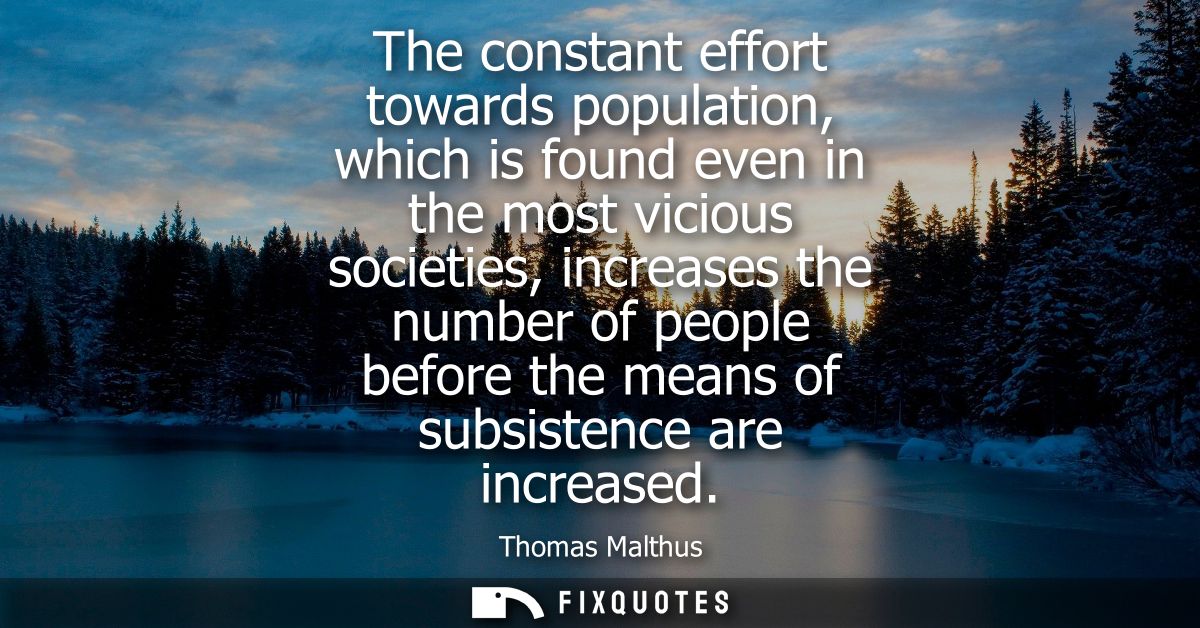
"The constant effort towards population, which is found even in the most vicious societies, increases the number of people before the means of subsistence are increased"
About this Quote
The sentence is built to feel inevitable. "Before the means of subsistence are increased" is the knife twist: population pressure is portrayed as structurally ahead of food supply, wages, and resources. In late-18th and early-19th century Britain, that was not an abstract fear. Urbanization, volatile grain prices, and anxiety over the Poor Laws created a political market for arguments that redefined poverty as a predictable consequence of arithmetic rather than exploitation. Malthus supplies exactly that: scarcity as natural law.
The subtext is disciplinary. If population growth outpaces subsistence, then charity risks becoming a trap, not a remedy - relieving pain today while allegedly encouraging more births tomorrow. "Vicious societies" doubles as a rhetorical shield: he can sound unsentimental while pretending he is merely describing how humans behave at their worst. The intent is to move responsibility downward, from state and landowners to families, turning hunger into a cautionary tale about limits rather than a scandal about distribution.
Quote Details
| Topic | Reason & Logic |
|---|---|
| Source | Thomas Malthus, An Essay on the Principle of Population (1798), Chapter I — passage asserting population tends to increase before means of subsistence. |
| Cite |
Citation Formats
APA Style (7th ed.)
Malthus, Thomas. (2026, January 18). The constant effort towards population, which is found even in the most vicious societies, increases the number of people before the means of subsistence are increased. FixQuotes. https://fixquotes.com/quotes/the-constant-effort-towards-population-which-is-3025/
Chicago Style
Malthus, Thomas. "The constant effort towards population, which is found even in the most vicious societies, increases the number of people before the means of subsistence are increased." FixQuotes. January 18, 2026. https://fixquotes.com/quotes/the-constant-effort-towards-population-which-is-3025/.
MLA Style (9th ed.)
"The constant effort towards population, which is found even in the most vicious societies, increases the number of people before the means of subsistence are increased." FixQuotes, 18 Jan. 2026, https://fixquotes.com/quotes/the-constant-effort-towards-population-which-is-3025/. Accessed 27 Mar. 2026.