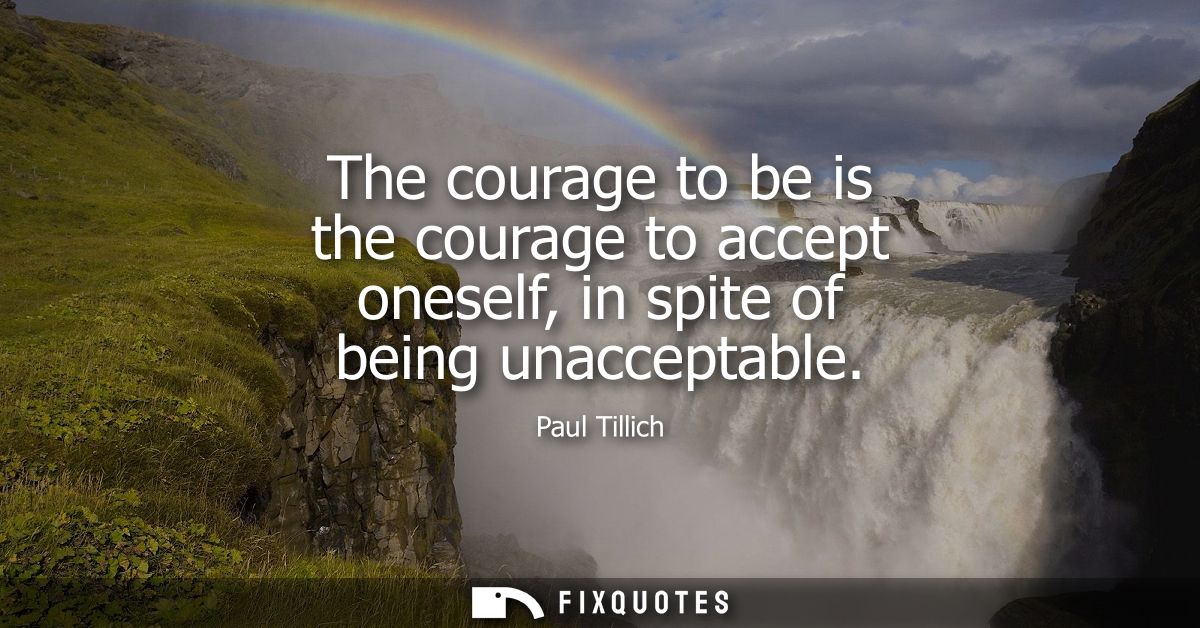
"The courage to be is the courage to accept oneself, in spite of being unacceptable"
About this Quote
The line lands because it reverses the usual order of self-acceptance. We like acceptance as a reward for improvement: become acceptable, then you can belong. Tillich, writing in the existentialist shadow of two world wars and the collapse of old certainties, treats anxiety as the baseline human condition. In that landscape, “accept oneself” isn’t indulgence; it’s resistance against despair. The subtext is theological, but it reads psychologically: you cannot outwork the fear that you’re fundamentally flawed, finite, complicit, or doomed. You can only face it.
“Unacceptable” is doing heavy lifting here. It hints at guilt, shame, and the social tribunal inside our heads. Tillich’s Christian inflection suggests that acceptance ultimately comes from beyond the self (grace, not self-esteem), but he frames it as courage because it still requires agency. You have to consent to being seen - by God, by others, by yourself - without guarantees. The intent is bracing: real existence isn’t earned; it’s claimed, trembling, against the evidence.
Quote Details
| Topic | Self-Love |
|---|---|
| Source | Help us find the source |
| Cite |
Citation Formats
APA Style (7th ed.)
Tillich, Paul. (2026, January 18). The courage to be is the courage to accept oneself, in spite of being unacceptable. FixQuotes. https://fixquotes.com/quotes/the-courage-to-be-is-the-courage-to-accept-11368/
Chicago Style
Tillich, Paul. "The courage to be is the courage to accept oneself, in spite of being unacceptable." FixQuotes. January 18, 2026. https://fixquotes.com/quotes/the-courage-to-be-is-the-courage-to-accept-11368/.
MLA Style (9th ed.)
"The courage to be is the courage to accept oneself, in spite of being unacceptable." FixQuotes, 18 Jan. 2026, https://fixquotes.com/quotes/the-courage-to-be-is-the-courage-to-accept-11368/. Accessed 12 Feb. 2026.