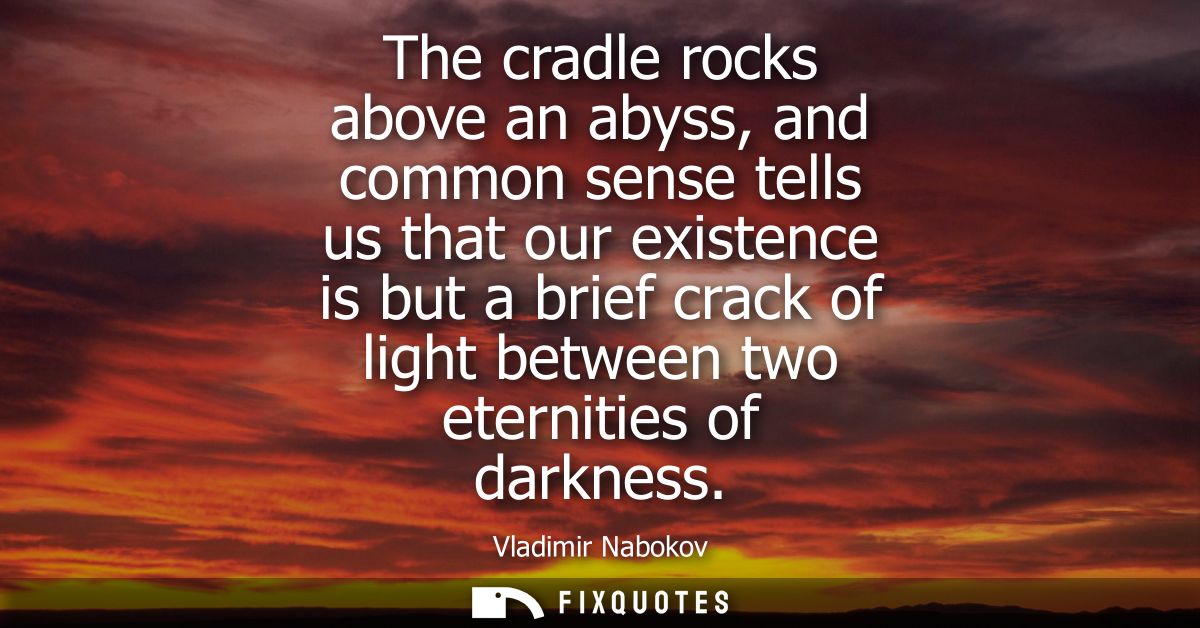
"The cradle rocks above an abyss, and common sense tells us that our existence is but a brief crack of light between two eternities of darkness"
About this Quote
Then comes the knife twist: “common sense.” Nabokov, a novelist allergic to dull consensus, uses the phrase with a faintly sardonic chill. Common sense is supposed to keep us oriented; here it’s the tool that informs us we’re temporary and mostly surrounded by nothing. Calling this view “common” makes the thought feel less like a dramatic poet’s lament and more like an everyday verdict we spend our lives politely ignoring.
The “brief crack of light” is doing multiple jobs at once. It’s a visual slit in darkness, but also the sound of a fracture: existence as a breakage, not an arrival. Between “two eternities of darkness,” life becomes an interruption, not a destination. That framing dovetails with Nabokov’s larger preoccupations: the exquisite intensity of perception under threat, the insistence on attention as an ethic. If time is a narrow seam, you don’t waste it on abstractions; you embroider it with detail.
Context matters: Nabokov wrote as an exile, a man who watched histories swallow people whole. The abyss isn’t only cosmic; it’s political and personal, the void that opens when the old world collapses. The line’s subtext isn’t pure nihilism. It’s pressure: if light is scarce, it’s worth seeing precisely.
Quote Details
| Topic | Meaning of Life |
|---|---|
| Source | Help us find the source |
| Cite |
Citation Formats
APA Style (7th ed.)
Nabokov, Vladimir. (2026, January 15). The cradle rocks above an abyss, and common sense tells us that our existence is but a brief crack of light between two eternities of darkness. FixQuotes. https://fixquotes.com/quotes/the-cradle-rocks-above-an-abyss-and-common-sense-34896/
Chicago Style
Nabokov, Vladimir. "The cradle rocks above an abyss, and common sense tells us that our existence is but a brief crack of light between two eternities of darkness." FixQuotes. January 15, 2026. https://fixquotes.com/quotes/the-cradle-rocks-above-an-abyss-and-common-sense-34896/.
MLA Style (9th ed.)
"The cradle rocks above an abyss, and common sense tells us that our existence is but a brief crack of light between two eternities of darkness." FixQuotes, 15 Jan. 2026, https://fixquotes.com/quotes/the-cradle-rocks-above-an-abyss-and-common-sense-34896/. Accessed 30 Mar. 2026.