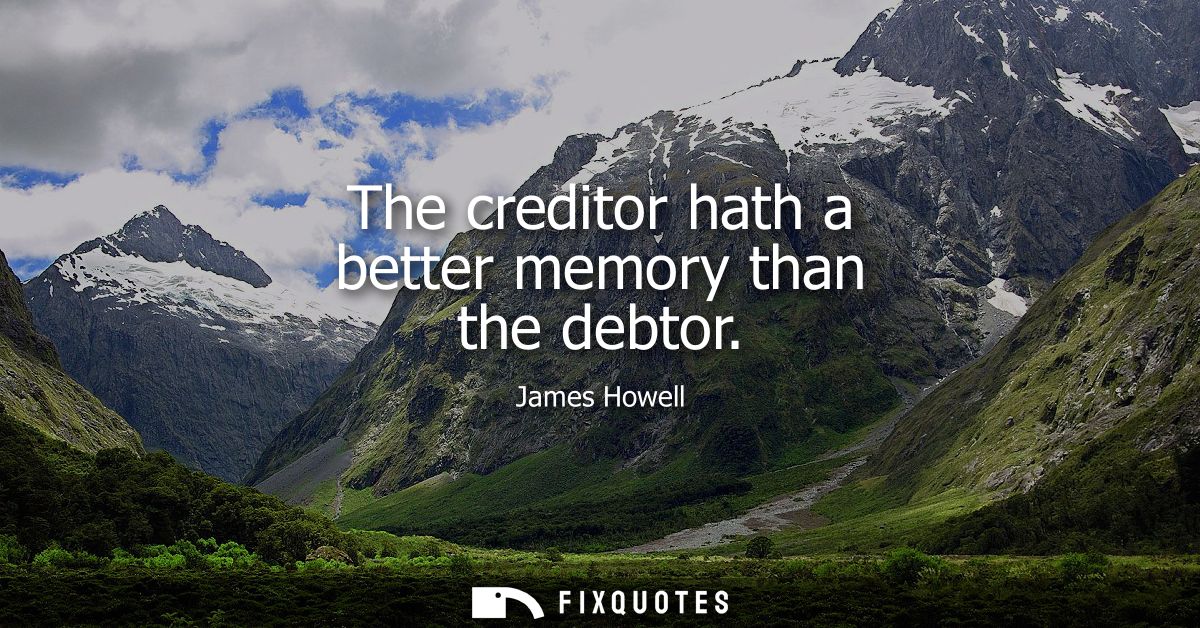
"The creditor hath a better memory than the debtor"
About this Quote
A debt is never just a number; it is a relationship with an asymmetry baked in. Howell’s line works because it turns a moral pressure point into a social fact: the person owed money has every incentive to remember, while the person who owes has every incentive to blur the edges of obligation. It’s not merely about forgetfulness. It’s about power. The creditor’s “better memory” is really an enforced memory, backed by leverage, reputation, and the quiet threat of consequence.
Howell, a seventeenth-century English writer navigating a world of patronage, fragile credit networks, and public honor, is speaking from inside an economy where trust was currency. Before modern consumer finance, “credit” meant character as much as coin. A debtor’s lapse could be read as vice, not misfortune. In that setting, memory becomes an instrument of social control: creditors keep ledgers, yes, but they also keep stories, and stories travel.
The subtext is a warning disguised as a proverb. If you borrow, you’re entering someone else’s narrative, and they will edit you ruthlessly if you don’t pay. Howell’s phrasing is slyly legalistic (“hath,” “debtor,” “creditor”), suggesting that the ledger is less a private record than a public accounting of who can be trusted. The line endures because it captures a timeless emotional math: shame makes people evasive; entitlement makes people exacting. Creditors remember because remembrance is part of the deal.
Howell, a seventeenth-century English writer navigating a world of patronage, fragile credit networks, and public honor, is speaking from inside an economy where trust was currency. Before modern consumer finance, “credit” meant character as much as coin. A debtor’s lapse could be read as vice, not misfortune. In that setting, memory becomes an instrument of social control: creditors keep ledgers, yes, but they also keep stories, and stories travel.
The subtext is a warning disguised as a proverb. If you borrow, you’re entering someone else’s narrative, and they will edit you ruthlessly if you don’t pay. Howell’s phrasing is slyly legalistic (“hath,” “debtor,” “creditor”), suggesting that the ledger is less a private record than a public accounting of who can be trusted. The line endures because it captures a timeless emotional math: shame makes people evasive; entitlement makes people exacting. Creditors remember because remembrance is part of the deal.
Quote Details
| Topic | Money |
|---|---|
| Source | Help us find the source |
| Cite |
Citation Formats
APA Style (7th ed.)
Howell, James. (2026, January 16). The creditor hath a better memory than the debtor. FixQuotes. https://fixquotes.com/quotes/the-creditor-hath-a-better-memory-than-the-debtor-112247/
Chicago Style
Howell, James. "The creditor hath a better memory than the debtor." FixQuotes. January 16, 2026. https://fixquotes.com/quotes/the-creditor-hath-a-better-memory-than-the-debtor-112247/.
MLA Style (9th ed.)
"The creditor hath a better memory than the debtor." FixQuotes, 16 Jan. 2026, https://fixquotes.com/quotes/the-creditor-hath-a-better-memory-than-the-debtor-112247/. Accessed 26 Mar. 2026.
More Quotes by James
Add to List