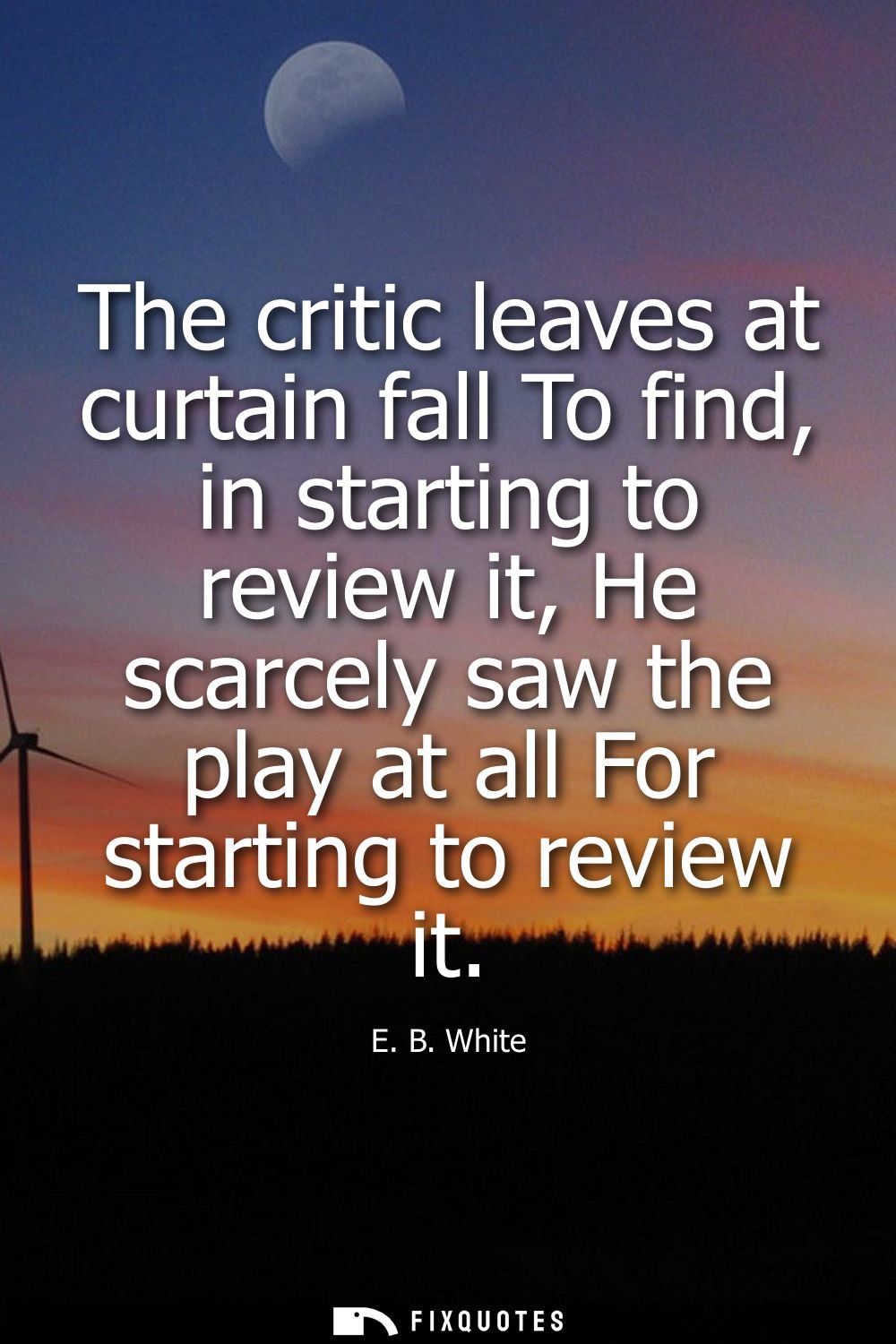
"The critic leaves at curtain fall, To find, in starting to review it, He scarcely saw the play at all, For starting to review it"
About this Quote
The intent is less anti-criticism than anti-premature criticism. White is wary of the way evaluation can colonize attention. The critic isn't malicious; they're busy. They leave at curtain fall and immediately begin manufacturing a coherent story about what happened, which means they were never fully available to the messy, contradictory experience of the play itself. Subtext: criticism can become a performance that competes with the art it claims to serve, and the critic's greatest sin is not harshness but distraction.
Context matters: White, a New Yorker stylist and a master of calibrated understatement, wrote in a media ecosystem that prized quick takes and authoritative voice long before social media made everyone a reviewer. The poem reads like an early warning about the attention economy: when your job is to judge, you start living in the future tense. White's wit exposes the cost - you can win the argument and miss the thing.
Quote Details
| Topic | Witty One-Liners |
|---|---|
| Source | Help us find the source |
| Cite |
Citation Formats
APA Style (7th ed.)
White, E. B. (2026, February 20). The critic leaves at curtain fall, To find, in starting to review it, He scarcely saw the play at all, For starting to review it. FixQuotes. https://fixquotes.com/quotes/the-critic-leaves-at-curtain-fall-to-find-in-19041/
Chicago Style
White, E. B. "The critic leaves at curtain fall, To find, in starting to review it, He scarcely saw the play at all, For starting to review it." FixQuotes. February 20, 2026. https://fixquotes.com/quotes/the-critic-leaves-at-curtain-fall-to-find-in-19041/.
MLA Style (9th ed.)
"The critic leaves at curtain fall, To find, in starting to review it, He scarcely saw the play at all, For starting to review it." FixQuotes, 20 Feb. 2026, https://fixquotes.com/quotes/the-critic-leaves-at-curtain-fall-to-find-in-19041/. Accessed 13 Mar. 2026.