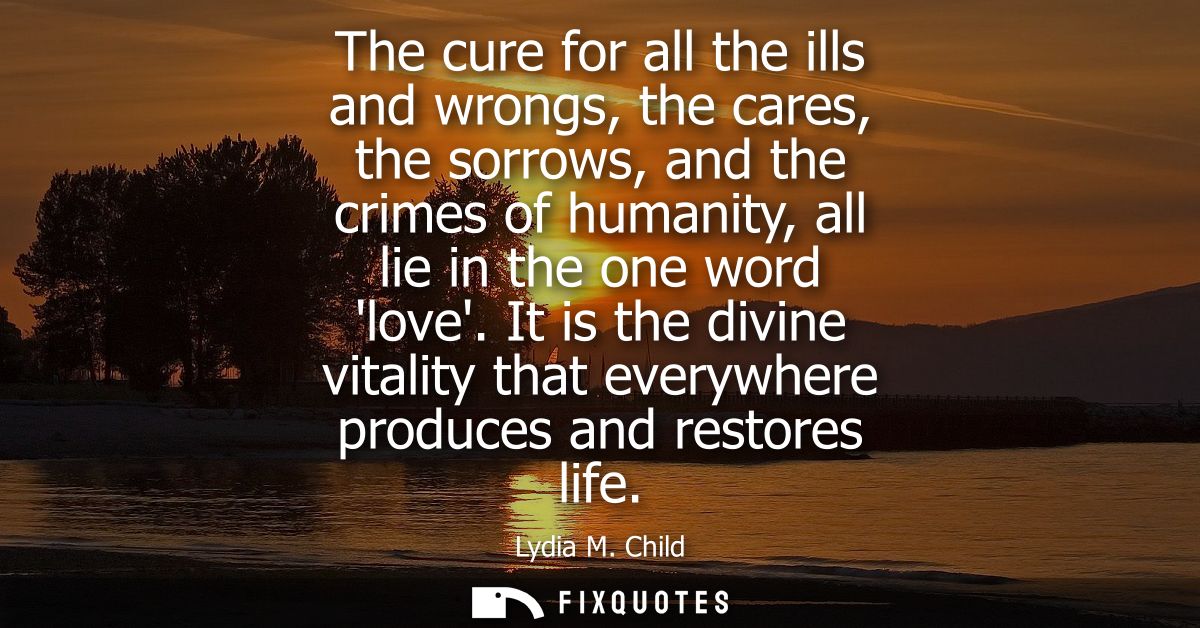
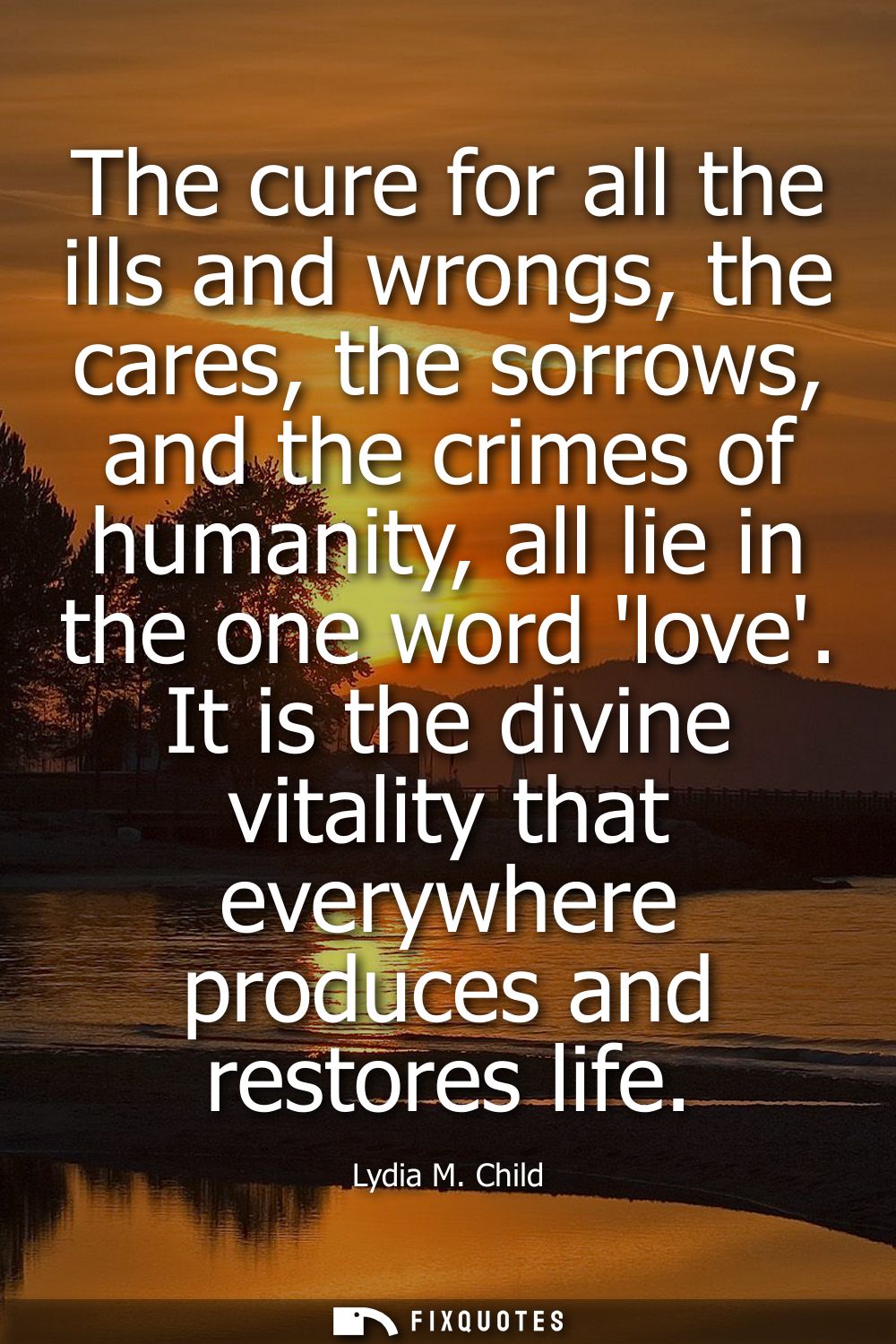
"The cure for all the ills and wrongs, the cares, the sorrows, and the crimes of humanity, all lie in the one word 'love'. It is the divine vitality that everywhere produces and restores life"
About this Quote
Child’s line is devotional in diction but political in intent: it takes a word often treated as private sentiment and recasts it as public medicine. The sheer pileup of nouns - ills, wrongs, cares, sorrows, crimes - works like a moral inventory. By refusing to rank suffering, she collapses the distance between the personal ache and the social atrocity, implying that the same underlying failure runs through both: a breakdown of recognition, responsibility, and kinship.
Calling love “the cure” is also a deliberate provocation from an activist steeped in America’s nineteenth-century reform culture, where abolition, women’s rights, and anti-poverty campaigns were constantly accused of being too radical, too disruptive, too angry. Child’s rhetoric answers that charge by offering a counter-moral authority: not vengeance, not mere law, but “divine vitality,” a phrase that fuses spiritual legitimacy with physical force. Love isn’t framed as softness; it’s energy, an engine that “produces and restores life.” That verb choice matters. Produces suggests creation, rebuilding social arrangements from the ground up. Restores suggests repair, a return to what humanity should have been but has failed to sustain.
The subtext is strategy. “One word” reads like simplicity, almost a slogan, but it’s also a demand that reform be rooted in sustained ethical attention rather than spectacle or purity tests. Child is arguing for a love that can bear consequence: the kind that insists on emancipation, education, and dignity not because the oppressed are perfect, but because life itself is sacred enough to be defended.
Calling love “the cure” is also a deliberate provocation from an activist steeped in America’s nineteenth-century reform culture, where abolition, women’s rights, and anti-poverty campaigns were constantly accused of being too radical, too disruptive, too angry. Child’s rhetoric answers that charge by offering a counter-moral authority: not vengeance, not mere law, but “divine vitality,” a phrase that fuses spiritual legitimacy with physical force. Love isn’t framed as softness; it’s energy, an engine that “produces and restores life.” That verb choice matters. Produces suggests creation, rebuilding social arrangements from the ground up. Restores suggests repair, a return to what humanity should have been but has failed to sustain.
The subtext is strategy. “One word” reads like simplicity, almost a slogan, but it’s also a demand that reform be rooted in sustained ethical attention rather than spectacle or purity tests. Child is arguing for a love that can bear consequence: the kind that insists on emancipation, education, and dignity not because the oppressed are perfect, but because life itself is sacred enough to be defended.
Quote Details
| Topic | Love |
|---|
More Quotes by Lydia
Add to List