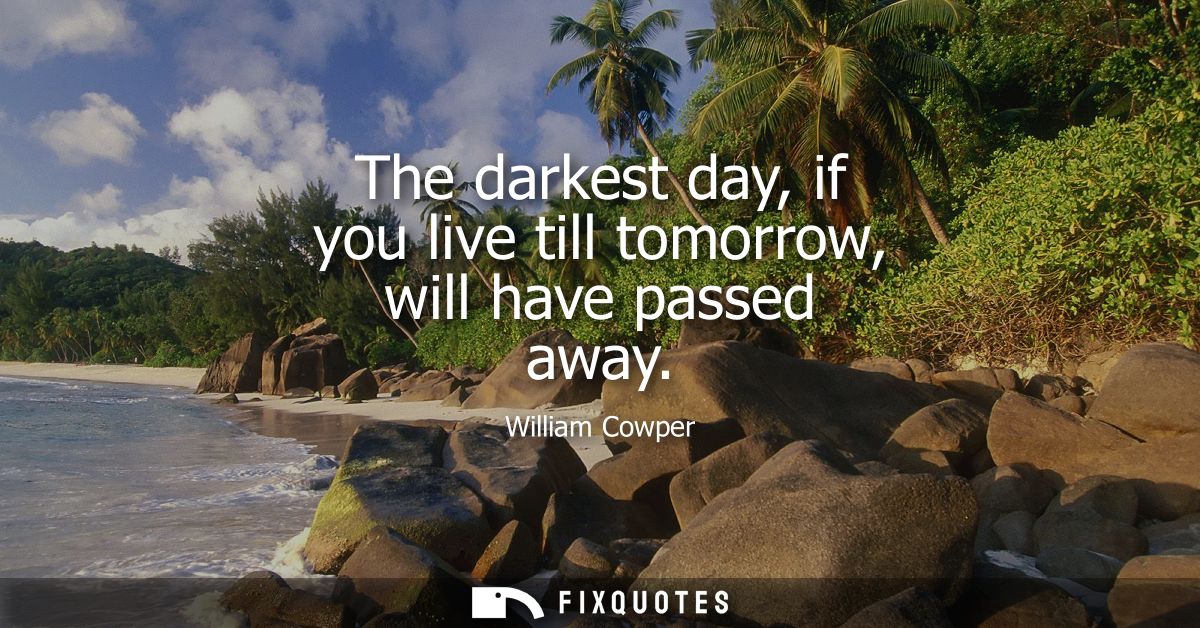
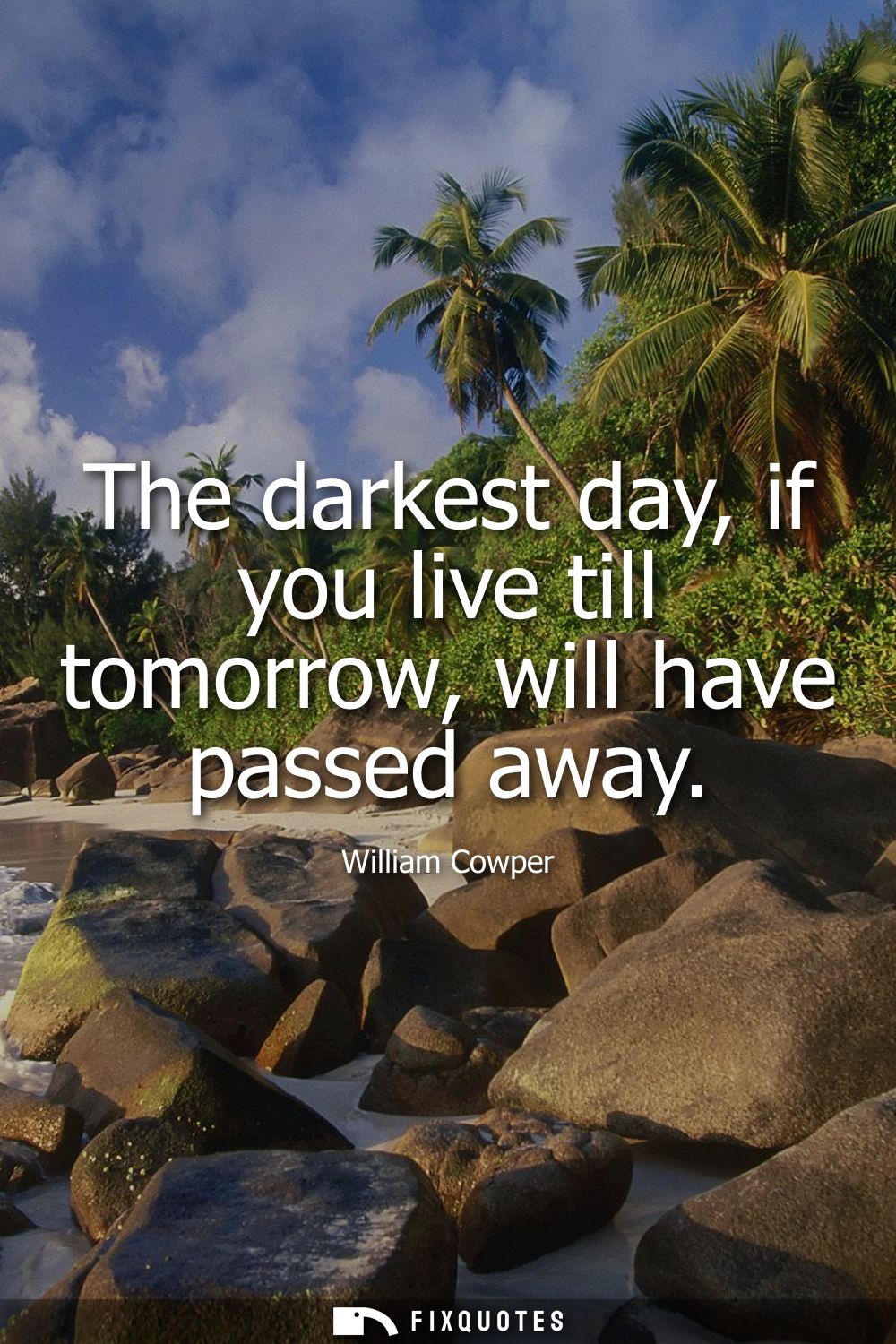
"The darkest day, if you live till tomorrow, will have passed away"
About this Quote
Cowper’s line offers hope with a scalpel, not a hug: it doesn’t promise that tomorrow will be better, only that time will move. “The darkest day” is framed as a unit you can outlast, a single span of hours that cannot legally extend itself once the calendar turns. The genius is in the conditional clause - “if you live till tomorrow” - which smuggles mortality and despair into what might otherwise read like a cheerful maxim. Survival is the only requirement. No moral improvement, no cosmic justice, no sudden miracle. Just staying alive long enough for the night to lose jurisdiction.
That restraint matters in Cowper’s context. Writing in an 18th-century England that prized composure and religious consolation, he was also a man repeatedly crushed by depression and anxiety, with documented breakdowns and suicide attempts. So the line carries the authority of someone who knows that “hope” can be chemically unavailable. He doesn’t sentimentalize pain; he gives it a boundary. Darkness is real, but it’s also temporal.
The subtext is almost procedural: endure, and the worst moment becomes past tense. That grammatical shift is the quote’s quiet power. It turns suffering into something that can be archived rather than endlessly inhabited. Cowper isn’t selling optimism; he’s describing a loophole in despair’s logic. Even on the day that feels total, tomorrow is an escape hatch - not because life transforms, but because duration itself is a kind of mercy.
That restraint matters in Cowper’s context. Writing in an 18th-century England that prized composure and religious consolation, he was also a man repeatedly crushed by depression and anxiety, with documented breakdowns and suicide attempts. So the line carries the authority of someone who knows that “hope” can be chemically unavailable. He doesn’t sentimentalize pain; he gives it a boundary. Darkness is real, but it’s also temporal.
The subtext is almost procedural: endure, and the worst moment becomes past tense. That grammatical shift is the quote’s quiet power. It turns suffering into something that can be archived rather than endlessly inhabited. Cowper isn’t selling optimism; he’s describing a loophole in despair’s logic. Even on the day that feels total, tomorrow is an escape hatch - not because life transforms, but because duration itself is a kind of mercy.
Quote Details
| Topic | Hope |
|---|---|
| Source | Help us find the source |
| Cite |
Citation Formats
APA Style (7th ed.)
Cowper, William. (2026, January 18). The darkest day, if you live till tomorrow, will have passed away. FixQuotes. https://fixquotes.com/quotes/the-darkest-day-if-you-live-till-tomorrow-will-17927/
Chicago Style
Cowper, William. "The darkest day, if you live till tomorrow, will have passed away." FixQuotes. January 18, 2026. https://fixquotes.com/quotes/the-darkest-day-if-you-live-till-tomorrow-will-17927/.
MLA Style (9th ed.)
"The darkest day, if you live till tomorrow, will have passed away." FixQuotes, 18 Jan. 2026, https://fixquotes.com/quotes/the-darkest-day-if-you-live-till-tomorrow-will-17927/. Accessed 3 Apr. 2026.
More Quotes by William
Add to List