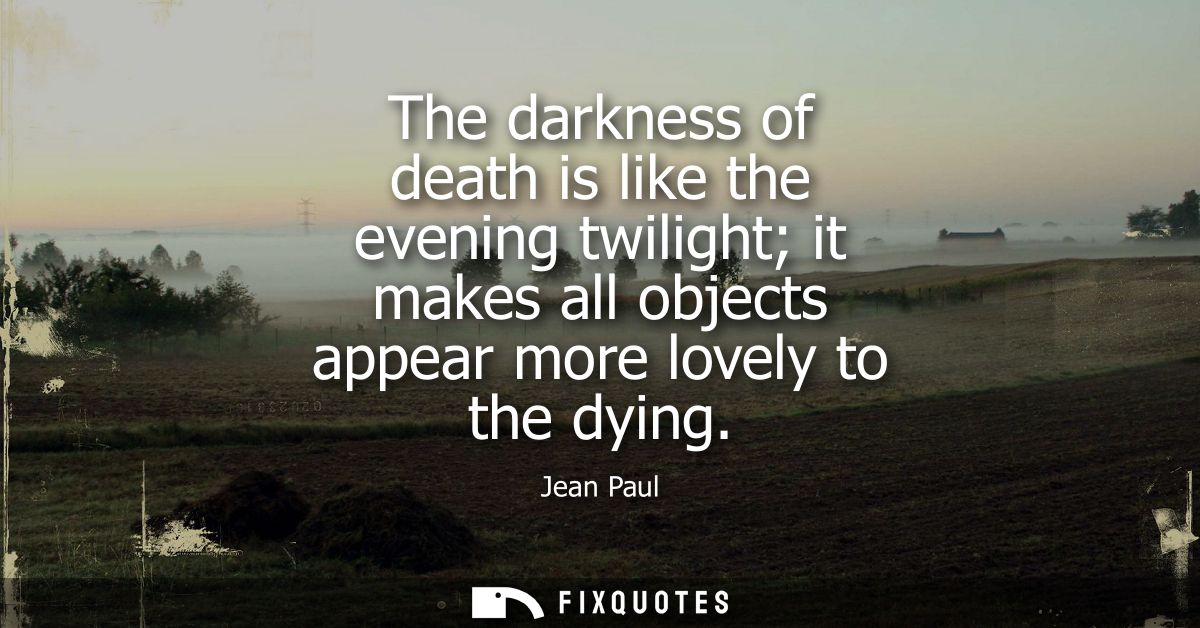
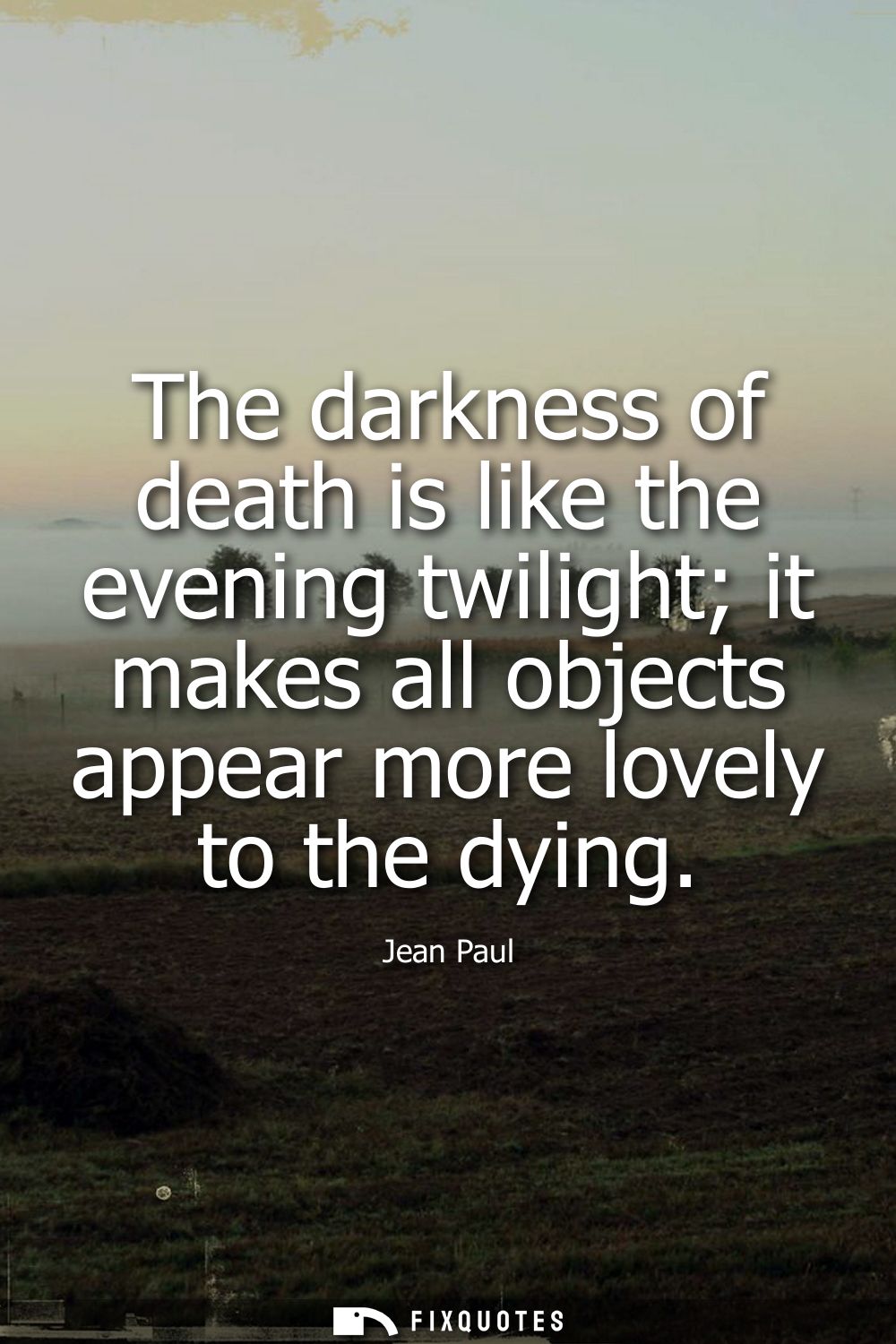
"The darkness of death is like the evening twilight; it makes all objects appear more lovely to the dying"
About this Quote
Jean Paul, a German Romantic-era writer with a taste for metaphysical comedy and sentiment, is working in a culture where feeling was not incidental; it was a way of knowing. The intent is consolation, but not the blunt kind. He suggests that the dying may experience a perceptual mercy, a last aesthetic filter that makes life seem more lovable precisely because it is slipping away. That is the subtext: beauty is not only in things; it is in the conditions under which we look. Scarcity sharpens affection.
Yet the metaphor also smuggles in a critique of the living. We often need the threat of loss to see whats worth seeing. Twilight is a daily rehearsal for disappearance, and the dying are cast as unwilling experts in valuation. The line comforts by implying a gentle, natural dimming, but it also unsettles: if death can make objects appear more lovely, how much of our ordinary sight is just bad lighting, self-protection, or indifference?
Quote Details
| Topic | Mortality |
|---|---|
| Source | Help us find the source |
| Cite | Cite this Quote |
Citation Formats
APA Style (7th ed.)
Paul, Jean. (n.d.). The darkness of death is like the evening twilight; it makes all objects appear more lovely to the dying. FixQuotes. https://fixquotes.com/quotes/the-darkness-of-death-is-like-the-evening-54977/
Chicago Style
Paul, Jean. "The darkness of death is like the evening twilight; it makes all objects appear more lovely to the dying." FixQuotes. Accessed February 2, 2026. https://fixquotes.com/quotes/the-darkness-of-death-is-like-the-evening-54977/.
MLA Style (9th ed.)
"The darkness of death is like the evening twilight; it makes all objects appear more lovely to the dying." FixQuotes, https://fixquotes.com/quotes/the-darkness-of-death-is-like-the-evening-54977/. Accessed 2 Feb. 2026.