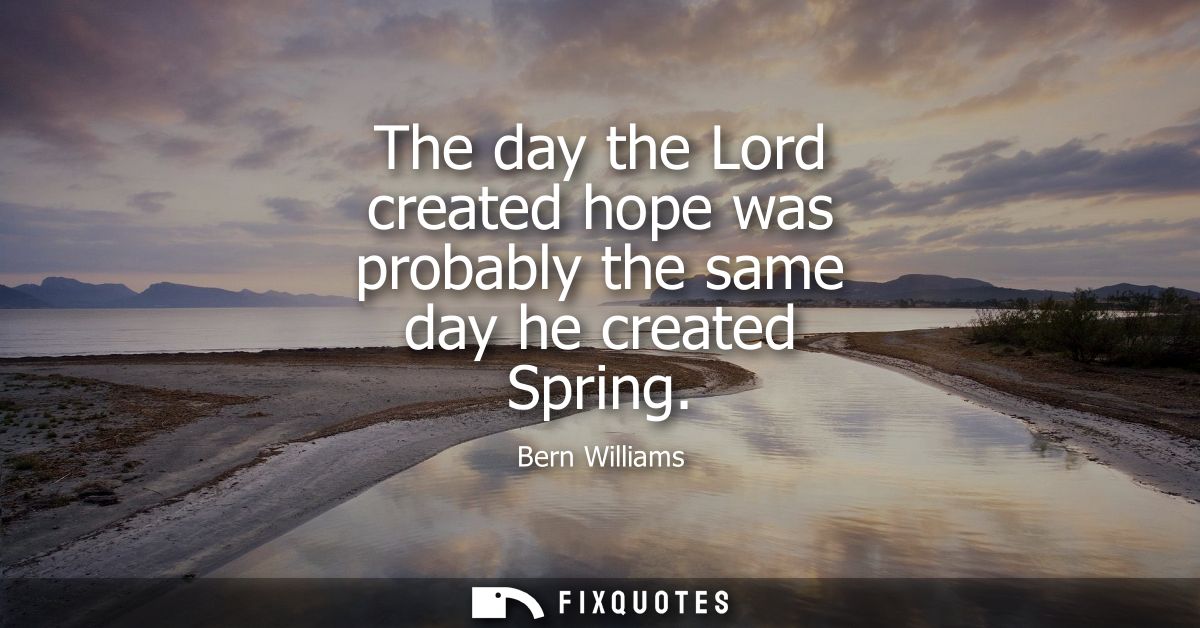
"The day the Lord created hope was probably the same day he created Spring"
About this Quote
The theology here is deliberately soft-focus. "Probably" is doing quiet work, winking at certainty. It lets the speaker invoke God without turning the sentence into doctrine. Williams gives you permission to believe in something - Providence, renewal, tomorrow - without signing up for anyone's creed. It's spirituality as a mood rather than a system.
The subtext is pastoral but also corrective. When life is bleak, we tend to treat despair as realism and hope as naivete. By pairing hope with Spring, Williams flips that hierarchy: despair becomes the temporary season, hope the designed return. Even the rhythm of the sentence follows that logic, moving from cosmic ("the Lord created") to tactile ("Spring") as if to say the metaphysical only matters when it shows up in the everyday.
Contextually, it reads like a line built for people crawling out of a hard stretch - grief, winter, burnout. Not a pep talk, more like a reminder that renewal has precedent. The world has done this before. It will, improbably and reliably, do it again.
Quote Details
| Topic | Hope |
|---|---|
| Source | Help us find the source |
| Cite |
Citation Formats
APA Style (7th ed.)
Williams, Bernard. (2026, January 14). The day the Lord created hope was probably the same day he created Spring. FixQuotes. https://fixquotes.com/quotes/the-day-the-lord-created-hope-was-probably-the-30099/
Chicago Style
Williams, Bernard. "The day the Lord created hope was probably the same day he created Spring." FixQuotes. January 14, 2026. https://fixquotes.com/quotes/the-day-the-lord-created-hope-was-probably-the-30099/.
MLA Style (9th ed.)
"The day the Lord created hope was probably the same day he created Spring." FixQuotes, 14 Jan. 2026, https://fixquotes.com/quotes/the-day-the-lord-created-hope-was-probably-the-30099/. Accessed 7 Feb. 2026.