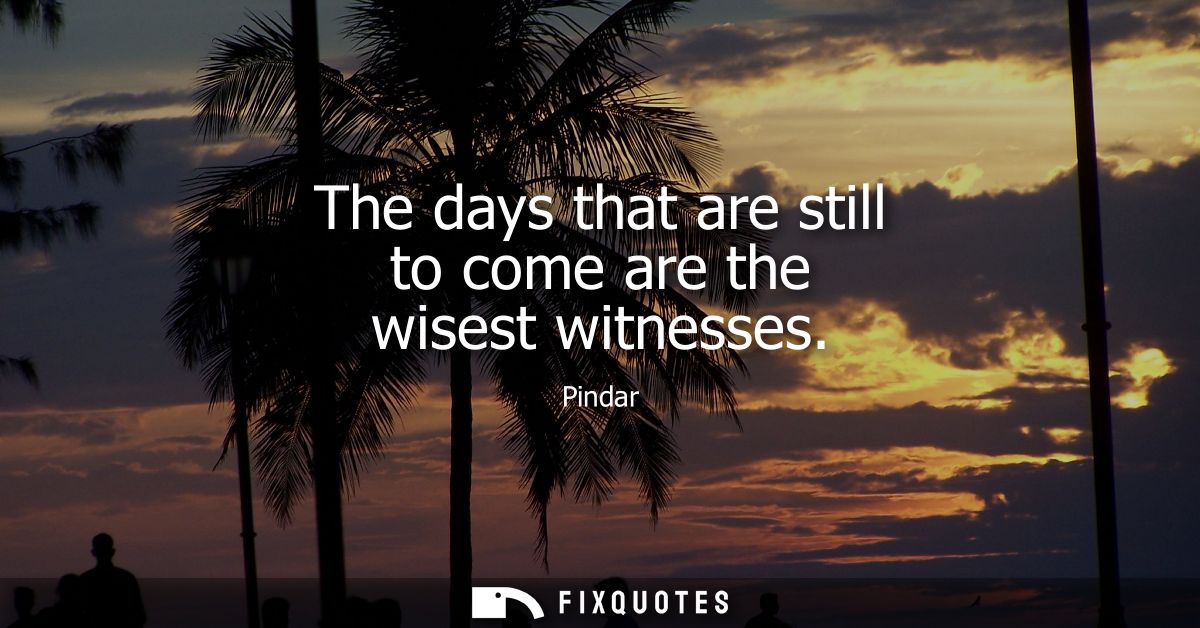
"The days that are still to come are the wisest witnesses"
About this Quote
Time, in Pindar’s hands, isn’t a gentle healer; it’s a judge with a long memory. “The days that are still to come are the wisest witnesses” carries the swagger of a poet who wrote victory odes for athletes and aristocrats, where public praise had to sound eternal even as it risked turning flimsy the moment the crowd moved on. Pindar’s line flatters the present while quietly refusing to trust it: applause is noisy, but the real testimony comes later, after the smoke clears and reputation has to live without the music.
The intent is a warning disguised as reassurance. If you’ve done something truly worthy, the future will corroborate it. If you’ve only staged a moment, the future will expose it. That’s the subtext that makes the sentence bite: it’s not just patience, it’s accountability. The “wisest” witness is not your friend; it’s the only witness that can’t be bribed by proximity, fashion, or collective intoxication.
Context matters here. Pindar’s world ran on kleos, fame as social currency, and on the fragile machinery of memory in a mostly oral culture. A poet was, effectively, a reputational engineer. By shifting authority to “days still to come,” Pindar elevates duration over display, lineage over trend, legacy over optics. It’s also a subtle flex: the poem itself is meant to be one of those future days, carrying the record forward, ensuring that what deserves to endure will have a witness waiting.
The intent is a warning disguised as reassurance. If you’ve done something truly worthy, the future will corroborate it. If you’ve only staged a moment, the future will expose it. That’s the subtext that makes the sentence bite: it’s not just patience, it’s accountability. The “wisest” witness is not your friend; it’s the only witness that can’t be bribed by proximity, fashion, or collective intoxication.
Context matters here. Pindar’s world ran on kleos, fame as social currency, and on the fragile machinery of memory in a mostly oral culture. A poet was, effectively, a reputational engineer. By shifting authority to “days still to come,” Pindar elevates duration over display, lineage over trend, legacy over optics. It’s also a subtle flex: the poem itself is meant to be one of those future days, carrying the record forward, ensuring that what deserves to endure will have a witness waiting.
Quote Details
| Topic | Time |
|---|---|
| Source | Help us find the source |
| Cite |
Citation Formats
APA Style (7th ed.)
Pindar. (2026, January 17). The days that are still to come are the wisest witnesses. FixQuotes. https://fixquotes.com/quotes/the-days-that-are-still-to-come-are-the-wisest-71814/
Chicago Style
Pindar. "The days that are still to come are the wisest witnesses." FixQuotes. January 17, 2026. https://fixquotes.com/quotes/the-days-that-are-still-to-come-are-the-wisest-71814/.
MLA Style (9th ed.)
"The days that are still to come are the wisest witnesses." FixQuotes, 17 Jan. 2026, https://fixquotes.com/quotes/the-days-that-are-still-to-come-are-the-wisest-71814/. Accessed 3 Apr. 2026.
More Quotes by Pindar
Add to List