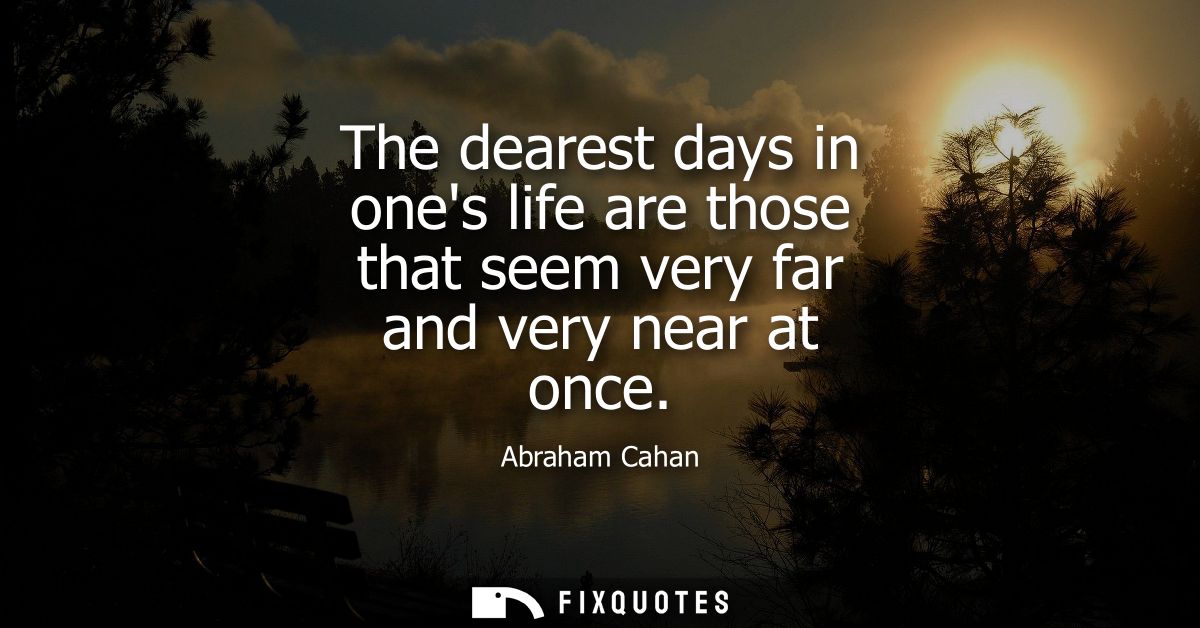
"The dearest days in one's life are those that seem very far and very near at once"
About this Quote
Cahan, a Jewish immigrant writer and longtime editor of The Jewish Daily Forward, built a career on lives suspended between worlds: old-country habits and American reinvention, communal obligation and self-making. Read through that lens, the quote becomes less a generic meditation and more an immigrant’s emotional map. The “dearest days” are often those of transition - first arrivals, first earnings, first humiliations, first intimacies - experiences that are objectively distant (a former self, a former language) but psychologically immediate because they structured everything after.
The subtext is quietly unsentimental. These days feel “near” not because they were perfect, but because they remain unfinished business. Memory becomes a double exposure: you see the person you were overlaying the person you are, and the closeness can ache as much as it comforts. Cahan’s genius is the restraint; he doesn’t name loss, longing, or displacement, yet the sentence carries all three like a sealed letter you can’t stop rereading.
Quote Details
| Topic | Nostalgia |
|---|---|
| Source | Help us find the source |
| Cite |
Citation Formats
APA Style (7th ed.)
Cahan, Abraham. (2026, January 17). The dearest days in one's life are those that seem very far and very near at once. FixQuotes. https://fixquotes.com/quotes/the-dearest-days-in-ones-life-are-those-that-seem-75134/
Chicago Style
Cahan, Abraham. "The dearest days in one's life are those that seem very far and very near at once." FixQuotes. January 17, 2026. https://fixquotes.com/quotes/the-dearest-days-in-ones-life-are-those-that-seem-75134/.
MLA Style (9th ed.)
"The dearest days in one's life are those that seem very far and very near at once." FixQuotes, 17 Jan. 2026, https://fixquotes.com/quotes/the-dearest-days-in-ones-life-are-those-that-seem-75134/. Accessed 31 Mar. 2026.