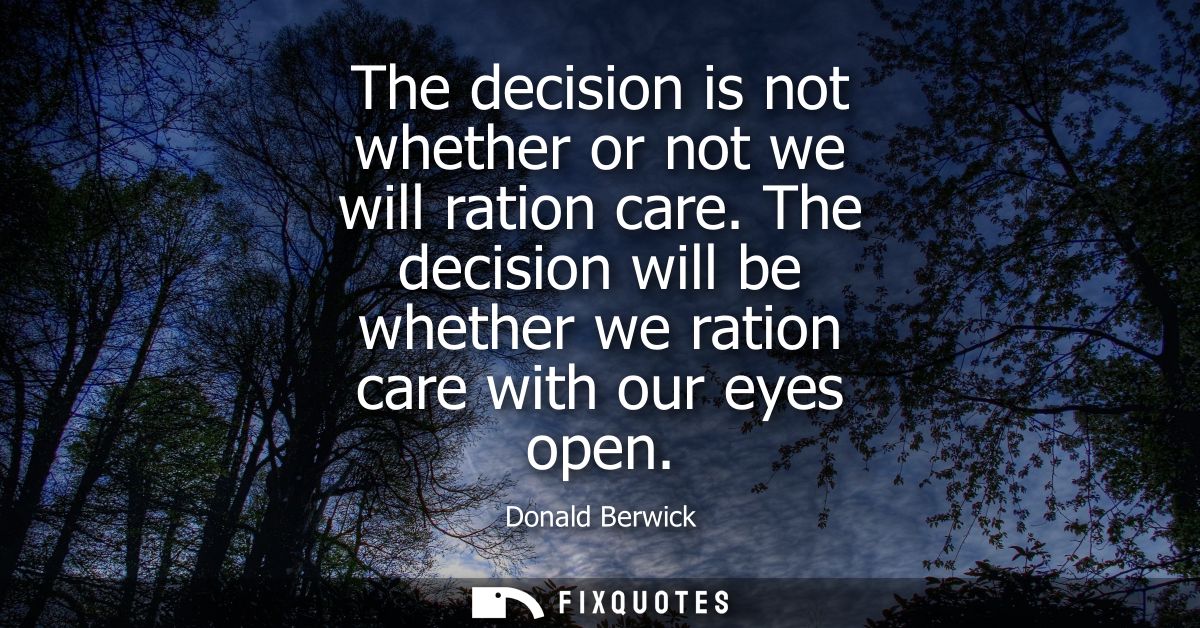
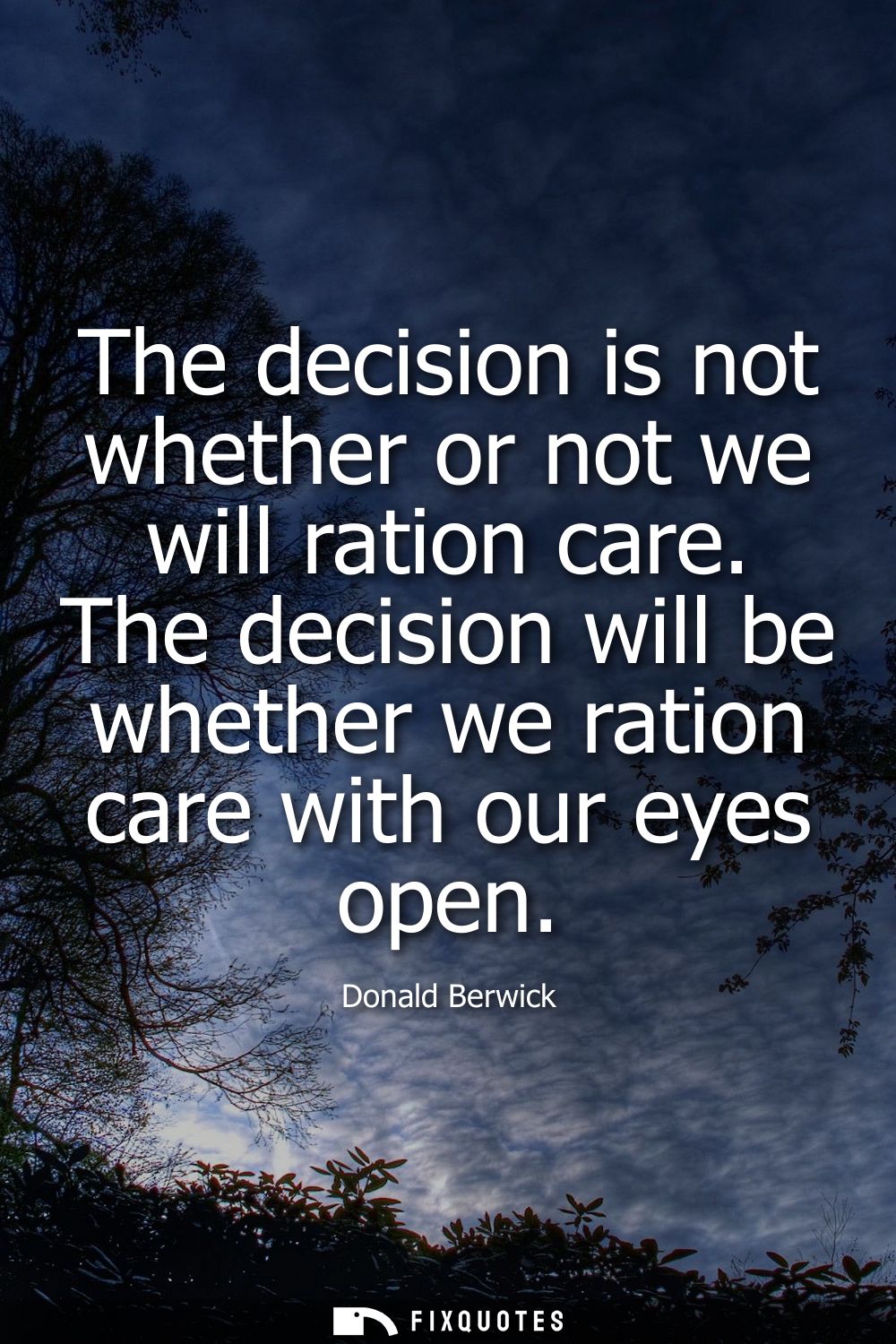
"The decision is not whether or not we will ration care. The decision will be whether we ration care with our eyes open"
About this Quote
The subtext is a critique of the comfortable illusion that the U.S. doesn’t ration. We already do, Berwick implies, just not with neat guidelines. We ration by price, insurance design, geography, network exclusions, prior authorization friction, understaffing, and the soft denial of patients who can’t navigate paperwork. That’s rationing with plausible deniability - and it tends to punish the people with the least power.
Context matters: Berwick, a leading quality-improvement voice and former CMS administrator, is speaking from inside the machinery of coverage and clinical policy. His line defends an ethic of explicitness: if scarcity is unavoidable, the least we can do is make the trade-offs legible, contestable, and tied to outcomes rather than status. "Eyes open" is a quiet indictment of willful blindness - and a dare to replace comforting rhetoric with transparent rules that can actually be argued with, audited, and improved.
Quote Details
| Topic | Ethics & Morality |
|---|---|
| Source | Help us find the source |
| Cite |
Citation Formats
APA Style (7th ed.)
Berwick, Donald. (2026, January 15). The decision is not whether or not we will ration care. The decision will be whether we ration care with our eyes open. FixQuotes. https://fixquotes.com/quotes/the-decision-is-not-whether-or-not-we-will-ration-49892/
Chicago Style
Berwick, Donald. "The decision is not whether or not we will ration care. The decision will be whether we ration care with our eyes open." FixQuotes. January 15, 2026. https://fixquotes.com/quotes/the-decision-is-not-whether-or-not-we-will-ration-49892/.
MLA Style (9th ed.)
"The decision is not whether or not we will ration care. The decision will be whether we ration care with our eyes open." FixQuotes, 15 Jan. 2026, https://fixquotes.com/quotes/the-decision-is-not-whether-or-not-we-will-ration-49892/. Accessed 6 Mar. 2026.