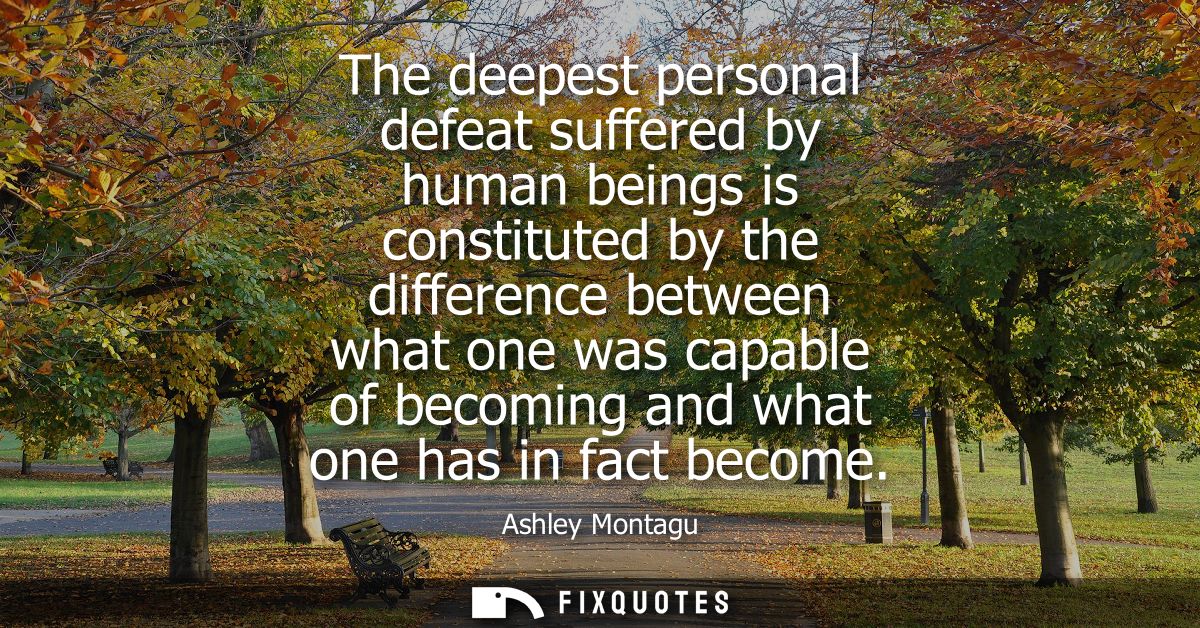
"The deepest personal defeat suffered by human beings is constituted by the difference between what one was capable of becoming and what one has in fact become"
About this Quote
The subtext is less self-help than indictment. Montagu isn’t comforting you with “try harder.” He’s warning that the most devastating losses don’t always come from outside forces; they can be authored slowly, through compliance, timidity, distraction, or surrender to other people’s scripts. “Capable of becoming” implies the raw materials were there: temperament, intelligence, opportunities, a set of unrealized trajectories. The sting comes from the implication of agency, even when circumstances are real and limiting. It’s a moral sentence disguised as an observation.
Context sharpens it. Montagu spent a career challenging biological determinism, especially around race and human nature. In that light, the quote reads as a defense of plasticity: humans are not fixed specimens; we’re unfinished projects. But it’s also a critique of cultures that corral people into narrow outcomes, then call the results “natural.” The real defeat is when a society convinces you your possible self was never possible at all.
Quote Details
| Topic | Failure |
|---|---|
| Source | Help us find the source |
| Cite |
Citation Formats
APA Style (7th ed.)
Montagu, Ashley. (2026, January 18). The deepest personal defeat suffered by human beings is constituted by the difference between what one was capable of becoming and what one has in fact become. FixQuotes. https://fixquotes.com/quotes/the-deepest-personal-defeat-suffered-by-human-15499/
Chicago Style
Montagu, Ashley. "The deepest personal defeat suffered by human beings is constituted by the difference between what one was capable of becoming and what one has in fact become." FixQuotes. January 18, 2026. https://fixquotes.com/quotes/the-deepest-personal-defeat-suffered-by-human-15499/.
MLA Style (9th ed.)
"The deepest personal defeat suffered by human beings is constituted by the difference between what one was capable of becoming and what one has in fact become." FixQuotes, 18 Jan. 2026, https://fixquotes.com/quotes/the-deepest-personal-defeat-suffered-by-human-15499/. Accessed 10 Mar. 2026.