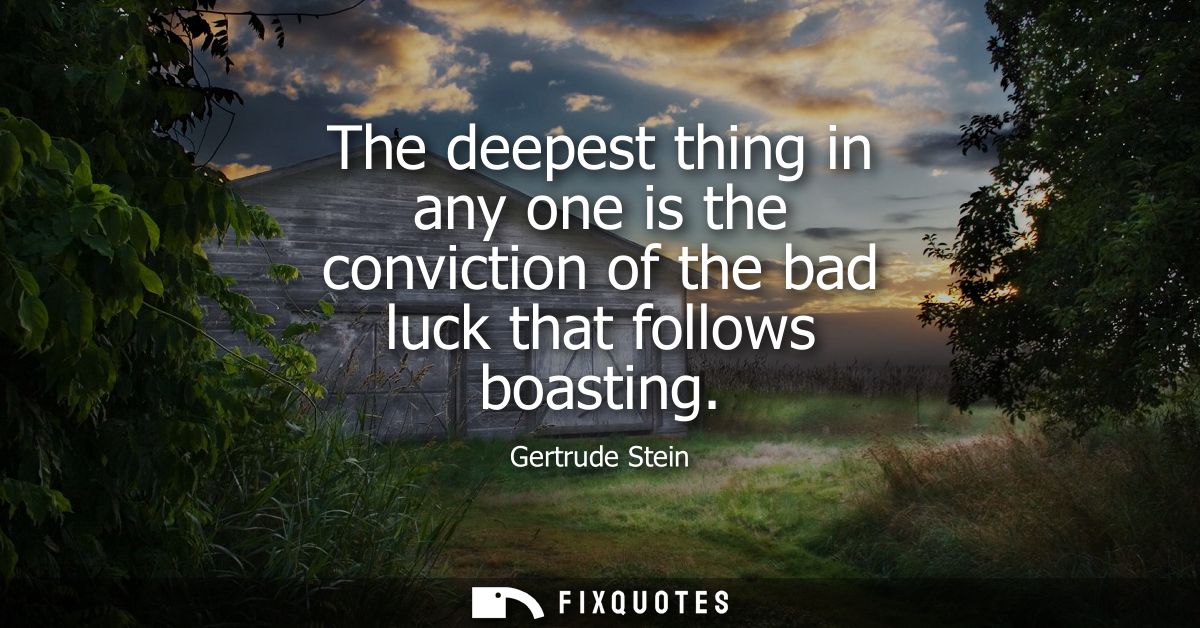
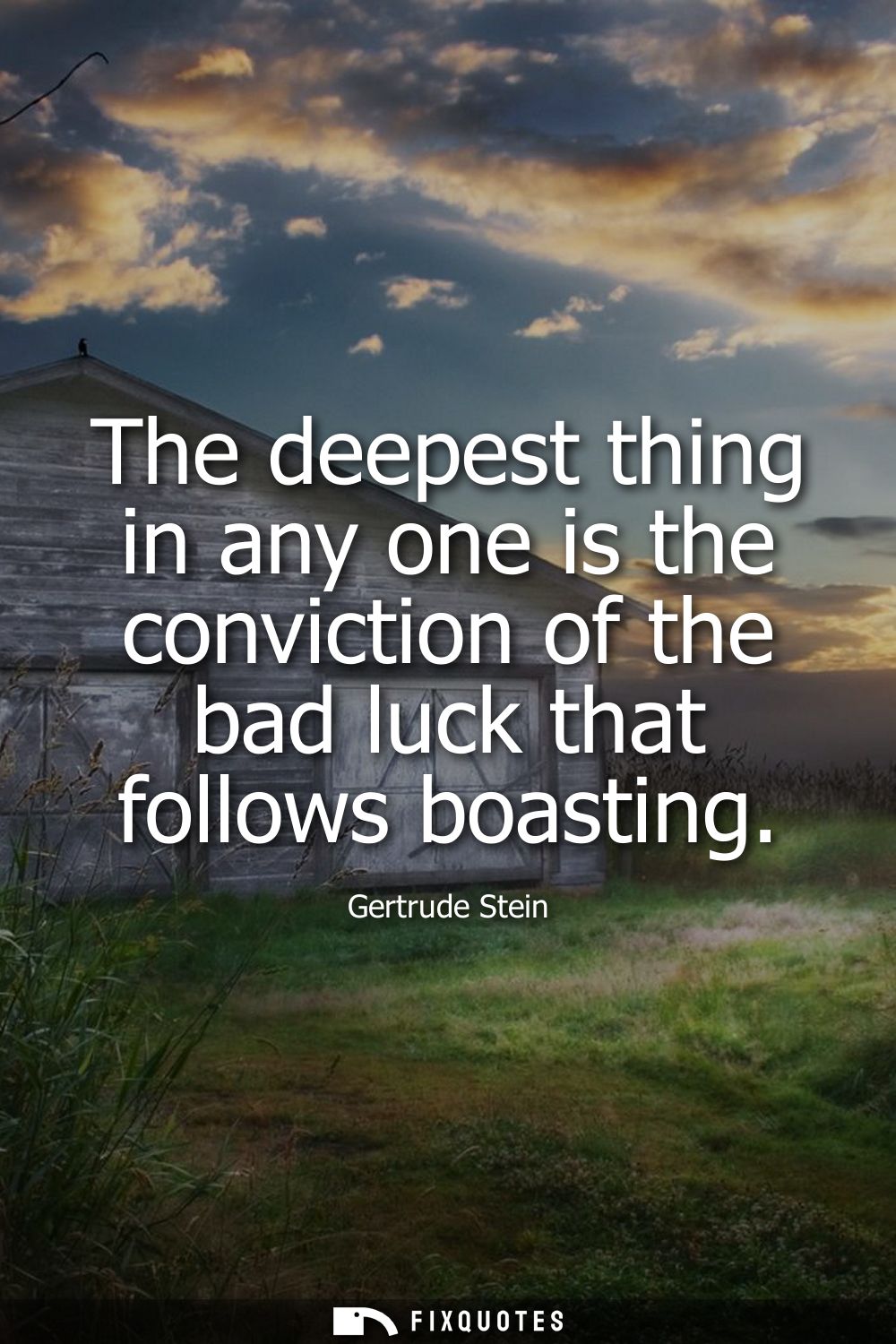
"The deepest thing in any one is the conviction of the bad luck that follows boasting"
About this Quote
The phrasing does the work. “Conviction” suggests something sturdier than anxiety, almost a creed; “bad luck” dresses moral consequence in the costume of randomness. That tension is the subtext. We pretend the universe is indifferent, then act as if it’s a petty accountant, ready to balance any surplus of pride with an invoice. Stein isn’t just warning against hubris; she’s diagnosing a culture where success is always shadowed by the fear of being seen as wanting it too loudly.
Context matters: Stein, an expatriate modernist watching American confidence from Paris, understood that braggadocio and self-doubt often share a spine. Her experimental style often exposes how language hides our real motives; here she does it cleanly, with a sentence that feels like a proverb but lands like a tell. The “deepest thing” isn’t destiny or virtue. It’s the small, persistent belief that applause tempts fate - and that someone, somewhere, is listening.
Quote Details
| Topic | Humility |
|---|---|
| Source | Help us find the source |
| Cite |
Citation Formats
APA Style (7th ed.)
Stein, Gertrude. (2026, January 18). The deepest thing in any one is the conviction of the bad luck that follows boasting. FixQuotes. https://fixquotes.com/quotes/the-deepest-thing-in-any-one-is-the-conviction-of-7349/
Chicago Style
Stein, Gertrude. "The deepest thing in any one is the conviction of the bad luck that follows boasting." FixQuotes. January 18, 2026. https://fixquotes.com/quotes/the-deepest-thing-in-any-one-is-the-conviction-of-7349/.
MLA Style (9th ed.)
"The deepest thing in any one is the conviction of the bad luck that follows boasting." FixQuotes, 18 Jan. 2026, https://fixquotes.com/quotes/the-deepest-thing-in-any-one-is-the-conviction-of-7349/. Accessed 2 Apr. 2026.