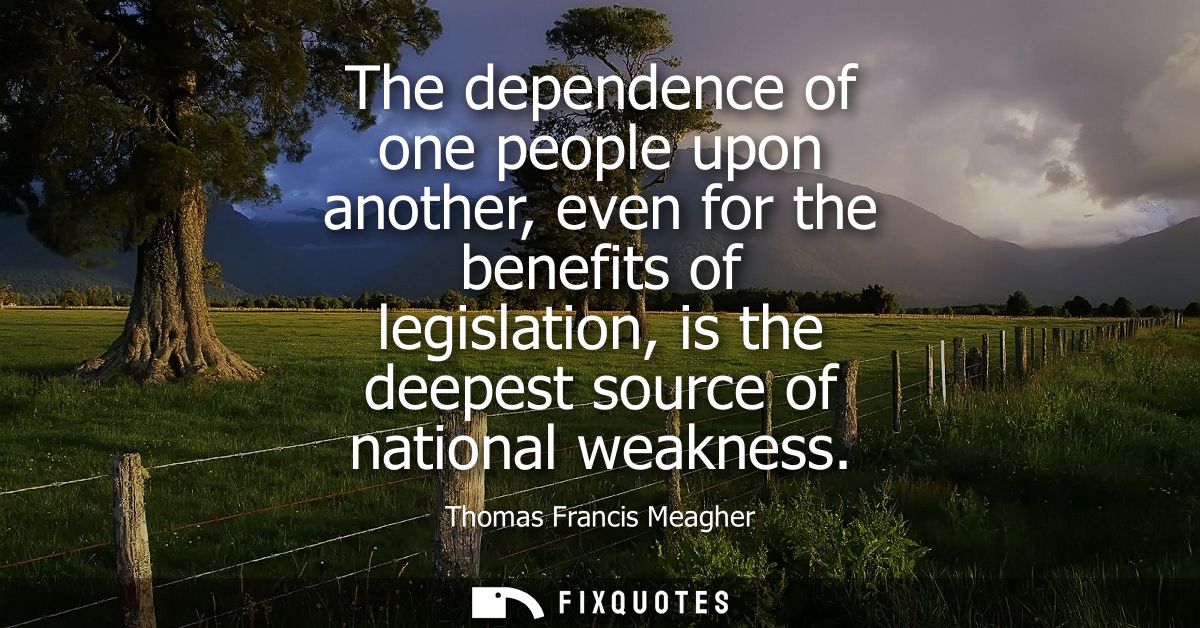
"The dependence of one people upon another, even for the benefits of legislation, is the deepest source of national weakness"
About this Quote
The subtext is about dignity, but it’s also about power in its most practical form. Dependence trains a nation to negotiate from its knees: it dulls political initiative, fractures solidarity (“some will bargain, some will resist”), and makes reform feel like a favor granted rather than a right asserted. Meagher isn’t warning against cooperation; he’s warning against political outsourcing. There’s a world of difference between alliance and administration, between shared interests and borrowed authority.
Context sharpens the edge. Meagher was an Irish nationalist shaped by British rule and the failure of constitutional promises to deliver real autonomy. As a soldier, he’s predisposed to see governance as a matter of readiness and morale. “National weakness” isn’t a metaphor; it’s a condition that can be exploited. The line doubles as recruitment rhetoric: if dependence is the deepest weakness, then self-government isn’t a lofty ideal, it’s national defense.
Quote Details
| Topic | Freedom |
|---|---|
| Source | Help us find the source |
| Cite |
Citation Formats
APA Style (7th ed.)
Meagher, Thomas Francis. (2026, January 16). The dependence of one people upon another, even for the benefits of legislation, is the deepest source of national weakness. FixQuotes. https://fixquotes.com/quotes/the-dependence-of-one-people-upon-another-even-110873/
Chicago Style
Meagher, Thomas Francis. "The dependence of one people upon another, even for the benefits of legislation, is the deepest source of national weakness." FixQuotes. January 16, 2026. https://fixquotes.com/quotes/the-dependence-of-one-people-upon-another-even-110873/.
MLA Style (9th ed.)
"The dependence of one people upon another, even for the benefits of legislation, is the deepest source of national weakness." FixQuotes, 16 Jan. 2026, https://fixquotes.com/quotes/the-dependence-of-one-people-upon-another-even-110873/. Accessed 1 Apr. 2026.