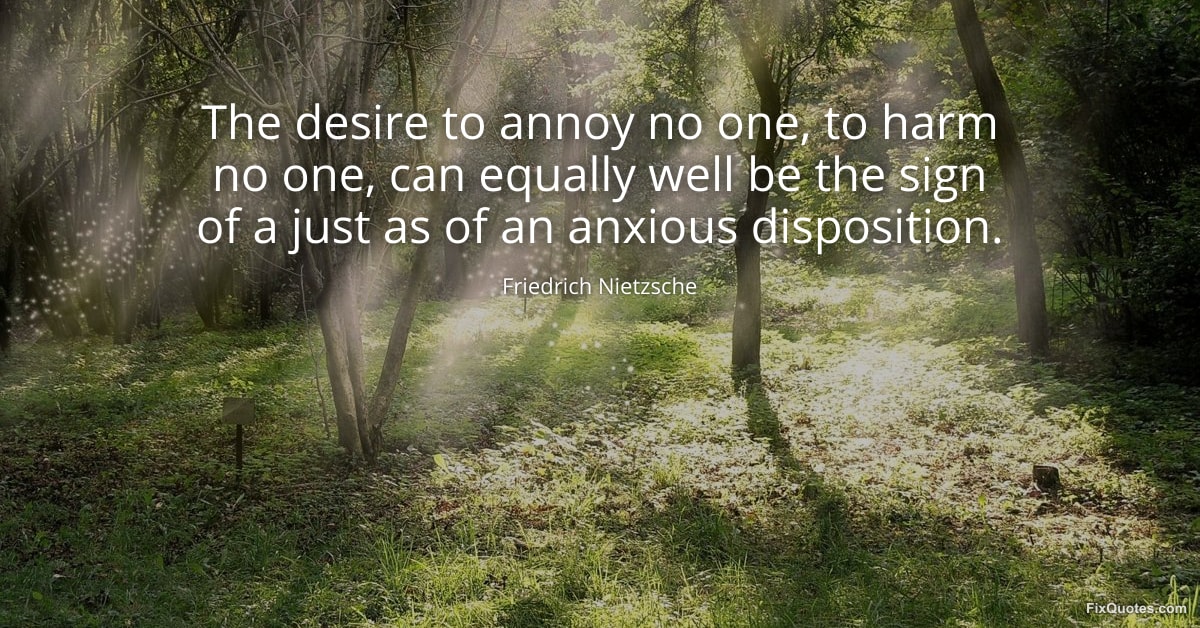
"The desire to annoy no one, to harm no one, can equally well be the sign of a just as of an anxious disposition"
About this Quote
The intent is diagnostic, not merely contrarian. Nietzsche’s target is a culture that confuses the absence of aggression with moral achievement, turning restraint into a halo. By pairing “just” with “anxious,” he exposes how often our “kindness” is a strategy of self-protection: avoid conflict, avoid judgment, avoid consequences. The subtext is sharp: when you never risk annoying anyone, you may be less compassionate than terrified. Your “peace” might be compliance.
Context matters. Nietzsche is writing against Christian-moral and bourgeois respectability systems that prize meekness, self-denial, and social smoothness. His broader project questions whether prevailing morality serves life and strength or merely manages fear and resentment. Here, “harm” is not a blanket endorsement of cruelty; it’s a reminder that any serious commitment - to truth, to art, to justice itself - sometimes injures someone’s comfort. A just person may refrain from harm out of principle; an anxious person may do it out of dependency on approval.
The line works because it flips moral legibility. It demands we read motives, not manners, and it suggests that virtue without the capacity to offend is often just a well-trained survival instinct.
Quote Details
| Topic | Ethics & Morality |
|---|---|
| Source | Verified source: Human, All Too Human (Friedrich Nietzsche, 1878)
Evidence: Considerate. - To desire to offend no one and injure no one can be the mark of a just disposition as well as of a timorous one. (Part I, Section 6 "Man in Society," aphorism 314; English trans. p. 168 in the 1996 Cambridge edition). The wording you supplied is not the earliest verifiable primary-source wording. The closest verified primary source is Nietzsche's own aphorism 314 in Menschliches, Allzumenschliches I (Human, All Too Human), first published in German in 1878. A reliable modern scholarly witness is the Cambridge University Press edition, which gives the line at aphorism 314 in Section 6, "Man in Society," on p. 168: "Considerate. - To desire to offend no one and injure no one can be the mark of a just disposition as well as of a timorous one." ([libraryofagartha.com](https://libraryofagartha.com/Philosophy/Nietzsche/Friedrich%20Nietzsche/Friedrich%20Nietzsche/Friedrich_Nietzsche_Nietzsche_Human%2C_All_Too_Human_A_Book_for_Free_Spirits____1996.pdf)) The 1996 Cambridge edition is a later translation, not the first publication; it confirms location and wording in English. Search evidence strongly suggests many quote sites modernized the sentence into "The desire to annoy no one, to harm no one, can equally well be the sign of a just as of an anxious disposition," but I did not find that exact wording in a primary Nietzsche source. The book itself was originally published in 1878. ([plato.stanford.edu](https://plato.stanford.edu/archIves/win1998/entries/nietzsche/?utm_source=openai)) Other candidates (1) The Very Best of Friedrich Nietzsche (David Graham, 2014) compilation95.6% ... The desire to annoy no one , to harm no one , can equally well be the sign of a just as of an anxious disposition... |
| Cite |
Citation Formats
APA Style (7th ed.)
Nietzsche, Friedrich. (2026, March 13). The desire to annoy no one, to harm no one, can equally well be the sign of a just as of an anxious disposition. FixQuotes. https://fixquotes.com/quotes/the-desire-to-annoy-no-one-to-harm-no-one-can-133879/
Chicago Style
Nietzsche, Friedrich. "The desire to annoy no one, to harm no one, can equally well be the sign of a just as of an anxious disposition." FixQuotes. March 13, 2026. https://fixquotes.com/quotes/the-desire-to-annoy-no-one-to-harm-no-one-can-133879/.
MLA Style (9th ed.)
"The desire to annoy no one, to harm no one, can equally well be the sign of a just as of an anxious disposition." FixQuotes, 13 Mar. 2026, https://fixquotes.com/quotes/the-desire-to-annoy-no-one-to-harm-no-one-can-133879/. Accessed 21 Mar. 2026.