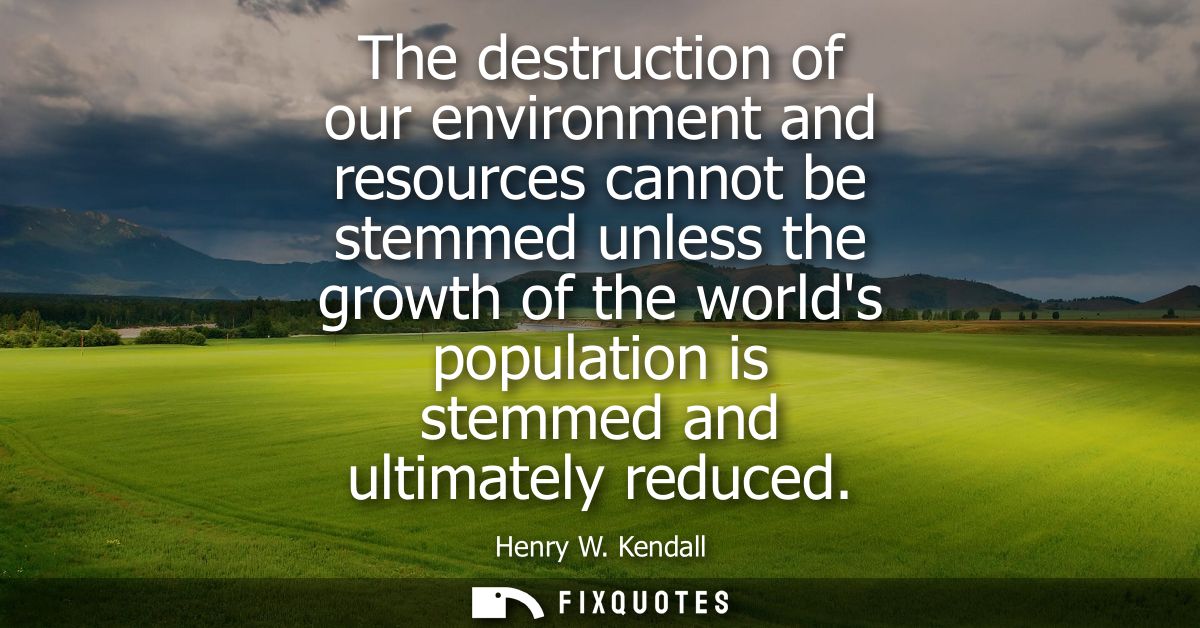
"The destruction of our environment and resources cannot be stemmed unless the growth of the world's population is stemmed and ultimately reduced"
About this Quote
Kendall’s sentence is built like a scientific warning label: blunt, conditional, and allergic to consolation. “Cannot be stemmed unless” isn’t rhetoric meant to persuade through beauty; it’s meant to close exits. The structure forces a single chokepoint in the reader’s mind: environmental collapse has a driver, and it’s not just technology, policy, or corporate greed. It’s headcount.
That’s the intent - to reframe ecology as arithmetic. Coming from a scientist (and, historically, from a late-20th-century ecosystem of Cold War-era systems thinking and “Limits to Growth” anxieties), it carries the authority of someone trained to treat the planet as a finite system with hard constraints. Kendall’s phrasing also smuggles in a moral wager: if we keep treating population growth as politically untouchable, we’re choosing environmental loss by default.
The subtext is where the line gets volatile. “Stemmed and ultimately reduced” is not neutral language; it implies intervention, potentially coercion, and it invites the old specter of Malthusianism - the idea that suffering is nature’s correction when humans overshoot. Even if Kendall’s target is consumption plus population, the quote spotlights only one variable, which is precisely why it works as provocation: it dares audiences to face an uncomfortable lever rather than hide behind vague sustainability slogans.
Its cultural context matters too. In the 1970s-90s, mainstream environmentalism often treated population as the master problem; today, the same claim lands amid sharper awareness of inequality, per-capita emissions, and the history of population control policies aimed at the poor. Kendall’s sentence retains force, but also exposes the ethical minefield beneath any “solution” that sounds like managing people instead of power.
That’s the intent - to reframe ecology as arithmetic. Coming from a scientist (and, historically, from a late-20th-century ecosystem of Cold War-era systems thinking and “Limits to Growth” anxieties), it carries the authority of someone trained to treat the planet as a finite system with hard constraints. Kendall’s phrasing also smuggles in a moral wager: if we keep treating population growth as politically untouchable, we’re choosing environmental loss by default.
The subtext is where the line gets volatile. “Stemmed and ultimately reduced” is not neutral language; it implies intervention, potentially coercion, and it invites the old specter of Malthusianism - the idea that suffering is nature’s correction when humans overshoot. Even if Kendall’s target is consumption plus population, the quote spotlights only one variable, which is precisely why it works as provocation: it dares audiences to face an uncomfortable lever rather than hide behind vague sustainability slogans.
Its cultural context matters too. In the 1970s-90s, mainstream environmentalism often treated population as the master problem; today, the same claim lands amid sharper awareness of inequality, per-capita emissions, and the history of population control policies aimed at the poor. Kendall’s sentence retains force, but also exposes the ethical minefield beneath any “solution” that sounds like managing people instead of power.
Quote Details
| Topic | Nature |
|---|
More Quotes by Henry
Add to List