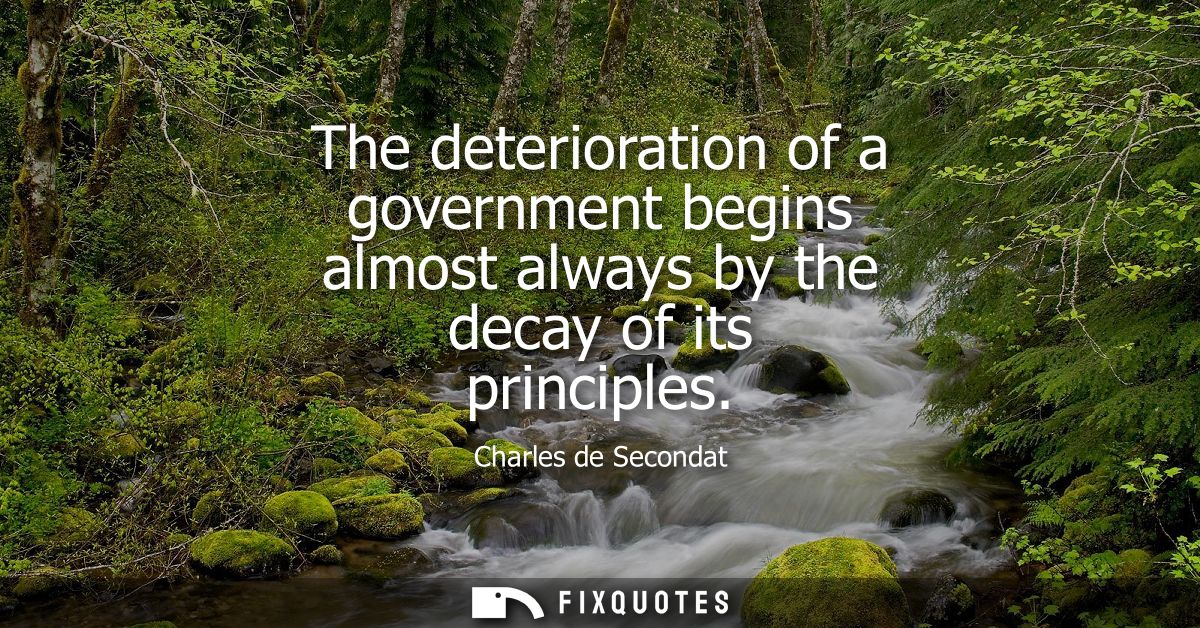
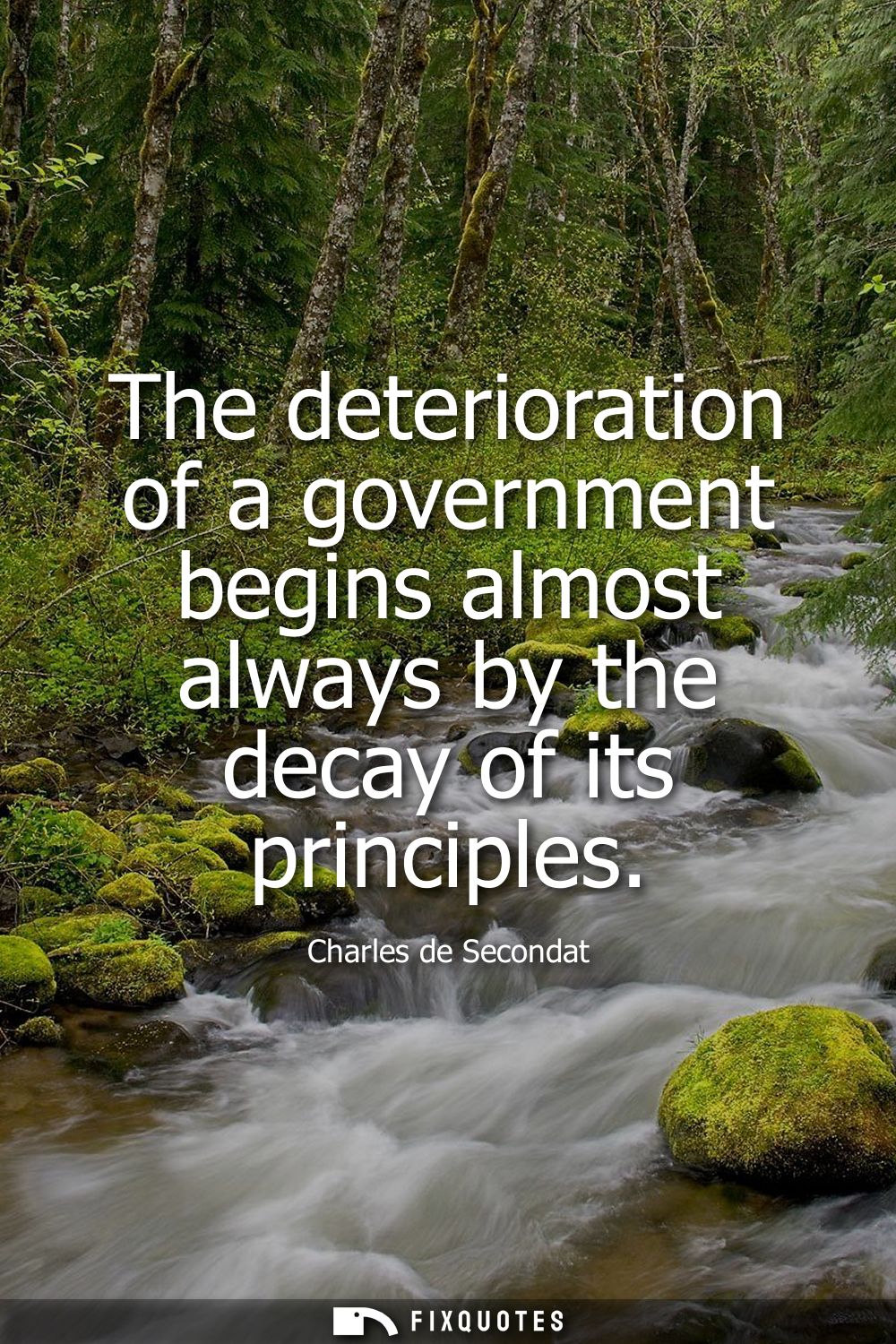
"The deterioration of a government begins almost always by the decay of its principles"
About this Quote
The line works because it treats "principles" not as decorative ideals but as operating software. Laws can remain on the books while their animating commitments evaporate. Courts can sit while independence turns into partisanship. Elections can occur while legitimacy is reduced to raw victory. Montesquieu, writing in an era of absolute monarchy and elite intrigue, understood that governments survive less on force than on agreed-upon limits: separation of powers, civic virtue, and the belief that authority is bounded.
The subtext is pointedly anti-cynical in one way and brutally cynical in another. It rejects the comforting story that institutions are self-correcting machines. It also implies that citizens and officials alike participate in decay each time they excuse a shortcut because it serves their side. Deterioration, here, is not a scandal; it is a habit. And habits are harder to indict, because they feel like realism right up until they become ruin.
Quote Details
| Topic | Ethics & Morality |
|---|---|
| Source | Help us find the source |
| Cite |
Citation Formats
APA Style (7th ed.)
Secondat, Charles de. (2026, January 17). The deterioration of a government begins almost always by the decay of its principles. FixQuotes. https://fixquotes.com/quotes/the-deterioration-of-a-government-begins-almost-24354/
Chicago Style
Secondat, Charles de. "The deterioration of a government begins almost always by the decay of its principles." FixQuotes. January 17, 2026. https://fixquotes.com/quotes/the-deterioration-of-a-government-begins-almost-24354/.
MLA Style (9th ed.)
"The deterioration of a government begins almost always by the decay of its principles." FixQuotes, 17 Jan. 2026, https://fixquotes.com/quotes/the-deterioration-of-a-government-begins-almost-24354/. Accessed 31 Mar. 2026.