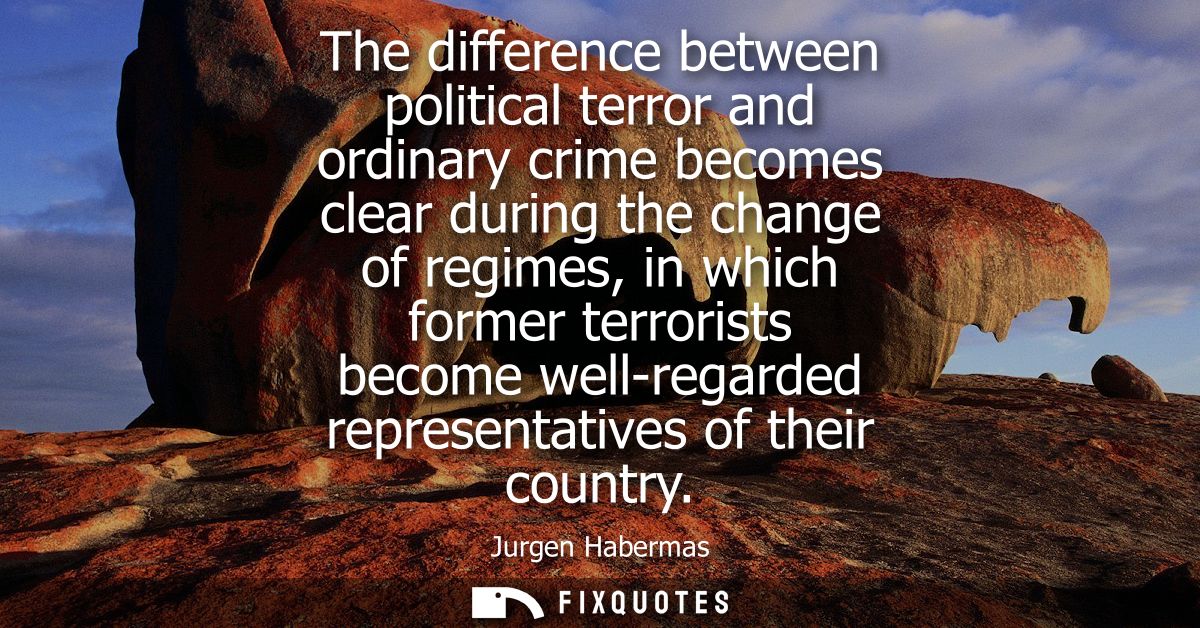
"The difference between political terror and ordinary crime becomes clear during the change of regimes, in which former terrorists become well-regarded representatives of their country"
About this Quote
The phrasing is clinical, almost bureaucratic, which is part of its sting. “Becomes clear” sounds like a neutral clarification, but the clarity is morally corrosive: the same person can be branded a criminal on Monday and pinned with a medal on Tuesday, depending on who controls the institutions that confer honor. “Well-regarded representatives” is deliberately polite, a diplomatic euphemism that highlights how quickly the language of respectability can smooth over bloodstains once international recognition, trade, and protocol are at stake.
The subtext fits Habermas’s lifelong fixation on legitimacy: real democratic authority is supposed to rest on public justification and communicative reason, not on force. This quote is a warning about what happens when legitimacy is treated as a property granted by victory rather than by procedures and accountability. It also nods to postwar Europe’s recurring pattern - resistance fighters, revolutionaries, separatists, anti-colonial insurgents - whose tactics were denounced as terror under one regime and sanctified under the next. Habermas isn’t excusing violence; he’s exposing how states manufacture moral categories to stabilize themselves after the fact.
Quote Details
| Topic | Justice |
|---|---|
| Source | Help us find the source |
| Cite |
Citation Formats
APA Style (7th ed.)
Habermas, Jurgen. (2026, January 17). The difference between political terror and ordinary crime becomes clear during the change of regimes, in which former terrorists become well-regarded representatives of their country. FixQuotes. https://fixquotes.com/quotes/the-difference-between-political-terror-and-68821/
Chicago Style
Habermas, Jurgen. "The difference between political terror and ordinary crime becomes clear during the change of regimes, in which former terrorists become well-regarded representatives of their country." FixQuotes. January 17, 2026. https://fixquotes.com/quotes/the-difference-between-political-terror-and-68821/.
MLA Style (9th ed.)
"The difference between political terror and ordinary crime becomes clear during the change of regimes, in which former terrorists become well-regarded representatives of their country." FixQuotes, 17 Jan. 2026, https://fixquotes.com/quotes/the-difference-between-political-terror-and-68821/. Accessed 28 Mar. 2026.