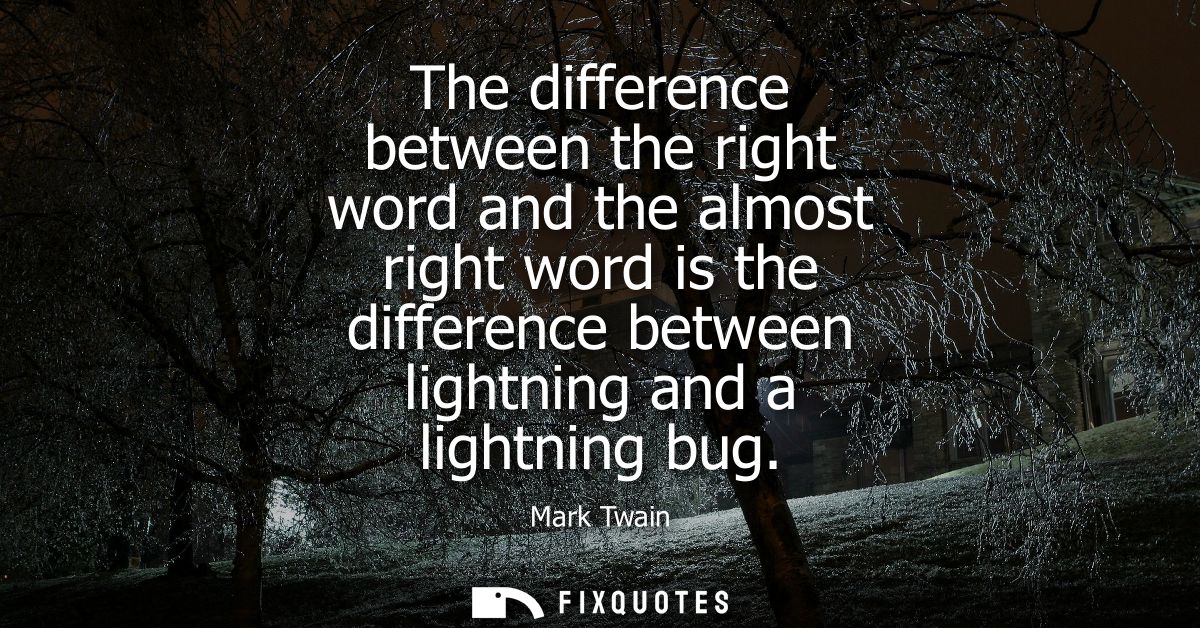
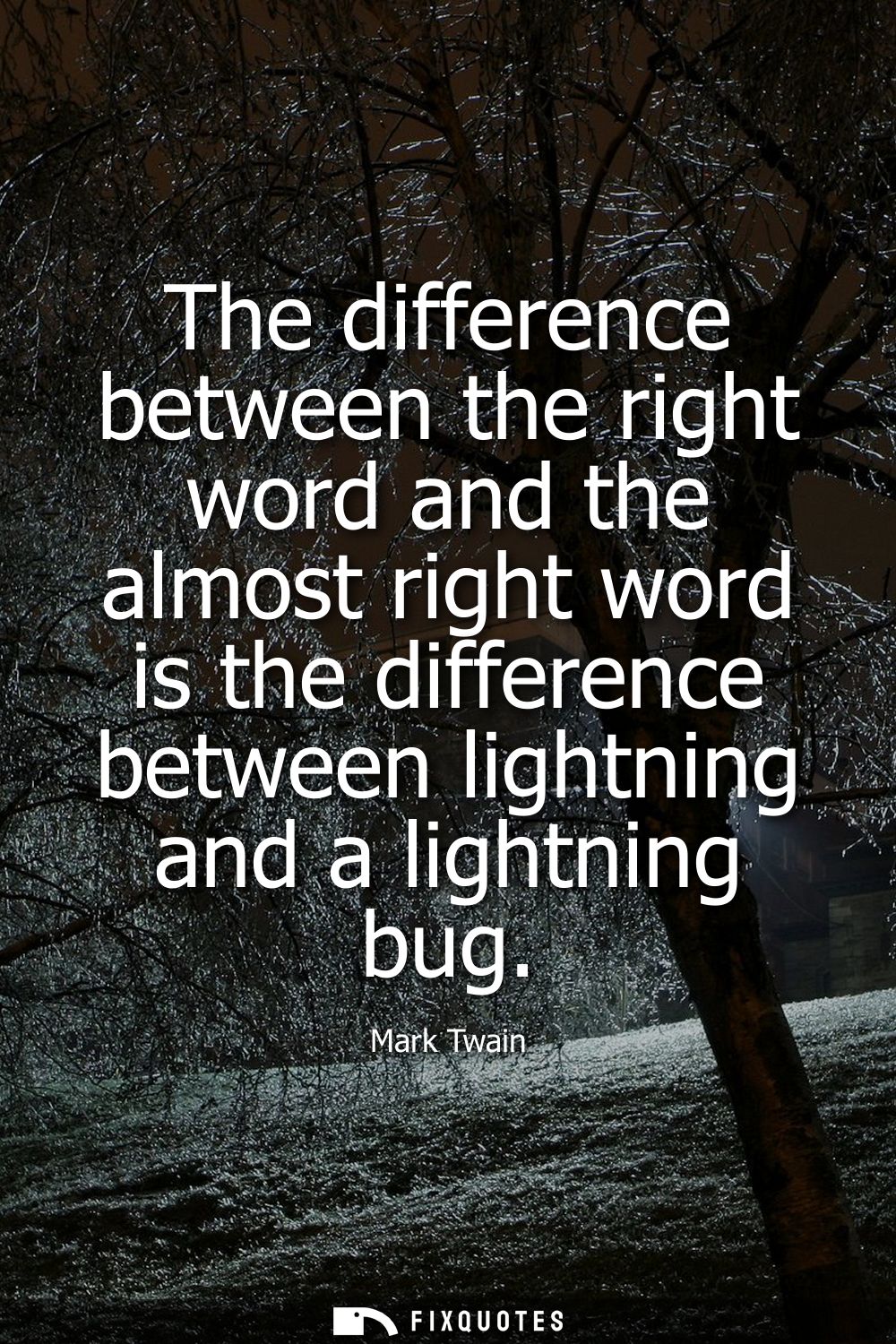
"The difference between the right word and the almost right word is the difference between lightning and a lightning bug"
About this Quote
The intent isn’t pedantry. It’s power politics on the page. The “right word” doesn’t just clarify; it controls pace, mood, and moral temperature. Choose precisely and you can make a reader flinch, laugh, or feel implicated. Choose “almost right” and you get prose that behaves like a polite imitation of itself: technically illuminated, emotionally dim.
There’s subtext, too, about American public speech in Twain’s era, when advertising, stump oratory, and sensational newspapers were professionalizing the art of sounding true without being exact. Twain, a journalist and satirist before he was anointed a literary monument, knew how easy it is to sell a glow in place of a strike. His metaphor draws a line between writing that merely decorates and writing that detonates.
It also doubles as a self-portrait. Twain’s own voice depends on the surgical pick of the exact phrase, the one that makes irony legible without announcing it. The punchline is that the “almost right word” is not a minor flaw; it’s a different species of meaning.
Quote Details
| Topic | Writing |
|---|---|
| Source | Unverified source: The Art of Authorship (Mark Twain, 1890)
Evidence: the difference between the almost-right word & the right word is really a large matter , it’s the difference between the lightning bug & the lightning. (pp. 87–88). This wording is from Mark Twain (Samuel L. Clemens) in a letter to George Bainton dated October 15, 1888, which Bainton solicited a... Other candidates (1) Vocabulary Ladders: Understanding Word Nuances Level 4 (Timothy Rasinski, Melissa Cheesman Smith, 2014) compilation95.0% ... The difference between the right word and the almost right word is the difference between lightning and a lightni... |
| Cite |
Citation Formats
APA Style (7th ed.)
Twain, Mark. (2026, February 28). The difference between the right word and the almost right word is the difference between lightning and a lightning bug. FixQuotes. https://fixquotes.com/quotes/the-difference-between-the-right-word-and-the-22246/
Chicago Style
Twain, Mark. "The difference between the right word and the almost right word is the difference between lightning and a lightning bug." FixQuotes. February 28, 2026. https://fixquotes.com/quotes/the-difference-between-the-right-word-and-the-22246/.
MLA Style (9th ed.)
"The difference between the right word and the almost right word is the difference between lightning and a lightning bug." FixQuotes, 28 Feb. 2026, https://fixquotes.com/quotes/the-difference-between-the-right-word-and-the-22246/. Accessed 29 Mar. 2026.