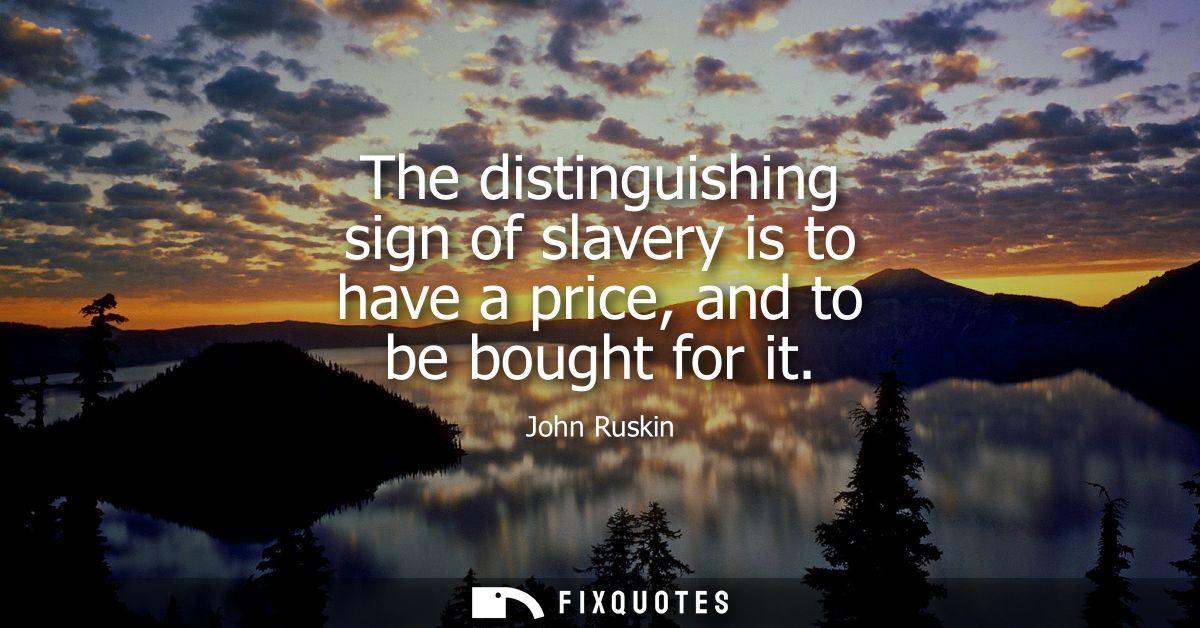
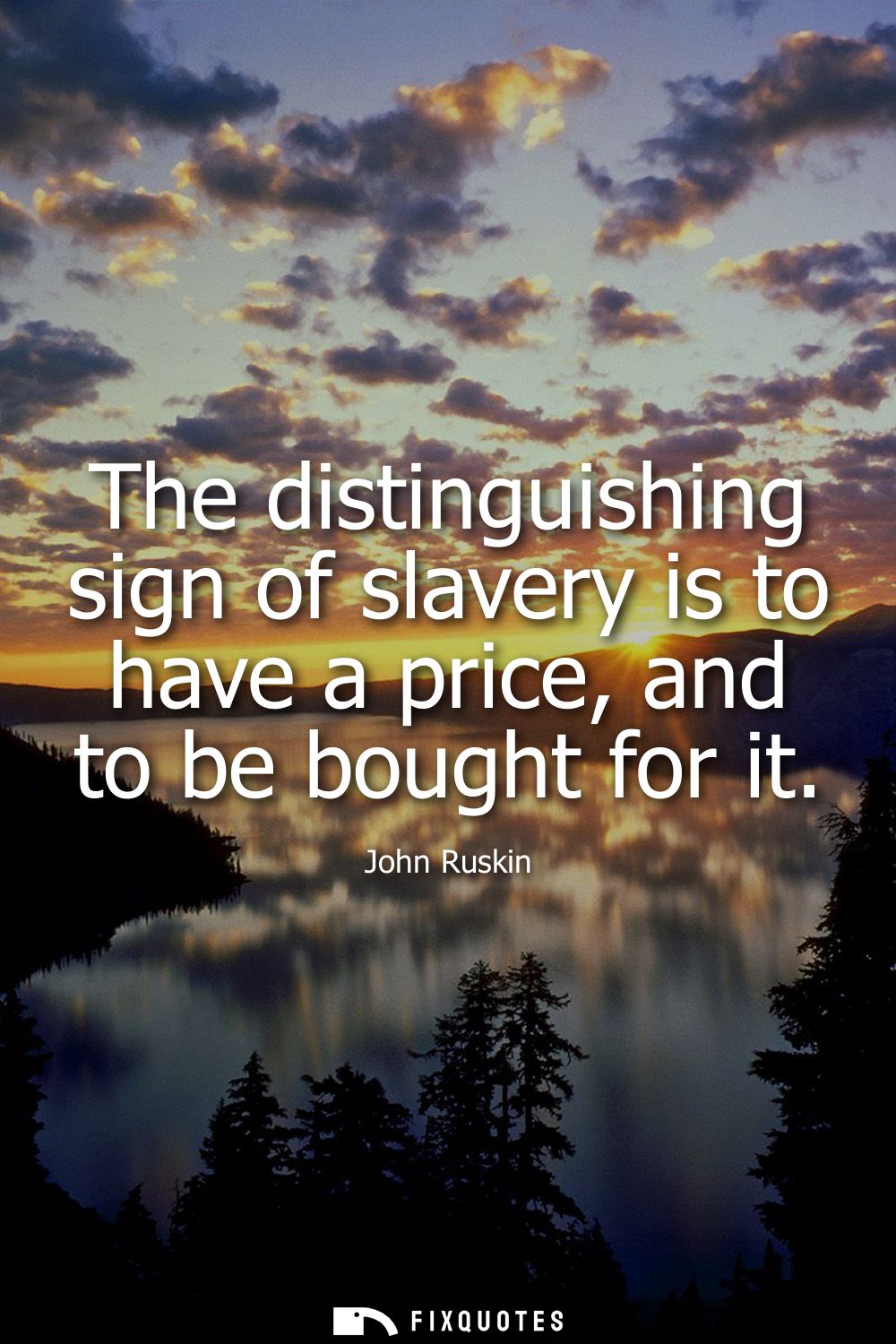
"The distinguishing sign of slavery is to have a price, and to be bought for it"
About this Quote
The subtext is Ruskin’s broader war on Victorian capitalism’s habit of turning life into units of exchange. Writing in an era when Britain congratulated itself on abolition while profiting from empire, factories, and precarious labor, he’s daring readers to see a continuum: if a person can be priced, they can be treated as a thing, whether that transaction happens on an auction block or behind the genteel language of wages, contracts, and “employment.” Ruskin often pushed the uncomfortable idea that an economy can be technically “free” while still feeding on coercion and dependency.
The sentence works because it’s both definitional and accusatory. Definitional, because it pins slavery to a concrete mechanism: purchase. Accusatory, because it implicates buyers. Slavery isn’t an abstract evil drifting in from elsewhere; it’s a relationship sustained by someone’s willingness to pay. In eight words of commercial realism, Ruskin drags morality back into the marketplace where it’s so often edited out.
Quote Details
| Topic | Freedom |
|---|---|
| Source | Help us find the source |
| Cite |
Citation Formats
APA Style (7th ed.)
Ruskin, John. (2026, January 17). The distinguishing sign of slavery is to have a price, and to be bought for it. FixQuotes. https://fixquotes.com/quotes/the-distinguishing-sign-of-slavery-is-to-have-a-36509/
Chicago Style
Ruskin, John. "The distinguishing sign of slavery is to have a price, and to be bought for it." FixQuotes. January 17, 2026. https://fixquotes.com/quotes/the-distinguishing-sign-of-slavery-is-to-have-a-36509/.
MLA Style (9th ed.)
"The distinguishing sign of slavery is to have a price, and to be bought for it." FixQuotes, 17 Jan. 2026, https://fixquotes.com/quotes/the-distinguishing-sign-of-slavery-is-to-have-a-36509/. Accessed 12 Feb. 2026.