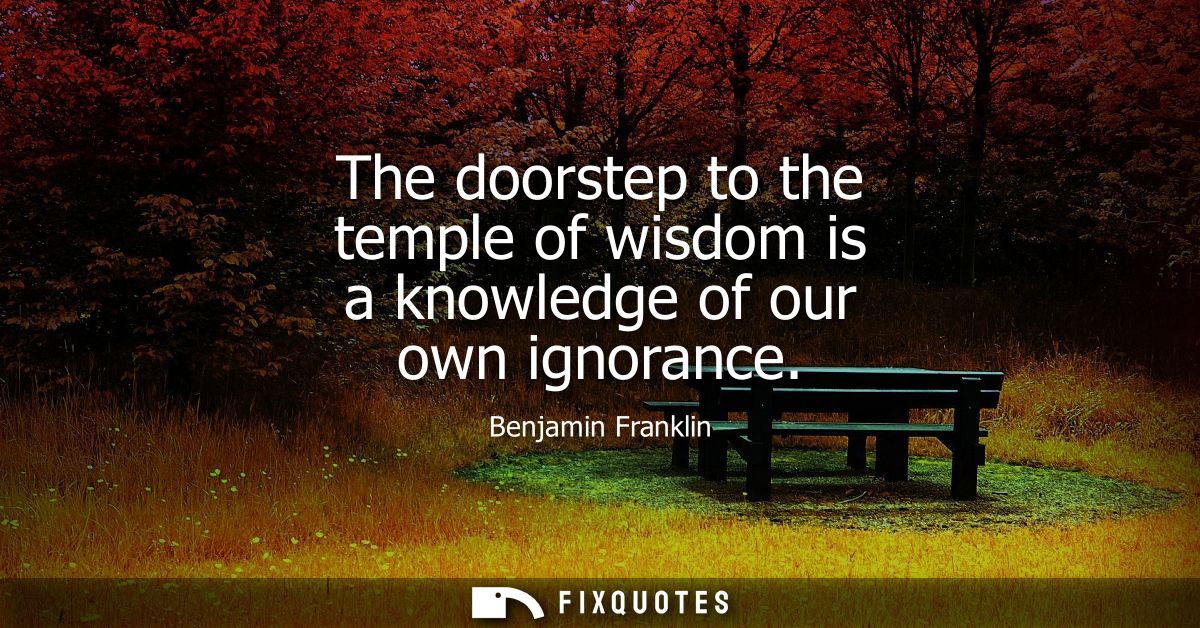
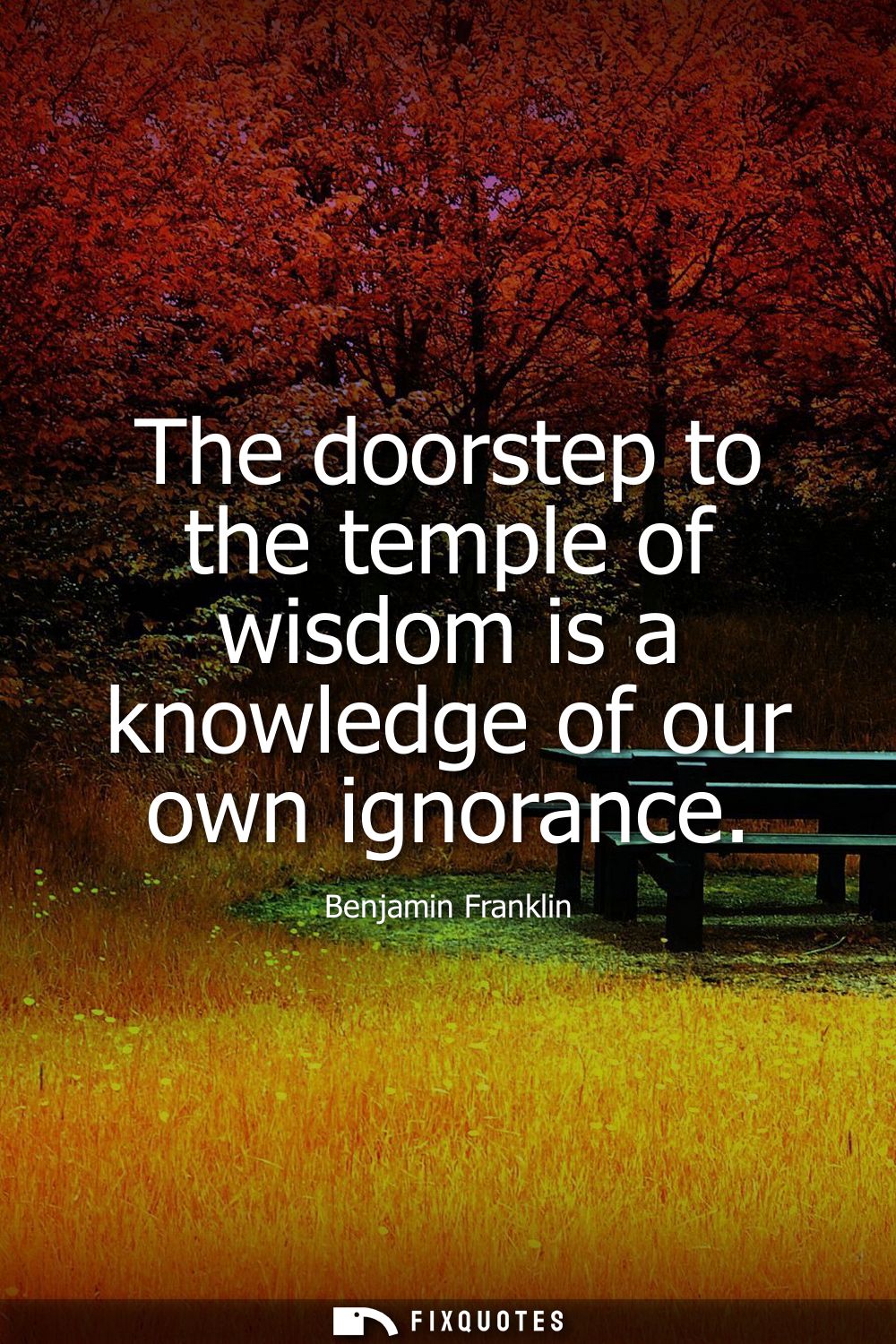
"The doorstep to the temple of wisdom is a knowledge of our own ignorance"
About this Quote
The line works because it flatters and scolds at once. It offers an attainable first step toward wisdom while quietly indicting the human habit of overclaiming. Franklin’s America was a noisy marketplace of pamphlets, sermons, and political schemes, a culture where rhetorical certainty could pass for truth and where a new republic would live or die on the quality of its public reasoning. In that context, acknowledging ignorance isn’t just personal virtue; it’s a democratic safeguard. The citizen who can say "I might be wrong" is harder to manipulate, less prone to factional hysteria, and more capable of deliberation.
The religious metaphor matters. Temples are spaces of discipline, initiation, and humility. Franklin borrows that aura to elevate a very Enlightenment idea: skepticism as entrance fee. The subtext is anti-dogma without being anti-belief. He’s warning against zealotry, conspiracy thinking, and the moral vanity of certainty. Wisdom becomes not a trophy for the brilliant but a practice for the honest: start by admitting the limits of your own mind, then build from there.
Quote Details
| Topic | Wisdom |
|---|---|
| Source | Help us find the source |
| Cite |
Citation Formats
APA Style (7th ed.)
Franklin, Benjamin. (2026, January 17). The doorstep to the temple of wisdom is a knowledge of our own ignorance. FixQuotes. https://fixquotes.com/quotes/the-doorstep-to-the-temple-of-wisdom-is-a-25529/
Chicago Style
Franklin, Benjamin. "The doorstep to the temple of wisdom is a knowledge of our own ignorance." FixQuotes. January 17, 2026. https://fixquotes.com/quotes/the-doorstep-to-the-temple-of-wisdom-is-a-25529/.
MLA Style (9th ed.)
"The doorstep to the temple of wisdom is a knowledge of our own ignorance." FixQuotes, 17 Jan. 2026, https://fixquotes.com/quotes/the-doorstep-to-the-temple-of-wisdom-is-a-25529/. Accessed 30 Mar. 2026.