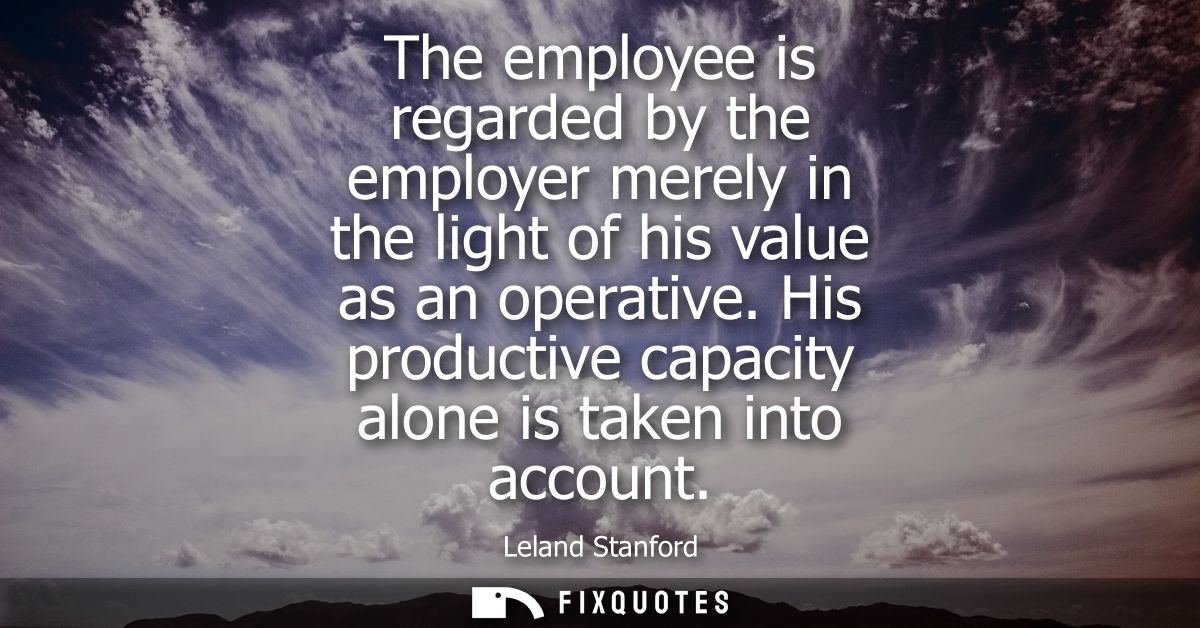
"The employee is regarded by the employer merely in the light of his value as an operative. His productive capacity alone is taken into account"
About this Quote
Stanford’s phrasing is almost clinically revealing: the worker reduced to a unit of output, “merely” a tool with a price tag. Coming from a robber-baron-era businessman, it reads less like a moral warning than an unvarnished description of how the machine actually runs. “Operative” is the tell. It’s not “employee” as a person with judgment and agency; it’s a human component in an industrial system, interchangeable and measurable. The sentence structure does the ideological work: the employer “regards,” the worker is “regarded.” Power sits on one side of the verb.
The intent is double-edged. Stanford is articulating a logic of management that was rapidly professionalizing in the late 19th century: efficiency, throughput, the quantification of labor. At the same time, the language carries a defensive frankness, as if naming the reduction could absolve it. He doesn’t say the employer is cruel; he says the employer is rational. That’s the subtext: exploitation reframed as accounting.
The historical context matters because Stanford wasn’t a distant commentator. As a railroad magnate and a political figure in a period of fierce labor conflict, he benefited from a system where “productive capacity” justified long hours, low wages, and strikebreaking. The quote captures the era’s moral bargain: prosperity for the few, impersonality for the many. It works because it doesn’t posture. It admits the quiet premise of industrial capitalism: if you can be priced, you can be replaced.
The intent is double-edged. Stanford is articulating a logic of management that was rapidly professionalizing in the late 19th century: efficiency, throughput, the quantification of labor. At the same time, the language carries a defensive frankness, as if naming the reduction could absolve it. He doesn’t say the employer is cruel; he says the employer is rational. That’s the subtext: exploitation reframed as accounting.
The historical context matters because Stanford wasn’t a distant commentator. As a railroad magnate and a political figure in a period of fierce labor conflict, he benefited from a system where “productive capacity” justified long hours, low wages, and strikebreaking. The quote captures the era’s moral bargain: prosperity for the few, impersonality for the many. It works because it doesn’t posture. It admits the quiet premise of industrial capitalism: if you can be priced, you can be replaced.
Quote Details
| Topic | Work |
|---|---|
| Source | Help us find the source |
More Quotes by Leland
Add to List