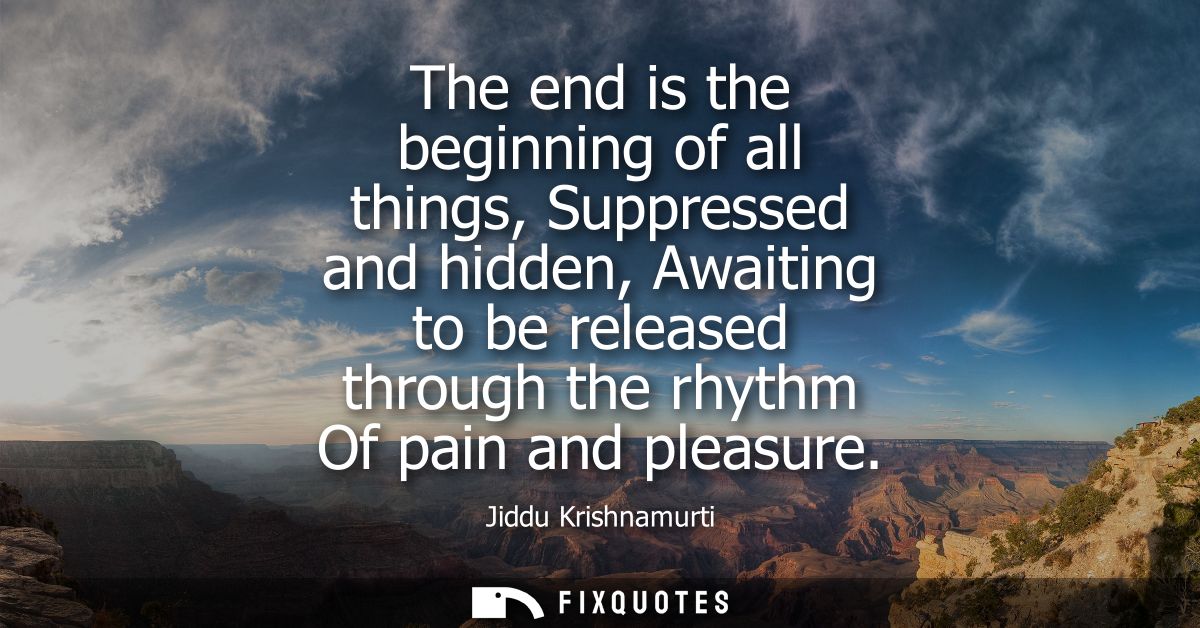
"The end is the beginning of all things, Suppressed and hidden, Awaiting to be released through the rhythm Of pain and pleasure"
About this Quote
“Suppressed and hidden” signals his central enemy: the accumulated, half-conscious residue of conditioning - fear, desire, memory, identity. The line implies that what we call “self” is less a stable essence than a storage unit of unresolved pressures. The “awaiting” is important too: these forces aren’t dead; they’re poised, staged, ready to take over the next thought, the next relationship, the next crisis.
Then he lands the knife: release comes “through the rhythm of pain and pleasure.” Krishnamurti isn’t romanticizing suffering; he’s exposing our addiction to oscillation. We chase pleasure, recoil from pain, and that pendulum becomes a metronome for the ego - a reliable beat that keeps the old story moving. The subtext is severe: as long as you’re organized around that rhythm, you’re not free, you’re merely alternating.
Context matters. Krishnamurti spent a lifetime rejecting gurus, including the one the Theosophists tried to make of him. This reads like a distillation of that refusal: liberation isn’t bestowed; it erupts when the psyche stops bargaining with its own discomfort and finally lets an ending end.
Quote Details
| Topic | Wisdom |
|---|---|
| Source | Help us find the source |
| Cite |
Citation Formats
APA Style (7th ed.)
Krishnamurti, Jiddu. (2026, January 17). The end is the beginning of all things, Suppressed and hidden, Awaiting to be released through the rhythm Of pain and pleasure. FixQuotes. https://fixquotes.com/quotes/the-end-is-the-beginning-of-all-things-suppressed-31932/
Chicago Style
Krishnamurti, Jiddu. "The end is the beginning of all things, Suppressed and hidden, Awaiting to be released through the rhythm Of pain and pleasure." FixQuotes. January 17, 2026. https://fixquotes.com/quotes/the-end-is-the-beginning-of-all-things-suppressed-31932/.
MLA Style (9th ed.)
"The end is the beginning of all things, Suppressed and hidden, Awaiting to be released through the rhythm Of pain and pleasure." FixQuotes, 17 Jan. 2026, https://fixquotes.com/quotes/the-end-is-the-beginning-of-all-things-suppressed-31932/. Accessed 10 Mar. 2026.