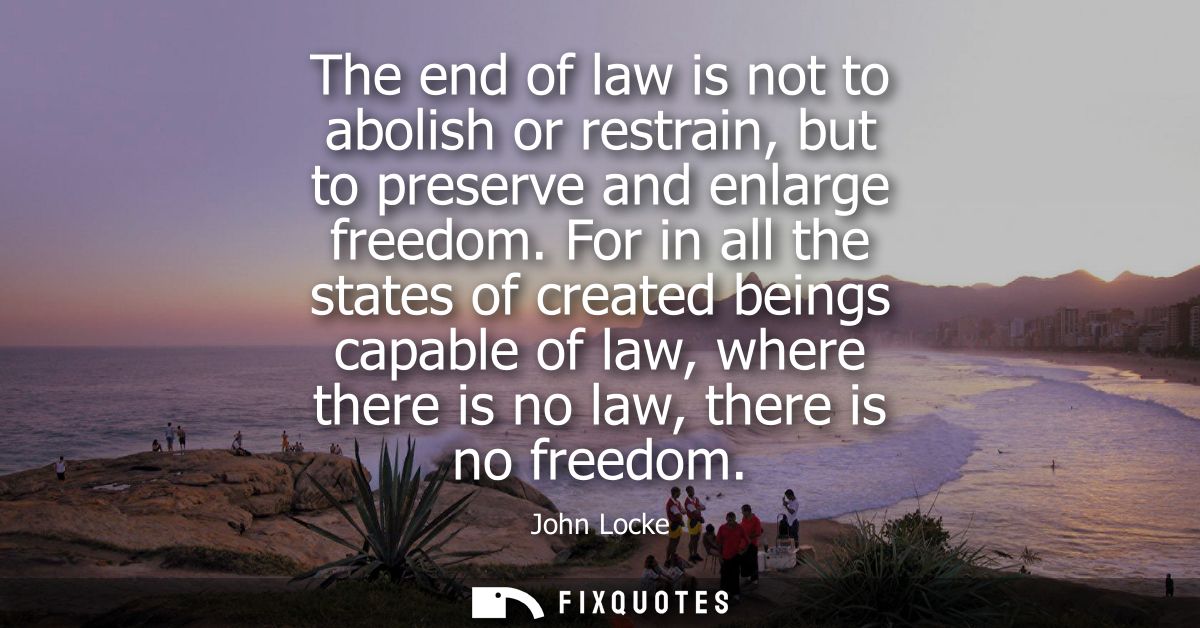
"The end of law is not to abolish or restrain, but to preserve and enlarge freedom. For in all the states of created beings capable of law, where there is no law, there is no freedom"
About this Quote
The subtext is a rebuke to two enemies at once. On one side, absolutist monarchy: rule by personal will is the anti-law, because it replaces public standards with a ruler’s moods. On the other, the fantasy of pure license: a world with no binding rules doesn’t produce autonomy, it produces domination by whoever is strongest. “Where there is no law, there is no freedom” isn’t a pious slogan; it’s an observation about power. In a vacuum, coercion doesn’t disappear, it just goes private.
Context matters: Locke is writing in the wake of England’s constitutional crises, when “liberty” had to be defended against kings who claimed divine authority and against disorder that could justify crackdowns. His intent is to justify limited government under consent, with laws that bind rulers as well as the ruled. Freedom, for Locke, isn’t the absence of government; it’s protection from arbitrary power through predictable, shared rules. That’s why the sentence remains provocative: it insists that the line between liberty and oppression isn’t the presence of law, but who controls it and whether it’s accountable.
Quote Details
| Topic | Freedom |
|---|---|
| Source | Verified source: Critical Thinking Unleashed (Elliot D. Cohen, 2009)ISBN: 9798216221883 · ID: w1qAEQAAQBAJ
Evidence: ... The end of law is not to abolish or restrain , but to preserve and enlarge freedom . For in all the states of created beings capable of law , where there is no law , there is no freedom . These statements form an argument because Locke ... Other candidates (1) John Locke (John Locke) compilation96.1% 27 the end of law is not to abolish or restrain but to preserve and enlarge freedom for in all the states of created ... |
| Cite |
Citation Formats
APA Style (7th ed.)
Locke, John. (2026, January 13). The end of law is not to abolish or restrain, but to preserve and enlarge freedom. For in all the states of created beings capable of law, where there is no law, there is no freedom. FixQuotes. https://fixquotes.com/quotes/the-end-of-law-is-not-to-abolish-or-restrain-but-8101/
Chicago Style
Locke, John. "The end of law is not to abolish or restrain, but to preserve and enlarge freedom. For in all the states of created beings capable of law, where there is no law, there is no freedom." FixQuotes. January 13, 2026. https://fixquotes.com/quotes/the-end-of-law-is-not-to-abolish-or-restrain-but-8101/.
MLA Style (9th ed.)
"The end of law is not to abolish or restrain, but to preserve and enlarge freedom. For in all the states of created beings capable of law, where there is no law, there is no freedom." FixQuotes, 13 Jan. 2026, https://fixquotes.com/quotes/the-end-of-law-is-not-to-abolish-or-restrain-but-8101/. Accessed 6 Mar. 2026.