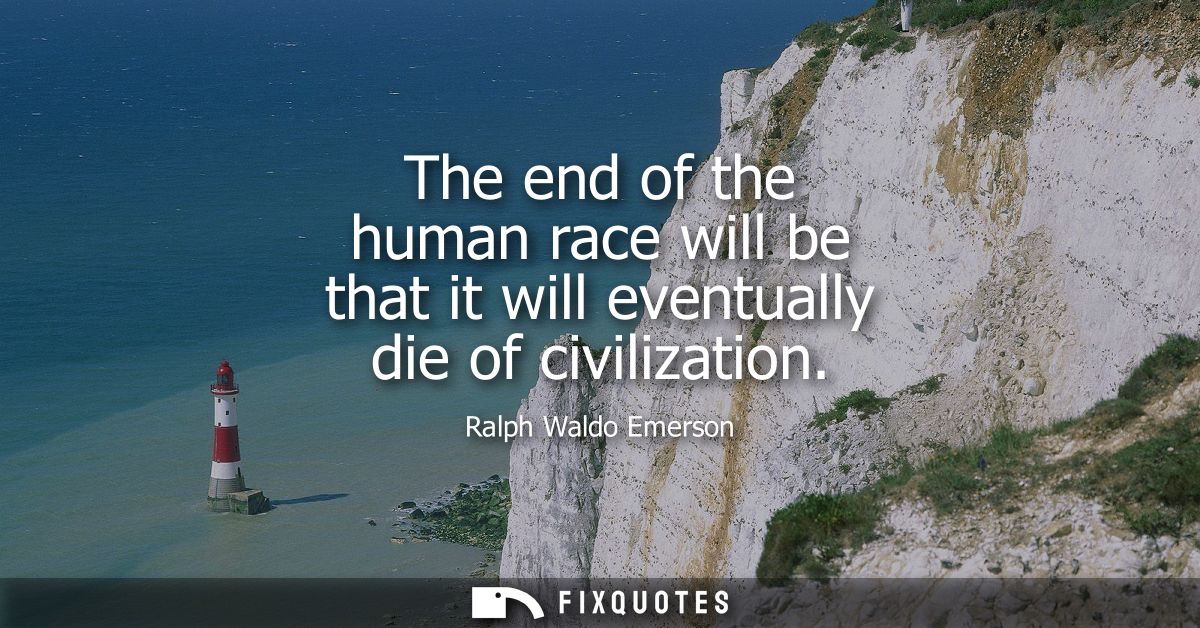
"The end of the human race will be that it will eventually die of civilization"
About this Quote
The phrasing “die of” is doing the sharpest work. Civilization isn’t framed as an external catastrophe but as a condition that turns chronic: comfort becomes dependency, complexity becomes paralysis, institutions become substitutes for conscience. Emerson’s broader project in self-reliance and transcendentalism is a revolt against secondhand living - people outsourcing perception to systems, routines, and “improvements” that quietly shrink the soul. In that context, “civilization” isn’t the sum of art and law; it’s the tendency to confuse refinement with wisdom, busyness with purpose, and social consensus with truth.
The subtext is also political. Early America was inventing a national identity built on expansion, commerce, and technology, then congratulating itself for it. Emerson punctures that self-congratulation: the civilizing mission can become a mass anesthetic, smoothing away the rough edges where independence and moral clarity live. His pessimism is strategic. By making civilization sound like a terminal illness, he forces the reader to ask whether progress is actually nourishing us - or just making us easier to manage, more distracted, more tame.
Quote Details
| Topic | Deep |
|---|---|
| Source | Later attribution: Ralph Waldo Emerson (Ralph Waldo Emerson) modern compilation
Evidence: ar civilization the end of the human race will be that it will eventually die of civilization ci Other candidates (2) Visions of the End Times (Laura Duhan-Kaplan, Anne-Marie Ellith..., 2022) compilation95.0% ... Ralph Waldo Emerson that " the end of the human race will be that it will eventually die of civilization . ” King... Rubáiyát of Omar Khayyám, and Salámán and Absál: Together... (Omar Khayyam, 1122) primary40.0% hten with the beauty of his presence said the sheikh be wise and leave it wholly in the hand of |
| Cite |
Citation Formats
APA Style (7th ed.)
Emerson, Ralph Waldo. (2026, February 7). The end of the human race will be that it will eventually die of civilization. FixQuotes. https://fixquotes.com/quotes/the-end-of-the-human-race-will-be-that-it-will-28860/
Chicago Style
Emerson, Ralph Waldo. "The end of the human race will be that it will eventually die of civilization." FixQuotes. February 7, 2026. https://fixquotes.com/quotes/the-end-of-the-human-race-will-be-that-it-will-28860/.
MLA Style (9th ed.)
"The end of the human race will be that it will eventually die of civilization." FixQuotes, 7 Feb. 2026, https://fixquotes.com/quotes/the-end-of-the-human-race-will-be-that-it-will-28860/. Accessed 2 Apr. 2026.