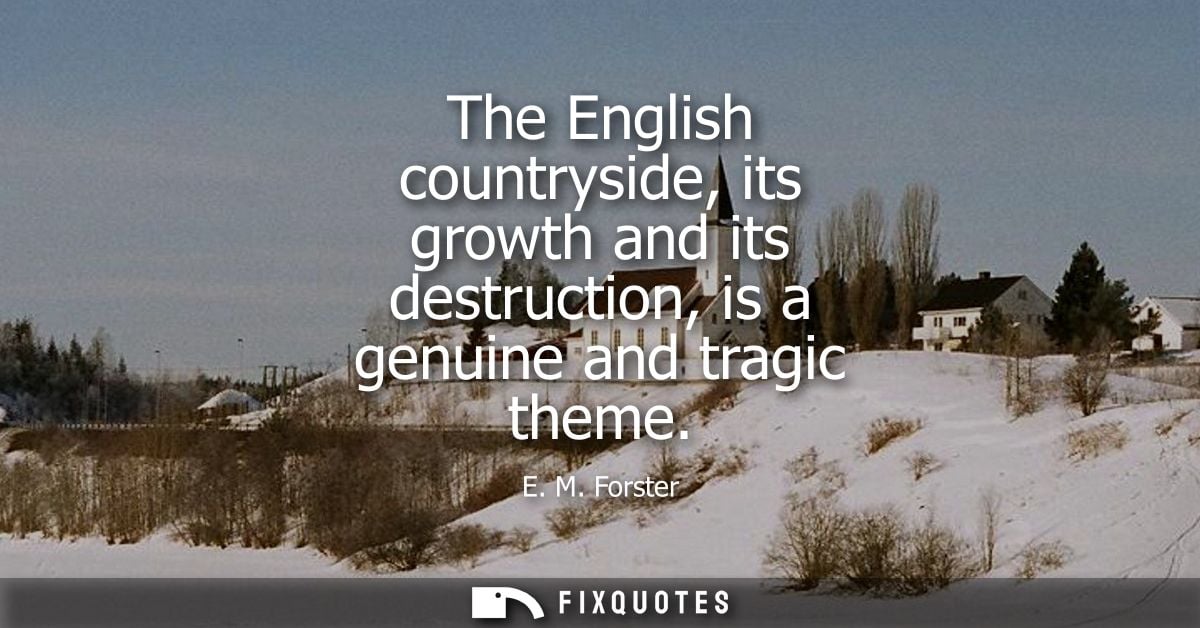
"The English countryside, its growth and its destruction, is a genuine and tragic theme"
About this Quote
The phrase “genuine and tragic” is doing quiet polemical work. Forster is staking a claim against the notion that nature-writing is minor art or mere nostalgia. Tragedy, in the classical sense, is what happens when forces larger than the individual - money, industry, empire, class habits - grind forward while everyone believes they’re being reasonable. That’s Forster’s specialty: social comedy that keeps revealing a harder calculus underneath.
Context matters: Forster is writing from an early 20th-century Britain where the countryside is being reorganized by modernity and by ownership. “The English countryside” is also code for a national self-image - continuity, restraint, “heritage” before the word calcifies. Calling its alteration tragic suggests not just ecological loss but spiritual and civic diminishment: a culture severing itself from the places that made its stories plausible. The intent isn’t to freeze England in amber; it’s to make the costs of “growth” readable, before they become irreversible and therefore unremarkable.
Quote Details
| Topic | Nature |
|---|---|
| Source | Help us find the source |
| Cite |
Citation Formats
APA Style (7th ed.)
Forster, E. M. (2026, January 17). The English countryside, its growth and its destruction, is a genuine and tragic theme. FixQuotes. https://fixquotes.com/quotes/the-english-countryside-its-growth-and-its-34819/
Chicago Style
Forster, E. M. "The English countryside, its growth and its destruction, is a genuine and tragic theme." FixQuotes. January 17, 2026. https://fixquotes.com/quotes/the-english-countryside-its-growth-and-its-34819/.
MLA Style (9th ed.)
"The English countryside, its growth and its destruction, is a genuine and tragic theme." FixQuotes, 17 Jan. 2026, https://fixquotes.com/quotes/the-english-countryside-its-growth-and-its-34819/. Accessed 10 Mar. 2026.